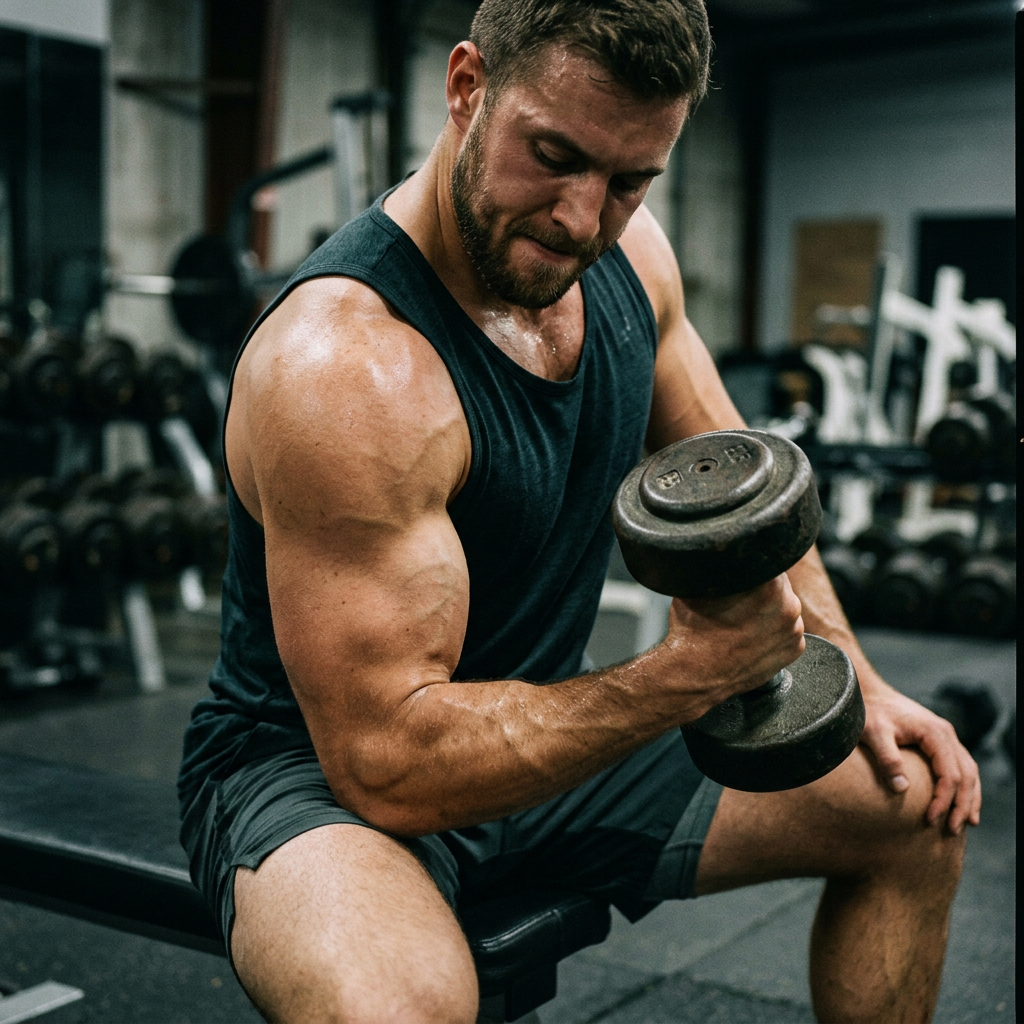
For decades, gym culture has operated on a simple if punishing covenant: to get stronger, you have to suffer. Feel the burn. Push through the soreness. No pain, no gain. A new opinion piece in the Journal of Sport and Health Science challenges that orthodoxy — and the implications could reshape how millions of people think about exercise.
The paper, authored by Kazunori Nosaka, Director of Exercise and Sports Science at Edith Cowan University in Australia, argues that eccentric exercise — a mode of movement in which muscles generate force while lengthening — offers a pathway to greater strength, improved health, and lasting fitness habits without the exhaustion or injury risk typically associated with hard training.
“The idea that exercise must be exhausting or painful is holding people back,” Nosaka said. “Instead, we should be focusing on eccentric exercises which can deliver stronger results with far less effort than traditional exercise — and you don’t even need a gym.”
Eccentric contractions occur whenever muscles resist a load during lengthening — the controlled lowering of a dumbbell, descending a staircase, or slowly sitting into a chair. They are the counterpart to concentric contractions, in which muscles shorten as they exert force. Though both are components of most everyday movements, eccentric loading has long been underappreciated, largely because of its association with delayed onset muscle soreness, the familiar ache that settles in a day or two after unfamiliar exercise.
Nosaka’s central argument is that this association has been misread as causation. Muscle soreness following eccentric exercise — technically classified as a form of mechanical hyperalgesia arising from the sensitization of nociceptors in connective tissue — is a transient side effect of unaccustomed loading, not a prerequisite for adaptation. The soreness, he notes, diminishes quickly once the exercise becomes a regular habit, a phenomenon researchers call the repeated bout effect.¹
“Muscle damage should not deter people from engaging in eccentric exercises,” says Nosaka.
What makes eccentric contractions unusual is a set of biomechanical properties that set them apart from other contraction types. Muscles working eccentrically can generate more than 20 percent greater force than during concentric or isometric efforts — while simultaneously demanding significantly less metabolic energy. Oxygen consumption is lower, heart rate is reduced at equivalent workloads, and the muscular effort required feels considerably less taxing.² That combination — more mechanical output for less physiological cost — gives eccentric exercise an unusual efficiency profile, one that Nosaka believes has been largely overlooked in mainstream fitness guidance.
The force advantage, he explains, stems from the engagement of titin, a giant elastic protein embedded within muscle fibers that acts like a molecular spring upon activation. During eccentric contractions, titin stores and releases energy in ways that augment force production beyond what the actin-myosin cross-bridge mechanism alone can achieve.
This efficiency makes eccentric exercise particularly attractive for populations who have traditionally been excluded from high-intensity training programs: older adults, people with chronic illness, those recovering from injury, and the sedentary. Because eccentric loading places less strain on the cardiovascular system, it is far more accessible for individuals whose capacity for aerobic exertion is limited.
According to Nosaka, “You can gain strength without feeling as exhausted. So, you get more benefit for less effort. That makes eccentric exercise appealing for a wide range of people.”
A growing body of research supports this view. A 12-week study of elderly obese women found that descending stair walking — a low-intensity eccentric exercise — produced significantly greater improvements in cardiovascular function, insulin sensitivity, blood lipid profiles, and muscle strength than ascending stair walking at the same frequency.³ The women who descended stairs twice a week saw resting heart rate drop by 10 percent and systolic blood pressure fall by 9 percent, compared to 4 percent and 3 percent, respectively, in the ascending group.
Even more striking, a separate study found that just five minutes of home-based eccentric exercise per day — four simple movements including chair squats, wall push-ups, chair reclines, and heel drops — produced meaningful improvements in muscle strength, flexibility, and mental health over eight weeks in sedentary adults.⁴ More than 90 percent of participants continued exercising beyond the intervention, suggesting the approach is not just effective but sustainable — a quality that eludes many fitness programs aimed at sedentary populations.
Another investigation showed that integrating controlled lunge steps into ordinary walking — what researchers termed eccentric walking — improved lower limb muscle strength and cognitive function in ways that regular walking alone did not.⁵ The lunges introduce an eccentric loading phase as the knee extensors control the body’s descent onto a single leg, without requiring any special equipment or gym access.
That last point carries real public health significance. Walking remains the most commonly performed physical activity worldwide, yet its mechanical demands on the lower limbs are modest. Incorporating eccentric elements into walking-based routines could substantially amplify health benefits at negligible additional cost.
Eccentric exercise also produces effects that extend beyond the musculoskeletal system. Research has found improvements in cardiovascular health, metabolic function, bone mineral density, and even cognitive performance in older women following eccentric training programs.⁶ There is also evidence of what researchers call the cross-education effect: training one limb eccentrically can strengthen the opposite, untrained limb — a finding with profound implications for rehabilitation following unilateral injuries or immobilization.
According to Nosaka, “These movements mirror what we already do in daily life. That makes them practical, realistic and easier to stick with.”
Nosaka is careful to note that some degree of muscle discomfort remains possible when individuals first encounter eccentric exercise, particularly at high intensities or volumes. But he argues that this risk is easily managed through gradual progression — starting with low intensity, fewer repetitions, and shorter muscle lengths, then building incrementally. The key insight is that preconditioning with even a small number of low-intensity eccentric contractions can provide substantial protection against more severe muscle damage in subsequent sessions.
The paper is adapted from a Priscilla M. Clarkson Tutorial Lecture delivered at the 2025 American College of Sports Medicine Annual Meeting, situating it within a well-established lineage of research on eccentric exercise and muscle adaptation. Clarkson’s own foundational work in the early 1990s first mapped the time course of muscle damage and recovery following eccentric bouts — a body of work Nosaka’s paper builds on and, in important respects, revises.⁷
“We should establish eccentric exercise as standard practice,” Nosaka writes in the paper, “and make it common, accessible, and widely accepted as the ‘new normal’ of exercise to improve life performance and high athletic performance.”
Whether the fitness industry — built on equipment sales, gym memberships, and the mythos of punishing effort — is ready to embrace chair squats and stair descents as the future of strength training remains an open question. The science, however, is increasingly clear: some of the most effective exercise you can do might be the kind you barely notice you’re doing.
Endnotes
1. Nosaka K. Eccentric exercise: Muscle damage to the new normal. J Sport Health Sci. 2026;15:101126.
2. Hody S, Croisier J-L, Bury T, Rogister B, Leprince P. Eccentric muscle contractions: Risks and benefits. Front Physiol. 2019;10:536.
3. Chen TC, Hsieh CC, Tseng KW, Ho CC, Nosaka K. Effects of descending stair walking on health and fitness of elderly obese women. Med Sci Sports Exerc. 2017;49:1614–22.
4. Kirk BJC, Mavropalias G, Blazevich AJ, Wilkie JLC, Molan A, Nosaka K. Effects of an 8-week minimal-dose home-based eccentric exercise program on physical health and exercise adherence. Eur J Appl Physiol. 2025. doi:10.1007/s00421-025-05989-7.
5. Katsura Y, Takeda N, Inami T, et al. Effects of lunges inserted in walking (eccentric walking) on lower limb muscle strength, physical and cognitive function of regular walkers. Eur J Appl Physiol. 2024;124:2343–52.
6. Huang MJ, Singh F, Taaffe D, Chen T, Nosaka K. Effects of eccentric vs. stretching exercise training on cognitive function of older women. Appl Physiol Nutr Metab. 2025;50:1–12.
7. Clarkson PM, Nosaka K, Braun B. Muscle function after exercise-induced muscle damage and rapid adaptation. Med Sci Sports Exerc. 1992;24:512–20.

COPY II (2-3 PARAGRAPHS)
IMAGE CREDIT: NASA.




Leave a Reply