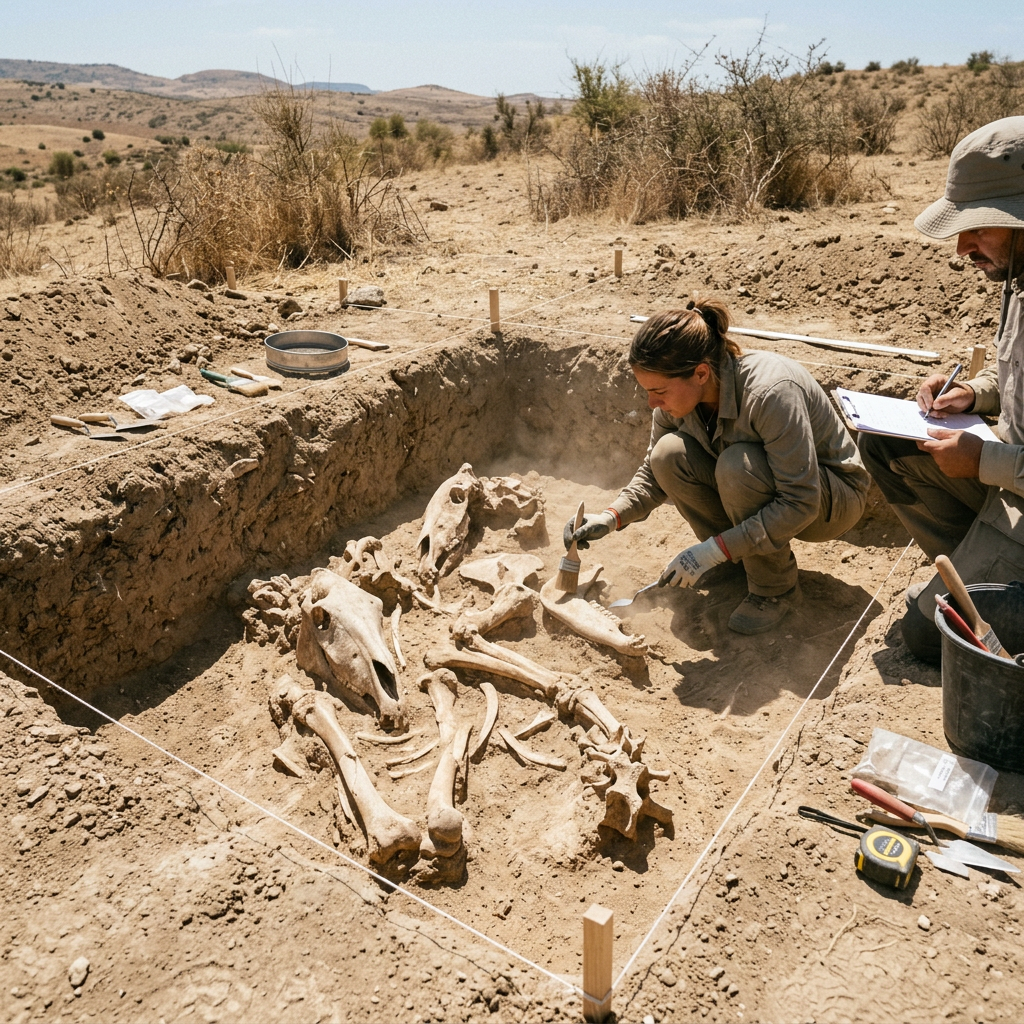
A new review argues that humans were riding, milking, and managing horses across three continents centuries before genetics alone would suggest—and that domestication was a slow, messy process, not a sudden breakthrough.
Sometime around 3500 BCE, on the windswept grasslands north of the Black and Caspian Seas, a person climbed onto the back of a horse. What happened next—who rode first, where, and what it meant for the trajectory of human civilization—has been one of archaeology’s most fiercely contested questions. A new review published in Science Advances may not end the debate, but it significantly redraws the timeline.
The paper, authored by archaeologist David Anthony of Hartwick College and Harvard University, bioanthropologist Martin Trautmann, and archaeologist Volker Heyd of the University of Helsinki, challenges a series of high-profile papers that placed effective horse domestication at around 2200–2100 BCE—coincident with the appearance of favorable genetic mutations in a lineage known as DOM2. Anthony and colleagues argue that by privileging genetics above all other evidence, those papers overlooked a rich body of archaeological, osteological, and proteomic data pointing to systematic horse management, milking, and riding at least a millennium earlier.
“Horses were already being used in sophisticated, widespread ways before we could pin down full domestication. That gap reshapes how we understand human history.” —Professor Volker Heyd

The earlier studies, led in part by the equine genetics team of Ludovic Orlando at the University of Toulouse and separately by William Taylor, identified a pivotal genetic bottleneck in which horses carrying mutations at two key gene loci—GSDMC, linked to back endurance and front-leg strength, and ZFPM1, associated with reduced fear and anxiety—came to dominate horse populations across Eurasia. The rapid expansion of these DOM2 horses after 2200 BCE, the argument went, represented the practical beginning of horse-based mobility. Riding before that point, even if it occurred, was peripheral.
Anthony, Trautmann, and Heyd push back forcefully. Their review synthesizes evidence from three genetically distinct horse populations that coexisted in the fourth millennium BCE. DOM1 horses occupied the Central Asian steppes east of the Ural Mountains—these are the animals studied at the famous site of Botai in Kazakhstan, where archaeologists have documented corralling, milking, and possible bit wear on teeth as early as 3500–3100 BCE. Modern Przewalski’s horses, long considered the last truly wild equids, are now known to be feral descendants of this domesticated DOM1 population. DOM2 horses evolved in the Pontic-Caspian steppes west of the Urals. DOM3, a grouping the authors newly name and define, covered an indigenous European and Anatolian lineage stretching from France to the Balkans.
The evidence for early management in all three populations is substantial. At the DOM2 settlement of Mykhailivka on the lower Dnipro River—the largest excavated site of the Yamnaya culture, the semi-nomadic steppe pastoralists who flourished from roughly 3200 to 2600 BCE—horse fats were detected on 37 percent of analyzed ceramic sherds, suggesting the animals were being processed for food at scale. In the Yamnaya kurgan cemetery at Tsatsa in the North Caspian steppes, forty horse heads were buried alongside a single male individual. Horse-head maces crafted from polished stone, found at Eneolithic cemeteries near the middle Volga dated to around 4500–4200 BCE, indicate that horses had already become symbols of political and military authority centuries before the DOM2 genetic mutations appeared.
“Selection for traits linked to endurance and temperament began centuries earlier. Rather than a sudden breakthrough, domestication was a protracted, regionally varied process.”
Perhaps the most direct line of evidence involves the human body itself. Trautmann and colleagues previously identified what they call a “horse-rider syndrome”—a cluster of six skeletal markers produced by the biomechanically unusual demands of bareback riding: thigh adductor stress reactions, acetabular ovalization, femoral bone shaft deformation, vertebral degeneration from repetitive vertical impact, and trauma consistent with falls. Applying these criteria to 217 individuals from 39 sites in Southeast Europe, they found that five Yamnaya individuals from graves in Romania, Bulgaria, and Hungary, dated between 3021 and 2501 BCE, exhibited four or more of these traits. Two pre-Yamnaya individuals showed similar profiles, including one from Csongrád in Hungary dated to around 4400 BCE. Critics who argued that wagon-driving could explain the same pathologies are countered in the review with a pointed observation: chariots had not yet been invented during the Yamnaya period, and the crude ox-drawn wagons of the era had no seat or elevated platform from which to steer.
The review also addresses the milk evidence head-on. Proteomic analysis of dental calculus from two Yamnaya individuals at the Kriviansky IX kurgan cemetery in the lower Don steppes, published by Sophie Wilkin and colleagues in 2021, identified distinctive horse milk peptides. The samples are centuries apart in date, suggesting the practice was habitual rather than incidental. Genetics papers that attempted to dismiss this evidence are rebutted in the review.
Central to the authors’ argument is what they call DOM3: a population of indigenous European horses that showed signs of management—size increases, greater size variability, and a tobiano spotting gene found only in domesticated horses—well before 3100 BCE. A horse skull from Salzmünde in Germany, dated to 3368–3101 BCE, carried the tobiano gene and was identified zoologically as domesticated. Similar patterns of size increase have been documented in Baden and TRB culture horses across Czechia, Hungary, and Austria. This parallel domestication effort in Central Europe has been largely ignored in the genetics-forward literature, and Anthony and colleagues argue its omission has skewed the entire debate.
The broader implication concerns the Yamnaya expansion itself—the demographic event that, beginning around 3100 BCE, introduced steppe ancestry into the genomes of European populations at a scale unmatched in the last five thousand years. Geneticists have linked this expansion, and the associated spread of Proto-Indo-European languages, to the invention of wheeled transport. The new review argues that horses played an equally essential role. A mounted herder in Mongolia can control three times more sheep than a pedestrian herder; without horses, the vast, water-scarce southern steppe—the Yamnaya heartland—could not have supported large multispecies herds. The wheel and the horse, the authors argue, were co-equal innovations.
“The role of horses in major historical developments is almost too vast to measure, hence the saying that the world was conquered on horseback.” —Professor Volker Heyd
One puzzle the review does not shy away from: if horses were being ridden by 3500 BCE or earlier, why does the material evidence for widespread riding—sacrificial horse cults, mounted archery, cavalry—appear only after 1200 BCE? The authors’ answer hinges on technology. Mounted archery was militarily ineffective with the long bows of the Bronze Age. Only with the invention of the composite recurve bow around 1200 BCE—the first bow short enough to use from horseback—did horse riding become a decisive instrument of war. The Scythians, who transformed steppe nomadism into a geopolitical force between roughly 700 and 200 BCE, could not have existed without that innovation. But their dominance, the review insists, should not be mistaken for the origin of riding itself.
The debate over horse domestication has real stakes for how we understand the formation of the modern world. If the Yamnaya were riding—managing herds, covering vast distances, projecting political authority from horseback—then the spread of Indo-European languages, the disruption of settled agricultural communities across Europe, and the genesis of Bronze Age mobility systems all look different. Domestication was not a switch that flipped in 2200 BCE. It was a slow negotiation between humans and horses, playing out across three populations and two millennia, before one lineage prevailed.
Endnotes
1. Anthony, D., Trautmann, M., & Heyd, V. (2026). Horse genetics, archaeology, and the beginning of riding. Science Advances, 12, eady7336. https://doi.org/10.1126/sciadv.ady7336
2. Librado, P., et al. (2021). The origins and spread of domestic horses from the Western Eurasian steppes. Nature, 598, 634–640.
3. Librado, P., et al. (2024). Widespread horse-based mobility arose around 2200 BCE in Eurasia. Nature, 631, 819–825.
4. Liu, X., et al. (2025). Selection at the GSDMC locus in horses and its implications for human mobility. Science, 389, 925–930.
5. Hosek, L., James, R.J., & Taylor, W.T.T. (2024). Tracing horseback riding and transport in the human skeleton. Science Advances, 10, ado9774.
6. Outram, A.K. (2023). Horse domestication as a multi-centered, multi-stage process. Frontiers in Environmental Archaeology, 2, 1134068.
7. Wilkin, S., et al. (2021). Dairying enabled Early Bronze Age Yamnaya steppe expansions. Nature, 598, 629–633.
8. Trautmann, M., et al. (2023). First bioanthropological evidence for Yamnaya horsemanship. Science Advances, 9, 1–13.
9. Gaunitz, C., et al. (2018). Ancient genomes revisit the ancestry of domestic and Przewalski’s horses. Science, 360, 111–114.
10. Lazaridis, I., et al. (2025). The genetic origin of the Indo-Europeans. Nature, 639, 132–142.
11. Wutke, S., et al. (2016). Spotted phenotypes in horses lost attractiveness in the Middle Ages. Nature Scientific Reports, 6, 1–9.
12. University of Helsinki press release. (May 13, 2026). The first domesticated horses: 6,000 years of a complex story. EurekAlert. https://www.eurekalert.org/news-releases/1128081



Leave a Reply