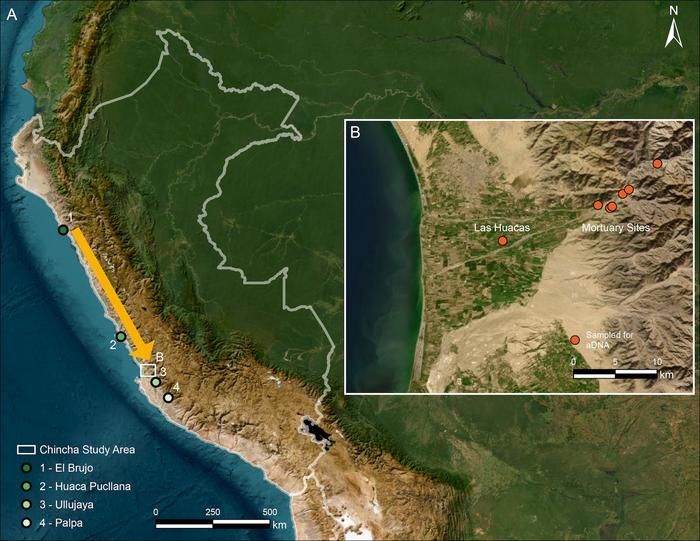
Long-distance migration along Peru’s Pacific coast began at least 800 years ago, centuries before the rise of the Inca Empire and much earlier than previously thought, a new international study reveals.
By analysing ancient DNA (aDNA) alongside archaeological and historical data, the study provides some of the strongest evidence to date of population movement along the Pacific coast prior to Inca rule (AD 1400 to 1532), demonstrating that pre-Inca coastal communities were far more mobile and connected at local and interregional scales than historically believed.
Published in Nature Communications, it suggests people travelled more than 700 kilometres from Peru’s north coast to the Chincha Valley in the south. Here, they settled and intermarried with neighbouring populations, while maintaining distinctive cultural traditions – such as cranial modification and painting the dead with red pigment – for generations. The study also identified a single grave containing relatives who engaged in endogamy, or close-kin procreation.

“Migration and kinship have long been part of the human story and the development of powerful societies,” said co-lead author Dr Jacob Bongers, digital archaeologist and member of the Vere Gordon Childe Centre at the University of Sydney, and Visiting Research Fellow at the Australian Museum Research Institute.
“What’s most interesting about this research is that it shows the close-knit and far-reaching social networks of pre-Inca coastal communities, as well as how people maintained cultural traditions of marking group identities for centuries, even as they intermarried with distinct groups,” he said.
Tracing ancient movement and mating patterns through aDNA
The research team analysed aDNA samples of 21 individuals recovered from burial sites in the Chincha Valley to reconstruct family relationships and explore genetic diversity over time.
“The genome-wide data and radiocarbon dates suggest migrants arrived in the Chincha Valley by at least the thirteenth century AD, well before Inca expansion,” Dr Bongers said. “Their ancestry traced back to the Peruvian north coast, more than 700 kilometres away, and the aDNA of these early migrants revealed no evidence of mixing with local populations.”
Genetic evidence revealed mixed ancestry between people from the north, central and south coasts over subsequent generations. “This likely means that, after northerners migrated to Chincha, they intermarried with groups from neighbouring coastal areas, a practice that continued during the Spanish Colonial Period (AD 1532-1825),” Dr Bongers said.
Genetic and bioarchaeological data from the aDNA samples also indicated close-kin procreation.
“The burial of family members together and the evidence for close-kin unions in the lower Chincha Valley highlights the importance of the familial unit for ancient Andeans,” said co-lead author Assistant Professor Jordan Dalton from the State University of New York, Oswego.
“The close biological relationships suggest the sampled individuals were members of an ayllu or parcialidad, a traditional, kin-based group that shares common territory, resources and ancestry. Close-kin unions may have served as a strategic means of retaining control over resources within the group,” she said.
Cultural traditions endured across centuries
All sampled individuals had some north coast ancestry, demonstrating population continuity for at least 200 years. This coincides with persistent cultural traditions maintained in Chincha from at least the thirteenth to fifteenth centuries.
“In the sampled individuals from the lower and middle valley we observed practices such as cranial modification, a process carried out in infancy to shape the head using boards and bindings, human vertebrae strung on reed sticks, and the postmortem application of red pigment to the skull,” Dr Bongers said.
“Postmortem red pigment application and cranial modification are cultural traditions that have long been documented on Peru’s north coast, so this evidence shows migrants may have brought their body modification traditions south to mark group identities.”
The timing of migration from northern Peru aligned with major social and political changes along Peru’s coast, yet the precise reasons for population movement remain uncertain, Dr Bongers said.
“Climate hazards, the expansion of powerful northern polities such as the Chimú, and access to valuable resources including seabird guano, are all possible drivers of ancient Andean migration,” he said.
“Importantly, this research expands our understanding of how and when interregional interaction occurred along the Andean Pacific coast and makes it clear the Inca incorporated highly mobile and deeply connected coastal communities into their empire.”
IMAGE CREDIT: ESRI, Michael Bauer Research GmbH 2022, Instituto Nacional de Estadística e Informática (INEI), Earthstar Geographics, Vantor..


Leave a Reply