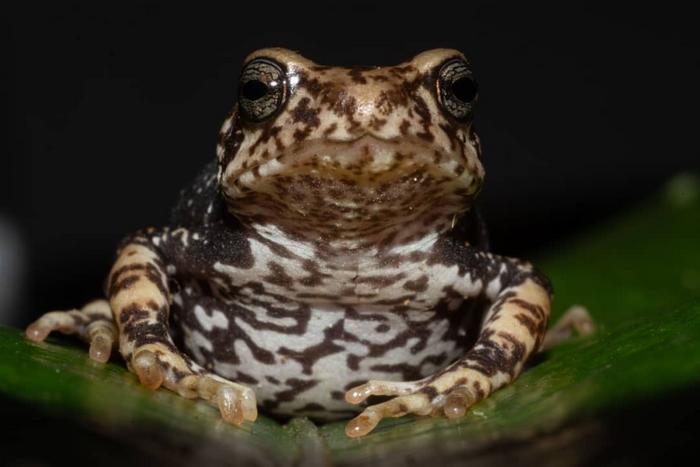
Tree-Dwelling Toads That Give Birth to Live Young
An international team has described three new species of African “tree toads” from Tanzania’s Eastern Arc Mountains that completely skip the tadpole stage. Instead of laying eggs in water, females of these Nectophrynoides species carry fertilized eggs internally and give birth to fully formed toadlets—placing them among the very few amphibians known to be truly live-bearing. Using “museomics” to extract DNA from 120-year-old museum specimens, researchers untangled old taxonomic puzzles and revealed hidden diversity published in Vertebrate Zoology. The toads’ tiny, fragmented forest habitats are rapidly shrinking due to logging, agriculture, mining, and climate change, leaving many species on the brink. The authors warn that without urgent protection, some of these newly recognized live-bearers could vanish soon after being named. (Eureka Alert)
Weird Eyeless Spider Discovered on Remote Atlantic Island
Arachnologists combing through museum collections have identified two new spider species from St Helena, one of Earth’s most isolated islands—and both may already be extinct. The Christy Jo goblin spider sports heavy abdominal armor, while the Martina miniscule spider is less than half a millimeter long and completely eyeless, despite not living in caves. The finds push St Helena’s endemic spider tally to more than 500 species, underscoring its status as a biodiversity hotspot. However, neither spider has been seen in the wild for over 30 years. Scientists suspect habitat loss, deforestation, and invasive species have pushed them to extreme rarity or extinction, turning these “new” species into haunting reminders of undiscovered life disappearing out of sight. (Mongabay)
Clarion Island Iguanas Turn Out to Be Ancient Natives, Not Invaders
Spiny-tailed iguanas on Mexico’s remote Clarion Island were long assumed to be recent introductions, possibly ferried in by the military along with pigs, sheep, and rabbits in the 1970s. New genetic analysis tells a very different story. Comparing island lizards with mainland populations, researchers estimate Clarion’s iguanas diverged around 425,000 years ago—far earlier than human arrival in North America. That suggests the reptiles rafted over on vegetation mats and evolved in isolation, making them an “evolutionarily significant unit” that may deserve subspecies or species status. Crucially, Mexico had been exploring iguana eradication, under the belief they were invasive. The study argues they are part of the island’s natural fauna and should be protected, not culled. (Mongabay)
Vietnam’s Mega-Caves Become a Model for Wildlife-Friendly Tourism
In central Vietnam’s Phong Nha–Kẻ Bàng National Park, protection of spectacular karst caves like Sơn Đoòng has catalyzed an unlikely wildlife rebound. Once, local livelihoods depended on hunting pangolins, langurs, and other forest species, along with logging and harvesting valuable agarwood. As cave tourism took off, park authorities and tour operator Oxalis imposed strict limits on visitor numbers, guided expeditions, and bans on hunting and logging. Former poachers were hired as porters and guides, trading snares for headlamps. Researchers and cavers now report far more sightings of endangered Hatinh langurs and other primates than 15 years ago, although robust population data remain scarce. The park’s apparent success is inspiring transboundary conservation plans with neighboring Laos, recently recognized by UNESCO. (Mongabay)

Meat-Eating Bats Hunt Like Tiny Lions—with a Much Higher Success Rate
In Panama’s forests, fringe-lipped bats punch far above their weight. A new study fitted 20 of these frog-eating bats with miniature biologger “backpacks” to eavesdrop on their nightly hunts. Instead of constantly cruising for prey, the bats spend nearly 90 percent of their time hanging motionless, then launch short, targeted attacks lasting only seconds. They frequently subdue frogs weighing up to two-thirds of their own body mass. Researchers liken the strategy to lions’ ambush hunting—except the bats succeed about half the time, versus roughly 14 percent for lions. By combining hearing, vision, and echolocation, they efficiently pinpoint calling frogs in the dark. But this high-gain strategy depends on intact, prey-rich habitats, making the bats vulnerable as tropical ecosystems decline. (Discover Wildlife)
Cracking the “Vowels” in Sperm Whale Speech
Using years of underwater recordings from the Caribbean, researchers have taken a fresh look at the click bursts—“codas”—sperm whales use to communicate. By analyzing fine-scale timing and frequency structure, the team found whales combine basic click units into more complex patterns that vary across social groups and contexts, creating something akin to syllables and “vowel-like” sounds. The work suggests whale communication has a richer, more flexible phonetic structure than previously recognized, potentially supporting a large repertoire of meanings. While scientists are careful not to label this a full-blown language, the findings strengthen parallels between human speech and cetacean communication and offer new footholds for future decoding efforts that mix field biology with machine-learning analysis. (National Geographic)
Antarctic Wildlife as Early-Warning System for Emerging Diseases
A National Geographic feature follows disease ecologist Jane Younger as she tracks pathogens at the ends of the Earth, treating Antarctic seabirds and seals as sentinels of a warming world. As climate change and human activity push more species—and people—into contact in polar regions, viruses and parasites can jump into naïve hosts with unknown consequences. Younger’s team samples blood, feces, and swabs from penguins, skuas, and marine mammals, building baselines for influenza and other microbes. The goal is to spot unusual outbreaks or viral shifts early, before they spill over more widely. The work highlights how conservation, animal health, and human pandemic preparedness are increasingly intertwined, especially as climate-driven ecosystem shifts redraw global disease maps. (National Geographic)
AI Wildlife Videos Are Warping Public Perception of Nature
Viral clips of leopards chased off by house cats or raccoons rafting on crocodiles may look real, but many are now crafted by generative AI. A study in Conservation Biology warns that such hyper-realistic fakes are distorting how people—especially children—understand wild animals. Reviewing widely shared AI videos, Spanish researchers found repeated themes: predators behaving like pets, prey and predators “playing,” and rare species appearing ubiquitous. That fuels anthropomorphism, disconnects viewers from real ecosystems, and can even stoke demand for exotic pets. The authors argue that when kids don’t encounter these fantasy animals outdoors, it can backfire, deepening disillusionment. They call for stronger media literacy, clear labeling of AI content, and better environmental education to anchor conservation messages in reality. (phys.org)
A $7-a-Year Plan to Save 130 Species in Southern Ontario
Southern Ontario is barreling toward a wave of local extinctions: 130 native species—from turtles and snakes to plants—could vanish by 2050 without intervention, according to new modeling. Ecologists examined land-use change, climate projections, and species’ habitat needs, then designed eight conservation strategies emphasizing habitat protection, restoration, and connectivity. Implementing the most efficient package would cost about $94 million annually, or roughly $7 per resident per year. That buys protection for all 130 at-risk species and benefits many more. The study frames biodiversity loss as a solvable public-finance problem, not an inevitable tragedy, and highlights the outsized leverage of relatively modest, well-targeted spending in densely populated regions under intense development pressure. (phys.org)
American Woodcock Mural Highlights Climate Threats to a Secretive Bird
In Queens, New York, artist Majo San’s mural of an American Woodcock peers from native asters and dogwood in a community garden. The piece is part of the Audubon Mural Project, which uses public art to spotlight bird species vulnerable to climate change. Woodcocks—a chunky, big-eyed shorebird that probes soil for worms—are still fairly common, but Audubon modeling suggests they could lose more than half their summer range if warming continues unchecked. The mural pairs the bird with native plants that supply food and cover, illustrating how small urban green spaces can support migration stopovers. Organizers hope such hyperlocal art can connect climate projections to specific neighborhoods and species, turning abstract risk into visible calls for habitat and emissions action. (Audobon)
IMAGE CREDIT: John Lyarkurwa



Leave a Reply