Bizarre new pterosaur discovered in fossilized dinosaur vomit
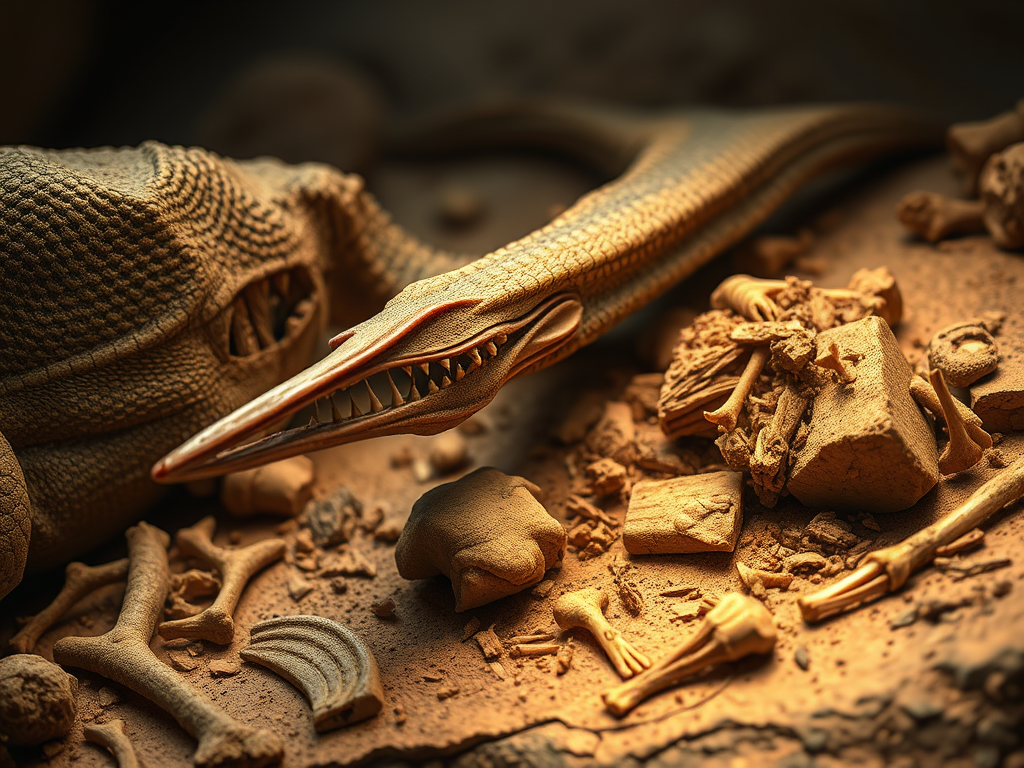
Paleontologists have named a new pterosaur, Bakiribu waridza, from bones preserved in fossilized dinosaur vomit from Brazil’s Early Cretaceous Crato Formation. The animal’s jaws are lined with long, bristle-like teeth, suggesting a filter-feeding lifestyle similar to baleen whales, sieving tiny organisms from water. The regurgitated mass also contains fish bones, indicating a predator—likely a dinosaur—gulped down at least two pterosaurs and several fish before vomiting them back up. The unusual “regurgitalite” preserves a rare snapshot of predator–prey interactions, feeding ecology, and soft, fragile skeletal elements that usually decay. It also highlights how Indigenous Kariri language informed the species name, underscoring local connections to the fossil site. (Science Alert)
Reptile “body farm” helps solve dinosaur death-pose mystery
A “reptile body farm” in Tennessee is answering a deceptively simple question: how do reptiles decompose, and what does that mean for dinosaur fossils? Researchers laid out dozens of culled Argentine black-and-white tegus in outdoor enclosures and monitored their decay across seasons. Time-lapse observations and dissections are helping explain why some fossils preserve delicate soft tissues while others lose skulls or limbs, and why so many dinosaurs end up in the dramatic arched “death pose.” The work links modern reptile anatomy, scavengers, and gravity-driven ligament shrinkage to fossil postures. Ultimately, the project should refine how paleontologists interpret cause of death, burial environments, and post-mortem transport in dinosaur bonebeds worldwide. (National Geographic)
Transylvanian bonebed reveals a Cretaceous mass grave of dinosaurs
In Romania’s Hațeg Basin, researchers have uncovered one of Europe’s richest dinosaur bonebeds: the K2 site, where more than a hundred vertebrate fossils cram each square meter. The Upper Cretaceous deposit, now described in PLOS ONE, records a flash-flood–fed lake that trapped carcasses and transported bones into a shallow delta. Thousands of fossils include amphibians, turtles, crocodiles, pterosaurs, mammals, and especially dinosaurs. Partial skeletons of a small, bipedal rhabdodontid herbivore and an unprecedentedly complete titanosaurian sauropod dominate the assemblage. As the oldest highly productive dinosaur bonebed in the Hațeg Basin, K2 offers a rare window into early stages of this island-like ecosystem, helping track how Late Cretaceous European dinosaur faunas evolved in relative isolation. (phys.org)
Arctic fossil haul captures the dawn of ocean-going reptiles
On the Arctic island of Spitsbergen, paleontologists have cataloged more than 30,000 teeth and bones from a 249-million-year-old marine community, revealing the earliest fully oceanic ecosystem of reptiles and amphibians after Earth’s greatest mass extinction. The assemblage, now detailed in Science, features small ichthyosaurs like Grippia, gigantic predators such as Cymbospondylus, marine amphibians (Aphaneramma), bony fish, and sharks. Textbooks long suggested a slow, stepwise invasion of open oceans following the end-Permian “Great Dying” 252 million years ago. Instead, the Spitsbergen fossils show a relatively rapid radiation of tetrapods into offshore habitats under extreme greenhouse conditions. The site tightly constrains how fast marine food webs rebounded and how quickly reptiles dominated early Mesozoic seas. (phys.org)
Decapitated Jurassic fish reveal brutal marine food chains
A new study of Germany’s Solnhofen Limestone, famous for Archaeopteryx, focuses on a more gruesome resident: the predatory fish Aspidorhynchus. Examining 343 fossils, researchers found that about 16 percent preserve only decapitated heads attached to gastrointestinal tracts. Stomach contents show these marlin-like hunters usually chased and swallowed schooling teleost fish whole. But the detached skulls and guts suggest Aspidorhynchus often ended up as prey themselves. Larger marine reptiles—ichthyosaurs, marine crocodiles, or pliosaurs—likely bit the tail, shook the body apart, and consumed the torso, leaving heads plus entrails behind. The work links anatomy, taphonomy, and behavior to reconstruct a violent Late Jurassic food web in the Tethys Ocean. (Popular Science)
Venice, Florida’s offshore sands archive 45 fossil shark species
A new survey off Venice, Florida—marketed today as the “Shark Tooth Capital of the World”—systematically catalogs fossil teeth collected by local divers and beachcombers. Researchers identified at least 45 shark and ray species spanning millions of years of Gulf of Mexico history, including extinct giants and ancestors of modern sand tiger and hammerhead sharks. The assemblage, described in Palaeontologia Electronica, reveals a once highly diverse coastal ecosystem and suggests the area served as a long-lived nursery ground. Species turnover tracks climatic and sea-level shifts, tying local fossils to global ocean changes. The study also showcases how citizen science and amateur collectors can generate publishable datasets, provided specimens are carefully documented and curated. (My Sun Coast)
Ancient mammoth RNA offers a molecular time capsule
Scientists have extracted the world’s oldest RNA from a 40,000-year-old woolly mammoth leg bone preserved in Siberian permafrost, pushing molecular paleontology beyond DNA. Unlike DNA, which records genetic blueprints, RNA reflects which genes were active in specific tissues at the time of death. By sequencing degraded transcripts, researchers reconstructed expression patterns consistent with cartilage and connective tissue, suggesting which body part the sample came from and hinting at the animal’s physiological state near its end. The study shows that RNA can survive for tens of thousands of years under ideal cold conditions, opening possibilities to probe ancient immune responses, pathogens, and stress. It may also refine reconstructions of extinct species’ biology beyond what DNA alone allows. (Science News)
AI teases out traces of Earth’s earliest life in ancient rocks
A Michigan State–led team has combined geochemistry and machine learning to search 3.3-billion-year-old rocks for chemical whispers of life. They trained an algorithm on modern microbial mats and rock samples to recognize subtle molecular patterns left by biology. Applying it to heavily altered Archean rocks, the system flagged organic signatures best explained by ancient microbial communities, bolstering evidence that life thrived on Earth far earlier than the fossil record alone suggests. Published in PNAS, the work shows how AI can sift noisy, metamorphosed rocks for biosignatures that humans might overlook. The approach could be adapted to core samples from Mars or icy moons, providing a new toolkit for astrobiology as well as early-Earth studies. (Discover)
Microplastics drive sex-specific heart disease in mouse study
Microplastics—tiny particles shed from packaging, textiles, and other plastics—may directly accelerate atherosclerosis, especially in males. In a new study, University of California, Riverside researchers exposed lean, cholesterol-prone mice to environmentally realistic doses of microplastics for nine weeks. Male mice developed dramatically more arterial plaque—63 percent more in the aortic root and over sixfold more in a major chest artery—while females showed no significant change. The particles lodged in plaques and endothelial cells, disrupting gene expression pathways tied to inflammation and vessel damage, without altering body weight or cholesterol. The findings, published in Environment International, suggest microplastics are more than passive contaminants and may pose underappreciated cardiovascular risks, highlighting the need to curb plastic pollution and probe human sex differences. (Science Daily)
Fugaku supercomputer builds the most realistic virtual brain yet
Using Japan’s Fugaku supercomputer, scientists from the Allen Institute and Japanese partners have built a biophysically detailed simulation of the entire mouse cortex. The virtual brain incorporates nearly 10 million neurons and 26 billion synapses across 86 interconnected regions, with each neuron modeled at subcellular resolution. Powered by hundreds of thousands of compute nodes, the system reproduces spontaneous cortical activity and can be configured to mimic conditions such as epilepsy or early Alzheimer’s disease. Researchers can now watch how pathological signals propagate through circuits, test hypotheses, and explore potential interventions in silico. Presented ahead of the SC25 supercomputing conference, the work is a major milestone toward whole-brain—and, eventually, human-scale—simulations grounded in real biological data. (Science Daily)



Leave a Reply