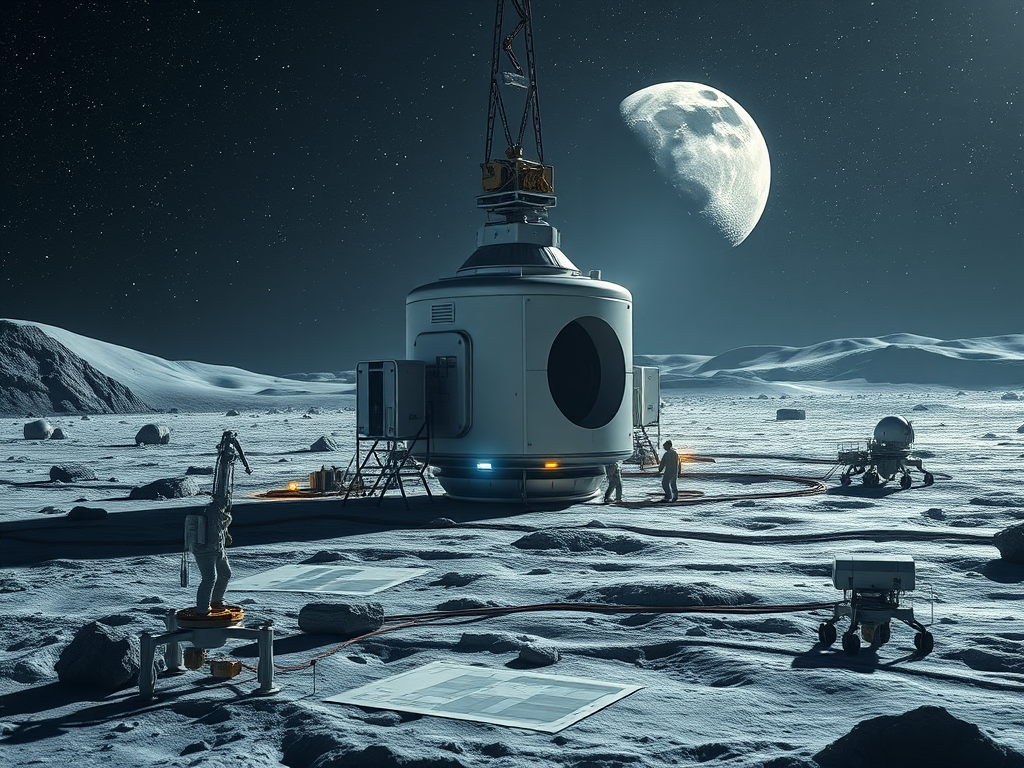
NASA races to plant a 100-kW nuclear reactor on the Moon by 2030
A directive from NASA’s interim administrator Sean Duffy orders development of a fission surface-power system to safeguard U.S. interests at the lunar south pole. The 100-kilowatt reactor—about enough juice for 80 U.S. homes—would eclipse the watt-level radioisotope generators used on probes and enable permanent Artemis bases, ISRU mining, and deep-space manufacturing. Experts say the tech exists but timelines are “racy”; China-Russia joint plans for a 2035 reactor intensify pressure. Private suppliers such as Boeing and Lockheed are vying for contracts, while policy analysts warn that the first nation to energize the Moon could declare keep-out zones. NASA will issue an industry RFP within 60 days. (Wired)
OpenAI rolls out GPT-5 and removes paywall for advanced AI
OpenAI has unveiled GPT-5, a “unified” flagship model that fuses the deep-reasoning abilities of its o-series with the rapid responses of earlier GPT versions. The system operates more like a digital agent, able to generate full software apps, manage calendars, and craft research briefs while an internal router decides when to think longer for tougher tasks. CEO Sam Altman calls the release a major AGI milestone. Benchmark data put GPT-5 slightly ahead of rivals on coding tasks (74.9 % on SWE-bench) and PhD-level science questions, with health-related hallucinations falling to 1.6 %. Crucially, GPT-5 is now the default for all free ChatGPT users, ending the advanced-model paywall and intensifying pressure on competing labs. (Tech Crunch)
Japan unveils fully home-grown superconducting quantum computer
Osaka University’s Center for Quantum Information and Quantum Biology switched on a domestically designed 64-qubit machine built entirely with Japanese components and open-source software. The milestone showcases national self-reliance in dilution refrigeration, control electronics and the Open Quantum Toolchain (OQTOPUS). Expo 2025 visitors will run cloud experiments and view quantum-generated art, bridging science and culture. (Science Sources)
Room-temperature optomechanics traps nano-cluster in a pure quantum state
ETH Zurich physicists levitated a tower of three glass nanospheres and used laser cooling to quash thermal motion—without cryogenics. Achieving near-ground-state vibrations at ambient conditions opens paths to ultrasensitive quantum sensors and tests of fundamental physics beyond the lab freezer. The work demonstrates that gravitational and environmental noise can be tamed with optical tweezers alone, a key milestone for deployable quantum tech. (Eureka Alert)
DeepMind Unveils “Genie 3” AI That Renders Interactive Simulations
DeepMind revealed Genie 3, an AI system capable of generating explorable virtual environments in real time, from just a textual prompt or image. The system constructs immersive 3D worlds on the fly—meticulously detailing terrain, lighting, and objects that users can explore dynamically. This leap promises applications across gaming, architecture, and simulation-based learning. Designers could draft environments verbally, while educators might simulate complex ecosystems or historical settings interactively. Safety and ethical considerations remain—particularly around misuse or distortion—but Genie 3 offers a tantalizing glimpse into AI-crafted, user-driven virtual realities. (Ars Technica)
Africa’s uneven mpox landscape mixes success and new alarms
Mpox cases across Africa have retreated from their May peak, yet the Africa CDC says overall 2025 infections and deaths already exceed last year’s totals. Sierra Leone exemplifies progress: intensified community surveillance, better testing, and strong vaccine uptake cut weekly cases from 600 to 94, with 3,000 more doses arriving August 11. In contrast, clade 2b has appeared in Kinshasa alongside 1a/1b, Guinea is seeing exponential spread amid weak surveillance, Liberia’s positivity has leapt to 72 %, and newly affected Mozambique reports cross-border risks. Thirteen of 27 nations logged fresh infections last week, underlining chronic challenges in contact tracing, isolation capacity, and public awareness despite regional successes.(CIDRAP)
NASA Confirms Two Large Asteroids Will Safely Fly By Earth Today
Today—August 8, 2025—NASA alerted that two large asteroids, 2025 OJ1 (~300 ft wide) and 2019 CO1 (~200 ft), will pass safely by Earth at distances of roughly 3.2 million and 4.24 million miles, respectively. No collision risk exists. While it’s not uncommon for such near-Earth objects (NEOs) to closely approach our planet, the size and timing of these flybys highlight the critical importance of continuous monitoring systems. NASA’s vigilance ensures early detection and public awareness—showing that, while cosmic visitors are routine, vigilance remains essential. (Times of India)
Climate Scientist Issues Eight-Point Manifesto for Asian Cities
Leading climate scientist Benjamin Horton has released an urgent eight-point manifesto calling for transformative climate action in major Asian metropolises, prompted by extreme weather events witnessed since arriving in Hong Kong in April 2025. The manifesto emphasizes that decisions made in the next three decades will determine long-term livability and economic resilience. Key recommendations include exploring carbon capture technologies, developing circular economy models, and leveraging Hong Kong’s ties with mainland China, now a global leader in renewable energy. Horton argues Hong Kong is uniquely positioned to become a model for climate-smart urban development, with HK$240 billion allocated over two decades for carbon neutrality by 2050. The manifesto responds to Asia’s surge in record-breaking rainfall, typhoons, and prolonged heatwaves, warning that immediate action is crucial for regional and global climate leadership. (Eureka Alert)
James Webb Telescope Discovers Potential Exoplanet at Alpha Centauri
Astronomers using NASA’s James Webb Space Telescope have found strong evidence of a giant planet orbiting Alpha Centauri A, the nearest sun-like star to Earth at just 4 light-years away. This discovery represents a major breakthrough in exoplanet detection, as the Alpha Centauri triple star system has long been a compelling target for astronomers searching for worlds beyond our solar system. The potential planet’s proximity makes it an ideal candidate for detailed atmospheric studies and future characterization. If confirmed, this would be the closest known exoplanet to Earth orbiting a sun-like star, offering unprecedented opportunities for direct observation and analysis. The discovery demonstrates JWST’s remarkable capabilities in detecting planets around bright nearby stars, opening new possibilities for finding Earth-like worlds in our cosmic neighborhood. (space.com)
Beetle invasion threatens Hawaii’s coconut palms
A glossy coconut rhinoceros beetle is hollowing out palms across Hawaii, carving telltale V-shaped frond cuts and trunk holes that foretell fatal crown rot. Since a 2013 detection near Honolulu’s airport, the pest has exploded; Oahu and Kauai are now judged beyond eradication, though officials still treat hundreds of trees and maintain 1,500-foot exclusion zones at ports, nurseries and compost sites. The Coconut Rhinoceros Beetle Response team—scientists, field crews and two larvae-sniffing dogs—has trapped or poisoned more than 144,000 adults, drilling trunks to inject imidacloprid and deploying drones over Big Island palms where eradication remains possible. State lawmakers pledged $500,000 annually as federal funds may wane, but managers admit current tactics only buy “more good years” before palms fade. (New York Times)
Million-year-old Sulawesi tools redraw Wallacean hominin map
Seven battered chert flakes excavated from the Calio riverbank on Sulawesi push hominin presence in Indonesia back to at least 1.04 million, perhaps 1.48 million, years ago. Dated with pig fossils and stratigraphic modelling, the artifacts pre-date any bones, yet eclipse previous Wallacean records from Flores and Luzon, implying seafaring—or tsunami-borne—ancestors reached the deep-water archipelago far earlier than our own species. Their makers remain unknown: possibilities range from widespread Homo erectus to more archaic australopithecine lineages that later spawned island dwarfs Homo floresiensis and Homo luzonensis. Isolation repeatedly splintered populations, fostering rapid evolution and dramatic body-size shifts. Discovering fossils on Sulawesi could reveal whether the island bred its own Hobbit variant and clarify how many distinct cousins once roamed Southeast Asia’s scattered islands. Further digs may eventually complete the story. (Ars Technica)


Leave a Reply