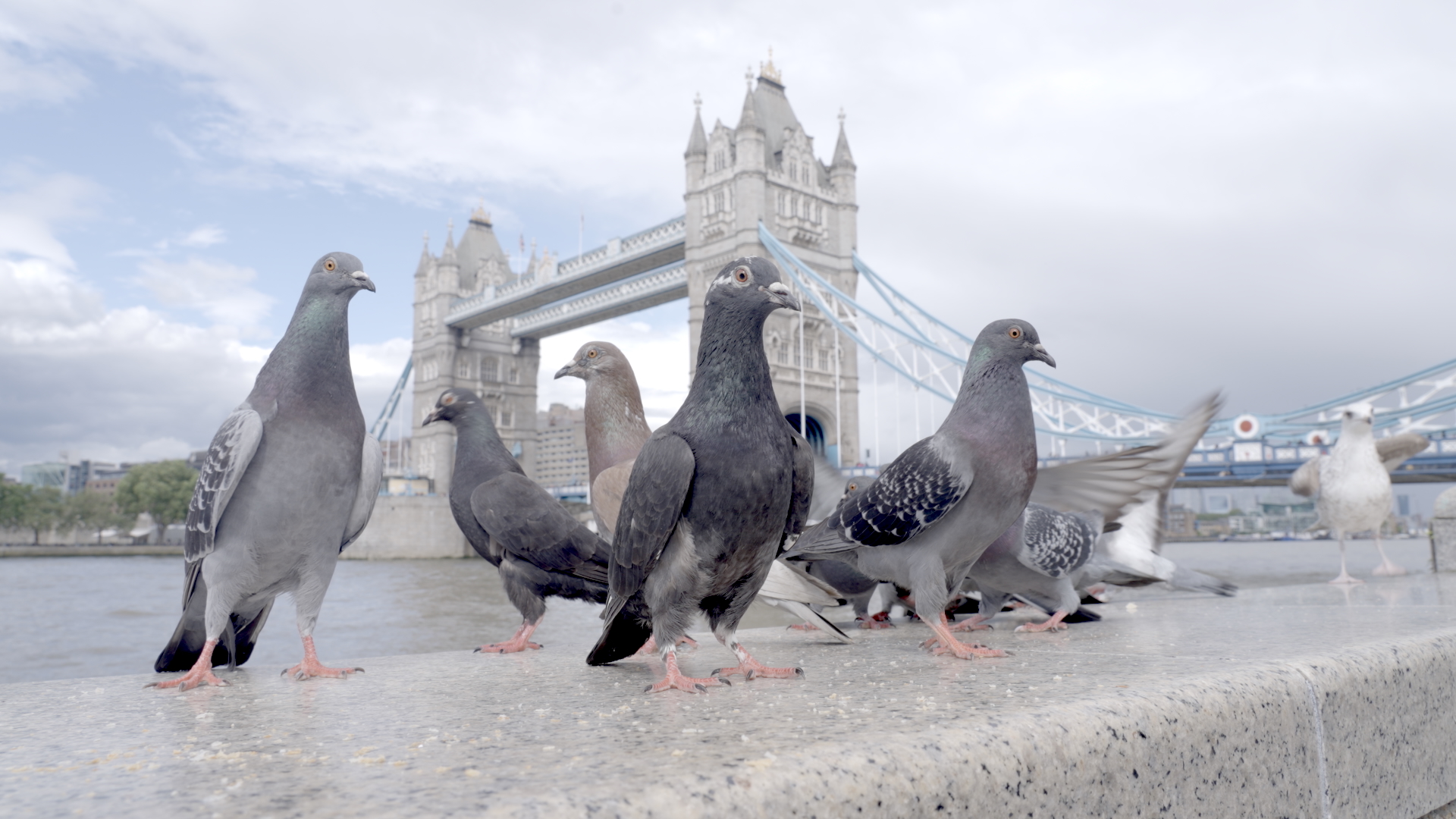
City dwellers may write them off as “rats with wings,” but Pigeon Hustle—a new Nature film now airing on PBS—makes a compelling case that urban pigeons are among the most remarkable animals sharing our streets. From threading subway tunnels and dodging traffic to memorizing food hotspots block by block, these birds have adapted to city life with a mix of agility, intelligence, and sheer hustle that’s easy to miss if you never stop to look.
To dig deeper into the science and storytelling behind the film, I spoke with Pigeon Hustle director Jackie Savery and longtime Nature executive producer Fred Kaufman. In the following Q&As, they talk about reframing a so-called “nuisance” species, the editorial vision for Season 44, and why pigeons might just change the way you see your own city.

SCINQ: “The Pigeon Hustle” reframes a species most city dwellers overlook—or dislike. What surprised your team most about feral pigeons in New York and London, and how do you hope the film shifts public perception or even urban policy about so-called “nuisance” species?
Jackie Savery: What interested me initially about pigeons is how accessible they are. They’re found on almost every continent and in almost every city or town around the world, and they’re often people’s first encounter with a wild animal.
SCINQ: What, for you, makes pigeons stand out from other urban wildlife?
Jackie Savery: I think the really surprising thing about pigeons is that they’re the only wild animal species we see and interact with in our cities every day. You might spot a fox occasionally or see a hawk fly over, but you can almost guarantee that if you walk through any major city in the world, you’ll see a pigeon—and it’ll probably be very close. It’s hard to think of any other wild species you can watch at such close quarters on a daily basis.
When the team began this project, they were a little dubious and had questions: Is there really enough to make a show about pigeons? What’s special about them? The problem is that pigeons are usually in the background of our lives. What we wanted to do in the film was bring them into the foreground so that the city became the backdrop. We worked a lot with camera angles to get down to pigeon level, literally putting them at the center of every shot.
Once our team started doing this—focusing on pigeons—they began to see the world from a pigeon’s viewpoint. Instead of pigeons being background extras, they became the lead characters, and the team’s perception changed as well. That’s probably our greatest aim with the film (apart from wanting it to be enjoyable to watch): that you look at pigeons in a new way. They’re incredible in how they’ve adapted to living with us.
SCINQ: What did you learn about their behavior and abilities that really stayed with you?
Jackie Savery: Once you shift your focus, you see how clever and adaptable pigeons are—from how they hustle for food to their incredible agility. The way they flew through the subway was astonishing. We saw similar feats in narrow streets and stairwells as they navigated the urban environment. Pigeons can handle extraordinary situations, and they’re so fearless. No other wild species flies down escalators, through underground tunnels, and onto subway or tube trains. When you think about it, it’s insane.
So for us, the aim of the film was to put pigeons center stage and focus on this incredible animal that has travelled with us through so much of human history.
SCINQ: People often joke that you never see baby pigeons. Did your team explore that?
Jackie Savery: Yes, that was something we were keen to explore. People often say, “I never see a baby pigeon—where are they? What do they look like?” They’re unusual-looking little animals, with fluffy yellow down before they feather up—much more like mini dinosaurs. You don’t see them because they stay in the nest until they’re almost fully independent. By the time you first see them, they’re already young pigeons, and it can be hard to tell them apart from adults.
Their nests are very hidden. Even in the biggest cities like New York and London, they’re under bridges, on the tops of buildings, in little caves and crevices that mimic their natural rock-dove past. Once you know what a young pigeon looks like—smaller, thinner, often with darker, less-developed legs—you start to spot them. It’s fascinating to watch a flock and see how the very new ones, who are a bit unsure of themselves, learn to assert themselves and figure out how to hustle within the group.
SCINQ: What changes when you really sit and watch a flock instead of just walking past?
Jackie Savery: If you sit and observe a group of pigeons, you start to notice individuals: the one with a slightly checkered pattern, the white splodge on its wing, or some other feature that helps you identify it. You quickly start to see how each behaves in the group—who’s being bullied, who’s doing well. It’s like a whole subculture running alongside our busy city lives, and it’s fascinating to observe.
There are issues with pigeons in cities. They can become a nuisance because they’re so successful and opportunistic. Their droppings can damage historic buildings or create hygiene issues where lots of pigeons congregate—usually as a result of human mess—and sometimes management is needed depending on the situation. But I think we have to respect how pigeons have adapted to living alongside us so closely.
So, in summary, we hope that after watching the film you’ll look more closely at the pigeons you see, rather than letting them remain part of the background. They are super adaptable, capable of incredible feats of memory, agility, and hustle. Whether you love them or feel less fond of them as a species, I hope you come away with a new respect for the pigeon.
SCINQ: What kinds of scientific advisors, data, or field methods informed “The Pigeon Hustle”? Did you track movement or microbiomes, test cognition, or examine human–pigeon co-adaptations, and how did those findings shape narrative choices?
Jackie Savery: We always work with scientific advisors, both to verify our work and to inspire new areas to explore and build narratives around. On this project, we collaborated with evolutionary scientists, biologists, museum curators, and many other experts and enthusiasts focused on pigeons.
Pigeons have always fascinated me personally. Early in my career, before I became a wildlife film producer, I trained and worked as a biologist, and one of my first research posts was on the pigeons of London. That gave me the chance to really observe their behavior. I was particularly fascinated by how well they get to know an area. You really do get pigeon “gangs” that know exactly when the hot dog stand opens or when food becomes available in a park—they know their streets or blocks just like local human residents.
In terms of scientific research for the project and how it shaped our narrative, we read a lot of papers on pigeon biology and behavior. What struck us very quickly was the incredible “superpowers” pigeons have—from their agility and ability to take off vertically at speed to avoid traffic and predators, to their memory, mental maps of their territories, and homing ability.
From a storytelling perspective, pigeons tick so many boxes because they operate at the extremes of what you might expect an animal to do in a city. The more we researched, the more superpowers we found. We then looked for creative ways to illustrate those—whether it was their vertical takeoffs in lines of traffic and how they adapt to city life, or experiments showing their ability to recognize logos and writing.
SCINQ: Season 44 opens with climate stress in “Walrus: Life on Thin Ice” and then dives into urban resilience in “The Pigeon Hustle.” What editorial throughline connects these very different habitats within the Forces of Nature collection—adaptability, human pressures, or something else?
Fred Kaufman: The walrus’s future hinges on a changing climate in the Arctic because their dependence on sea ice and food sources is deeply affected by warming temperatures. On the other hand, The Pigeon Hustle was intended to be an urban wildlife story—a popular theme for us—about a familiar bird that people know little about but that has adapted so perfectly to our urban jungle. To some extent, both shows are about adaptability.
SCINQ: You’re featuring Sir David Attenborough on Parenthood and Dr. Jane Goodall in Matriarch. From an executive producer’s seat, how do you weave decades-long science (Goodall) and global-scale storytelling (Attenborough) into a single season without diluting either voice?
Fred Kaufman: There is no way either voice can be diluted. David Attenborough is a storyteller unmatched in natural history documentaries. He tells the stories, but he isn’t the story. Jane Goodall is the story. So they occupy two very different places in the genre. We recently lost Jane. David is 99. There will never be another Dr. Jane Goodall or Sir David Attenborough.
SCINQ: Nature is known for “converting viewers into doers.” What specific audience actions are you hoping Season 44 catalyzes—urban biodiversity projects, climate engagement, citizen science—and how will you measure whether the series moves the needle?
Fred Kaufman: Several years ago, we did a three-night live broadcast in May called American Spring LIVE, where we joined scientists in the field as they made real-time observations about the arrival of spring. Longer days and warming temperatures trigger big changes in animals and plants. In that series, we promoted citizen science projects and encouraged viewers to participate. There was a spike in citizen science members. But these days, our series motto—our “North Star”—is “to be a voice for the natural world.”
SCINQ: Select episodes are streaming on PBS.org, the PBS app, and the Nature YouTube channel. What have you learned about reaching younger, mobile-first audiences, and did those insights influence how you structured or paced “The Pigeon Hustle” and other Season 44 films?
Fred Kaufman: No, our approach to The Pigeon Hustle was not influenced by any platform. Rather, we look at the subject matter and decide what would be a complementary style to the topic. Interestingly, a younger audience that wouldn’t ordinarily be looking for PBS on broadcast would more easily watch that same content on mobile devices or digital because they’re already on that platform.



Leave a Reply