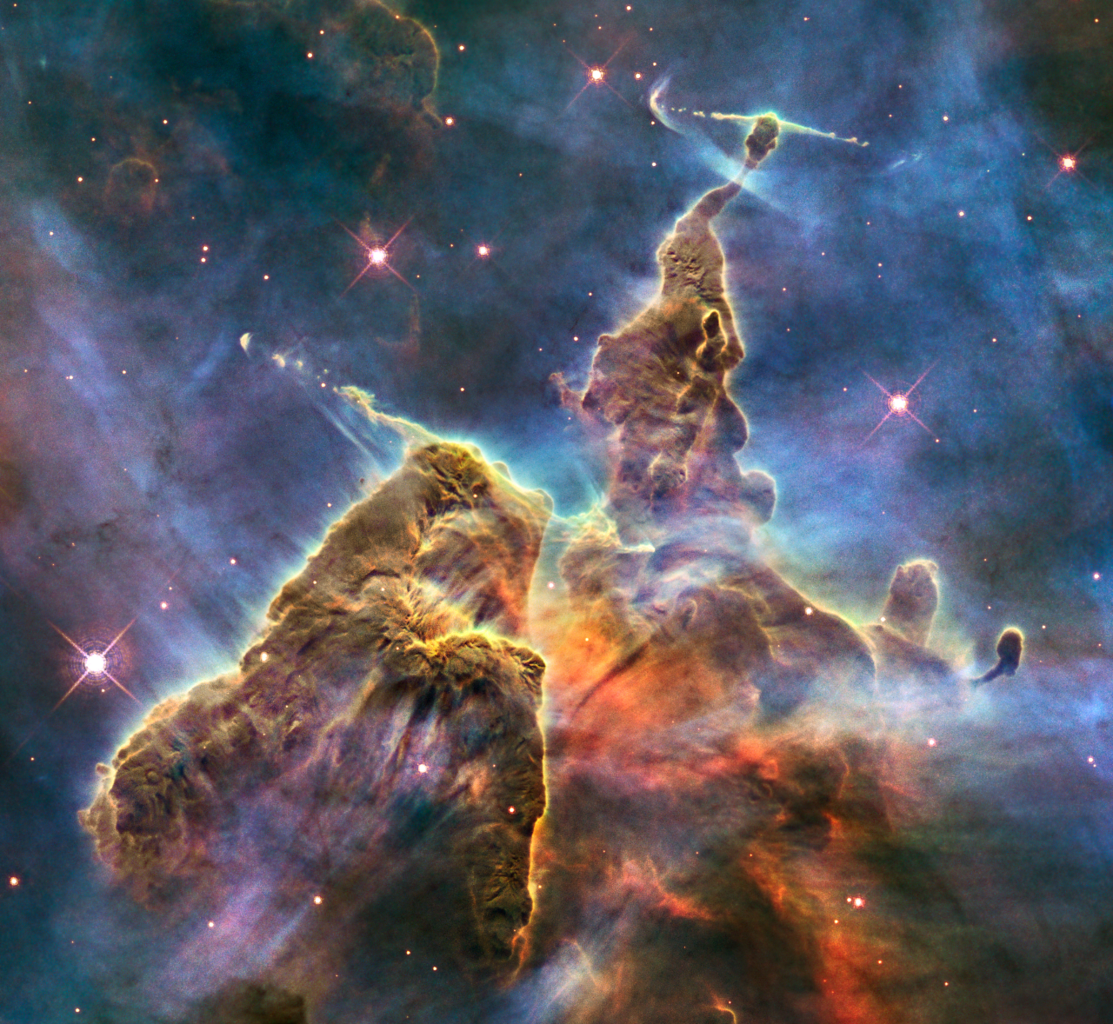

“Mystic Mountain” is a stunning region in the Carina Nebula, about 7,500 light‑years away, where dense pillars of gas and dust are being shaped by the fierce radiation and winds from nearby massive stars.
These structures aren’t simply static—they are dynamic scenes of both creation and destruction.
Structure & Processes
The pillar stands roughly three light‑years tall. Within it, cooler hydrogen gas and interstellar dust provide the raw material for star formation. But this raw material is under attack: ultraviolet radiation and stellar winds from massive, bright stars around the pillar are eroding its surface. Streams of ionized gas peel away from its ridges; close to its edges, the erosion is most intense.
Embedded in and around the pillar are Herbig‑Haro objects (specifically labeled HH 901 and HH 902 in this region) which are visible as jets of material being launched from young stars deep within the pillar. These jets interact with surrounding gas, heating and shocking it, lighting up the surroundings.
Why It’s Important
Observing regions like Mystic Mountain gives astronomers a view into how massive stars influence their environment—both by triggering new stars and by disrupting stellar nursery material. The balance between collapse (which forms new stars) and erosion (which disperses gas and dust) determines how many stars can eventually form in such regions.
Imaging Technique & Colors
The image is a composite, using different wavelength filters ‒ some in the visible spectrum, some in near‑infrared. False colors are used to tag different gases: for example, glow from oxygen, hydrogen, nitrogen, sulfur get different hues. This helps distinguish structures, see through dust (infrared penetrates more), and highlight where shocks or ionization are strongest.



Leave a Reply