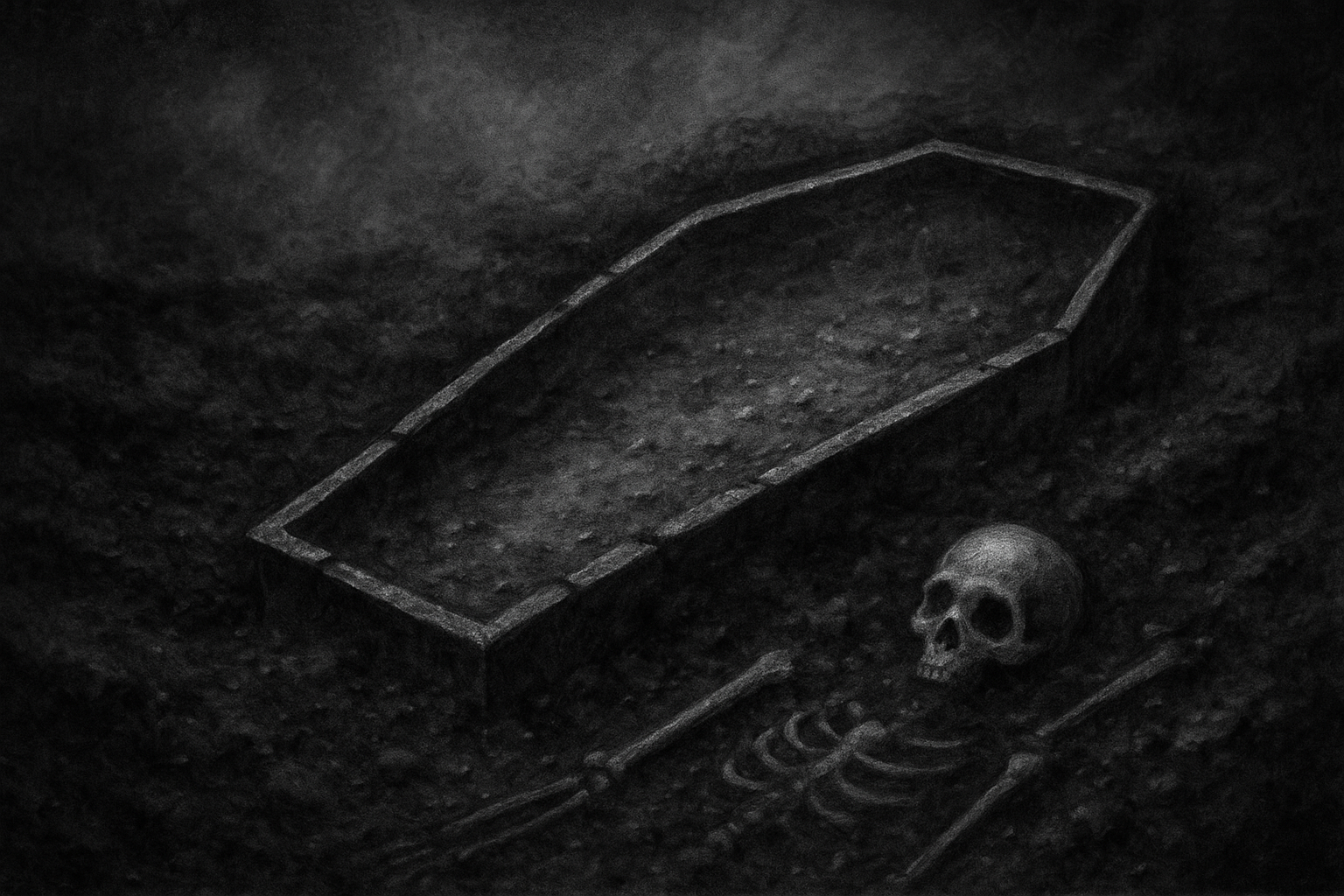
When archaeologist and forensic investigator Scott Warnasch first arrived at what was reported to be a homicide scene in Elmhurst, Queens, he expected a routine case. Instead, he uncovered one of New York’s most remarkable historical finds: the remains of Martha Peterson, later known as the Woman in the Iron Coffin. Warnasch’s decades of experience, from assessing forgotten churchyards to working with the New York City Medical Examiner’s Office, uniquely prepared him for the moment when fragments of a Fisk iron coffin shifted the story from crime scene to history.
In this first installment of our three-part conversation, Warnasch explains how earlier discoveries in Newark shaped his obsession with iron coffins, walks us through the day Martha’s grave was disturbed, and reveals the startling clues—from preservation to suspected disease—that made this case both a forensic puzzle and a window into Newtown’s free Black past.

Starting at the beginning, you already mentioned that there are other coffins that you had dealt with. How did you first get involved with this project? How did you first come across Martha Peterson and the Iron Coffin?
Well, I was working at the New York City Medical Examiner’s Office. I’ve been an archaeologist for over 30 years—probably about 30 years at the time of the discovery. I would respond to crime scenes that required excavation, you know, buried bodies kind of things. And that’s what this project really started with. It was a reported buried homicide victim in an abandoned lot. I went there as a routine call to respond to a situation like that. Before we even got to the body, I noticed the fragments of the coffin, which I’d been studying for a few years prior because of these prior discoveries. So I understood what we were dealing with wasn’t necessarily a straightforward crime scene at the time.
Can you discuss the prior coffins that you had discovered, and how that informed how you recognized what it was?
Right, so before I started working for the medical examiner’s office in New York City, I worked as a regular archaeologist for an engineering company. One of my jobs was to assess properties that were going to be developed. In this particular case, it was the Prudential Hockey Arena in downtown Newark, which was, at the time before construction, a parking lot behind the First Presbyterian Church.
I did the due diligence research and realized that this was an old Presbyterian church churchyard that had been paved over in 1959. It was questionable whether the graves were actually removed, although that was part of the contract. As it turned out, over 2,000 graves were still buried under this parking lot, and two of them happened to be in these iron coffins.
How were those Newark coffins different from what you found with Martha?
Unlike Martha’s, they stayed intact. They were found through an archaeological method, so they weren’t crashed through with a backhoe like Martha’s was. We managed to exhume those and eventually got them to the Smithsonian Institute, where they had previously done other openings and analysis of iron coffin occupants. That’s really where I learned about them and just became obsessed with the bodies in those two.
At the same time as the discovery, I was working at the medical examiner’s office and was very involved in identification processes through my work with Ground Zero and 9/11. So it kind of just dovetailed—these are really cold cases that I would like to try to identify the individuals from Newark, which I eventually did.
What was the timeline between those Newark discoveries and finding Martha?
That was in 2000—well, we found them in 2005. In 2009, they ended up down at the Smithsonian. It took a while to get the legal paperwork done. So by 2009, I was obsessed with these coffins and the occupants and the potential of what you could learn from them. Then in 2011, I went to the crime scene in Queens, so I already had a couple years really thinking about the coffins and potentially who could be in them.
Can you walk us through the initial discovery of that crime scene in Elmhurst? What were some of the key steps you took in identifying the body and identifying her as Martha Peterson?
Okay, so to begin with, it was a standard, straightforward, reported homicide burial. We show up at the site, just assuming that’s what it was, and talk to the detectives that were there. The body had been discovered, or actually exposed, the afternoon before. The police got there in the evening. It was already dark, the body was still pretty much covered with soil, and they couldn’t really tell what was going on. The police didn’t touch it at all. They call us in—that’s our job, our good relationship with the police. So we showed up thinking it’s just a buried body that had been disturbed by construction equipment.
What was your standard protocol for that kind of scene?
Forensic protocol suggests that you walk towards your target in a line. There were other anthropologists with us—we had a team of four—looking for other clues related to the scene. You could see where the backhoe had been parked. It was actually used because there was previously a building there, and the building had been removed, but it left a very deep footprint on the property. The construction laborers were working to grade the back side of that excavation because it was kind of steep, and they were afraid it was going to collapse since there were buildings nearby.
So that’s why the machinery was on the site. As it was grading, it caught the coffin, shattered it, and dragged the body out of the coffin. But it was still obscured by the dirt.
At what point did you realize this wasn’t a typical crime scene?
As we were walking towards our target, I happened to be standing right between where you could tell the backhoe tracks had been sitting, where it was positioned. You could see where it was scooping and dumping dirt. I looked down, and I found a fragment of the coffin, which I was very familiar with. It’s very sculptural—once you’ve seen one, you don’t really forget it. There’s sort of an energy about it.
Seeing that little fragment, it was clear that that’s what that was. That’s kind of what flicked the switch—this was no longer a crime scene. It was a body preserved in a hermetically sealed iron coffin from around 1850. That also suggested that this wasn’t just one body, that there was probably some sort of churchyard or graveyard from that time period, and there would probably be other graves that were disturbed through this machine action, which was the case.

How did you proceed once you realized what you were dealing with?
So, establishing that this wasn’t a crime scene, talking to the police—we said, “It’s okay, we’re not going to need a lot of extra people here. The scene isn’t going to need to be that long for an investigation of a crime.” We started to map the site and also called the Landmarks Preservation Commission, who are in charge of establishing what archaeological sites to protect them and designate them. We called them to find out a little bit more information about the property.
They got back to us and explained that the property was bought by free blacks in 1828, a year after the state ended slavery. They didn’t really have any other information about the cemetery itself, or who was interred there, but we got the idea that this was an African-American churchyard from that period.
Around the same time as we were doing the excavation and clearing off the body, we understood pretty quickly that this was an African-American female. This was very odd in the context of one of these Fisk iron coffins, because they were very new, they were expensive—literally presidents were being buried in them at the time. So the idea that a rural African American woman would end up in one of these coffins was an extreme mystery to me.
What was the condition of the body when you found it?
As we progressed in the excavations, you could see that the woman, who was very well preserved—the police thought the murder victim had died maybe 10 days earlier, that’s how well it was preserved—as we were clearing away the last vestiges of soil around the exposed skin areas, that’s when we started to see the lesions. Which really was shocking.
How did you handle that discovery?
We immediately called our office to let them know that there was a potential hazmat situation here. We called in to let the office know that the body transport people who were going to come to pick up the body had to take extra precautions because of the potential of maybe a smallpox episode. So from there, we called the CDC. They came up from Georgia to take samples of the lesions, to determine whether this was in fact smallpox, but also to get DNA of the virus to trace how it mutated over time, because they had other historical examples of smallpox.
What were the results of those tests?
Long story short, the test came back negative for any live virus. Even though the body was in very good condition on a cellular level, it had degenerated enough that they couldn’t get any DNA out of the smallpox. However, that was good, because then there was no health problem, and whatever was going to be done with the body could be done with the knowledge that nobody was going to be in danger.
Check back soon for the second installment of this fascinating interview with Scott Warnasch.




Leave a Reply