If the first part of our conversation with artist and activist, Cody Ann Herman, was about learning to see Flushing Creek again, the second installment is about what comes into view once that act of seeing begins. Waterways have always been more than scenery. In places like Newtown and Flushing, they shaped movement, labor, trade, settlement, and conflict, helping organize life long before highways, rezoning plans, and speculative development remade the landscape. Older histories of Newtown make clear that water was once central to how people understood place, economy, and power. Over time, however, that relationship was obscured as the city buried, redirected, industrialized, and neglected the very waterways that had once made settlement possible.
That loss of connection is not only environmental; it is historical and political. To become estranged from a waterway is also to become estranged from the struggles, inequalities, ambitions, and forms of life that grew up around it. Cody Herrmann’s work presses directly into that rupture. Through advocacy, public art, walking tours, and community engagement, she asks what it would mean not just to remember Flushing Creek, but to re-enter a relationship with it. In doing so, she also exposes the forces that have shaped who gets access to the waterfront, who gets excluded from it, and whose imagination has been allowed to define its future.
In this second part, Herrmann moves from the creek as place to the creek as contest: a site of stewardship, unequal access, environmental neglect, redevelopment pressure, and competing visions of public life. If waterways once tied communities to work, movement, and memory, Herrmann suggests they can still do so again—but only if people are willing to confront the politics that have severed those ties. In that sense, reconnecting with Flushing Creek is not simply an ecological act. It is also a way of recovering buried histories and reimagining what a more public, more honest relationship to the landscape might look like.

Marc Landas: You’ve worked with dragon boaters, Indigenous collaborators, and other community groups through Guardians of Flushing Bay. How has that collaboration shaped the way you understand the creek’s importance?
Cody Herrmann: One thing I’ve learned is that the creek means something different to everyone, and it always will. I notice that most clearly in myself, because I’m obsessed with this weird creek as a case study for communicating environmental issues. Nobody else cares about it for that exact reason. That reminds me that everyone is going to have a different relationship to this place.
The dragon boaters are especially interesting because many of them don’t even live in the adjacent neighborhoods, yet they love and steward the place because they train there. That’s very different from people who live nearby and may barely think about it. I find that contrast fascinating. These athletes love this place because they care about their bodies, they care about competition, and the water is part of that.
Then you talk to civic leaders in East Elmhurst and you might hear something like, “Why do we need to clean up the bay? We don’t kayak.” But to me that’s the moment of intervention. Why don’t you kayak? Why don’t the dragon boaters stay longer after practice? What are the missing pieces that would make these relationships feel more cohesive and more communal?
One of the things I most respect about Guardians of Flushing Bay is that they focus on getting people who have the greatest barriers between themselves and the water to the water. I really believe in experiential stewardship. If you don’t experience a place, if you don’t get your hands dirty, if you don’t actually do the thing, you’re probably not going to care about the thing.
When I first started asking people if they knew what Flushing Bay or Flushing Creek was, they often said no. But then I’d ask them whether they rolled up their car windows on the Van Wyck or Grand Central because it smelled bad over there, and they’d say yes, of course. So in fact they did know it, just in a different way. They knew it through experience, not through official language or geography.
Those are the people I care most about reaching: the people who can’t name it, but who experience it. Helping them connect ecological systems to quality of life in a highly urbanized place feels like some of the most meaningful work I can do.

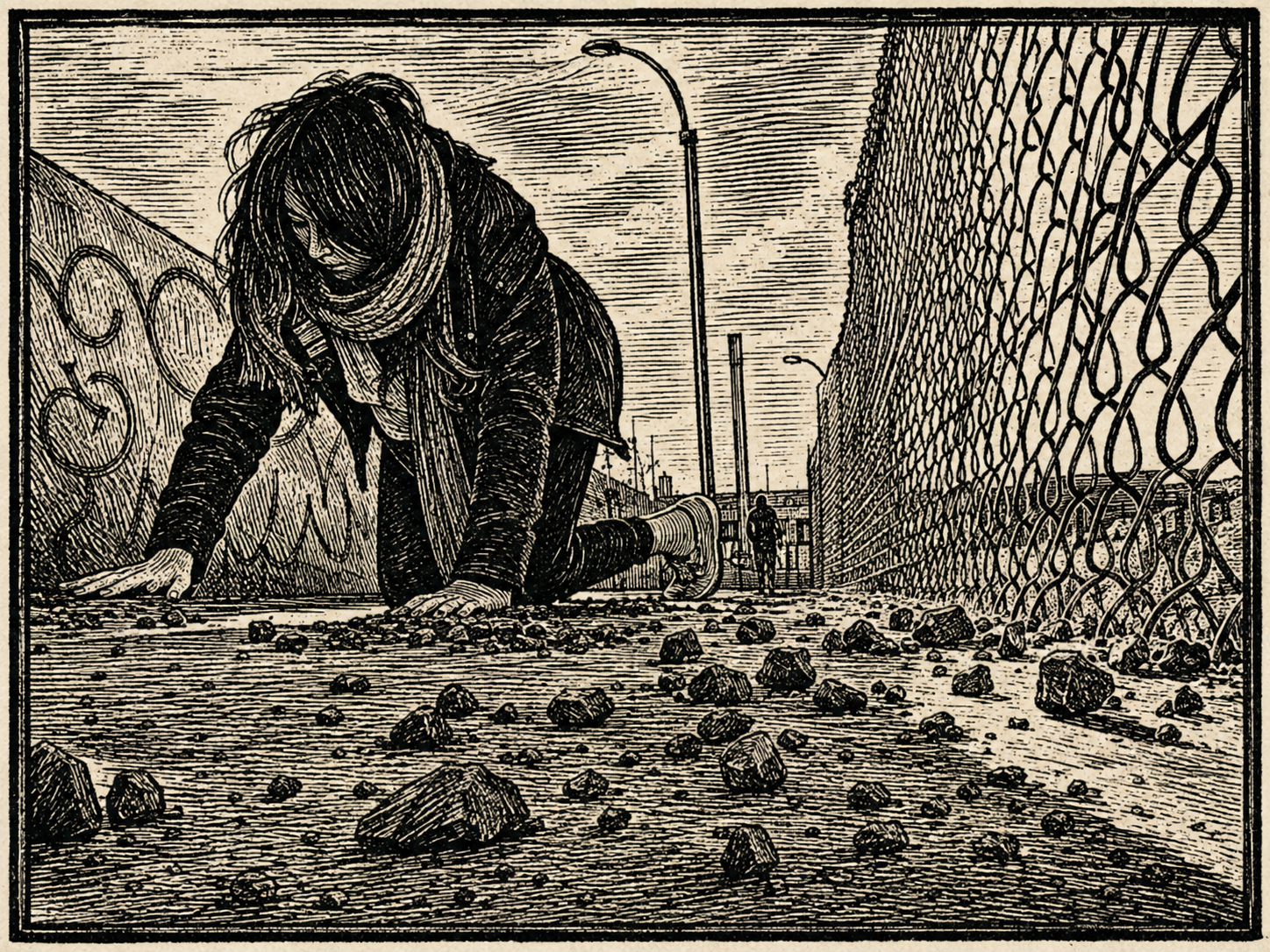
Marc Landas: A lot of your work has to do with outreach and involvement. Can you talk about the project in which you physically cleaned the bridge? Why did you do that? What did it mean, and how did people react?
Cody Herrmann: That project was really about access and agency, and about asking who is responsible for what. A lot of that series involved putting my body into situations I felt should have been addressed by city government—things that shouldn’t be my job, or any individual’s job, but that I could still physically do in that moment.
There’s a long history of maintenance art that influenced me, especially the work of Mierle Laderman Ukeles, who served as artist-in-residence at the Department of Sanitation for decades beginning in the 1970s. Cleaning the bridge was definitely, in some ways, an homage to that lineage. But again, it came back to the question: Whose job is this?
I love that piece because those rocks on the bridge could absolutely wreck your bike or cause someone to fall. A few years after I did the performance, State Senator John Liu—who rides his bike a lot—actually had a bad fall on that same bridge and hurt himself. There’s an irony there. It reinforces the question of who should be maintaining these spaces, and how the need for maintenance gets communicated.
In the areas around Flushing Bay and Creek, intentional blight has been part of the story. Waterfront lots in downtown Flushing were left vacant for decades for a reason. Willets Point was denied sewer infrastructure and road improvements for a reason. There has been so much intentional neglect over the last forty or fifty years in order to make places feel worthless, so that whatever comes next can be sold as an improvement.
The work about agency is partly about saying we can do things ourselves, and also about challenging the false dichotomy that says the only way to improve these places is to let some huge development machine take over. It asks what personal agency looks like in a place that has been systematically forgotten for a very long time.
Marc Landas: Can you say more about that intentional blight? How does that happen?
Cody Herrmann: It happens through the long game of speculative real estate, and through unequal governance. In Willets Point, you had a thriving community of auto-body workers, many from immigrant communities, and the government refused to install proper sewers or maintain the roads. These people were paying taxes. That kind of disrepair is a red flag. It fits right into the histories of redlining and urban renewal—letting communities decline while still extracting value from them.
In downtown Flushing, landowners sat on waterfront lots for decades, knowing there would eventually be a more profitable moment to assemble parcels and push for upzoning. These aren’t things everyday residents are thinking about, but landowners, politically connected developers, and elected officials are thinking across decades and generations. The plans move slowly.
You’re not withholding infrastructure in Willets Point in the 1980s by accident if you know that in 2025 you might want a soccer stadium there. It’s a long, opportunistic game.
There were even points when local businesses wanted to repair the roads themselves because the conditions were so bad, and the city wouldn’t allow them to do that either. So the city wouldn’t fix the potholes, but wouldn’t let the business owners fix them either. That’s cruel. It’s unjust. It shows how broken the system is.
In my walking tours I often point out that we are standing on public land—city land, state land. When people see dust-covered roads, sidewalks you can barely distinguish from the street, huge piles of garbage that have been there for years, I remind them that this is the result of government choices. The city is choosing this appearance, and that makes it easier to sell its future plans for the area.
And you can see how the city’s attention changes once major private investment arrives. I’ve been giving tours in Willets Point since 2019. There have been the same piles of garbage there for years. Now that a soccer stadium is being built, DSNY suddenly posts on social media about illegal dumping and cleanup in Willets Point. Where were they for the last several decades? It’s a very thin veil. Money talks, and the city follows money.
Marc Landas: What kind of access does the local community actually have to the waterways? And what does it say that government and developers have controlled that access for so long?
Cody Herrmann: People have a lot of access to Flushing Creek within Flushing Meadows–Corona Park. The problem is that they don’t recognize it as part of a larger system. You can stand at Willow Lake and think it’s lovely, without realizing that the water you’re looking at is connected all the way north to the East River and carries a whole story with it. So the access in the park is real, but it’s disconnected from the broader ecological reality.
The tidal section of Flushing Creek, which I find much more interesting, has almost no true public access. Without trespassing, or standing in the U-Haul parking lot, the only way to get to it is basically through the waterfront access strip behind Skyview Mall. That access exists because of zoning requirements that mandate publicly accessible pathways along new waterfront development.
But that’s mostly a checkbox. It doesn’t guarantee meaningful access to the water. You walk the full length of Skyview Mall to reach this narrow strip in back, and when you sit on the bench there, you can’t even really see the creek. You mostly see the side of the Van Wyck Expressway. That’s such poor design. If someone went looking for Flushing Creek and that was their first experience, they’d probably come away thinking it was disappointing and not worth caring about.
There’s also a revealing contrast with other parts of the city. In places like Williamsburg, developers like Two Trees built a park first and then built their buildings. In Flushing, the waterfront access was the afterthought. It’s right next to the loading dock. You see trucks coming and going. It’s not designed as the gem of the development, the way something like Domino Park is.
So even where access technically exists, it hasn’t played out the same way as in Williamsburg or Gowanus. Flushing Bay is somewhat different because you can walk the promenade, but it’s still hard to get to, and there aren’t real touchpoints with the water. Unless someone takes you to the public boat launch—the only place in Flushing Bay or Creek where you can touch the water without trespassing—you may not understand what’s there. You might miss the oysters, the recreation potential, the ecological value. Without interpretation, the place can still feel underwhelming.
Marc Landas: You mentioned oyster restoration. Is that happening there?
Cody Herrmann: Yes. It’s really interesting. I used to work for Billion Oyster Project, so I know a fair amount about this. The project received funding to put oysters into Flushing Bay, likely near the airport side or closer to the mouth of the bay and creek. It’s something we know is going to happen.
That’s also why I worry about the chlorination proposal for Flushing Creek. If something goes wrong, it could wipe out restoration work, including oysters. One thing that has helped create more opportunity for oyster restoration is that the section of Flushing Creek between Northern Boulevard and Roosevelt Avenue was effectively de-navigated. That means it no longer has to be dredged as an active navigation channel.
That’s important because if you stop dredging the creek bed, you create more opportunities for bottom restoration projects, which is where oysters can thrive. Oysters also happen to love filtering polluted water. In controlled tests, filter feeders like oysters and mussels can reduce bacteria levels by ten to twenty percent under certain conditions. I really do think oysters could help Flushing Bay and Creek, especially because the waters are relatively protected and there isn’t strong tidal action.
There isn’t a firm public timeline that I know of, but outreach is expected to begin soon, and there has already been sediment testing and wild oyster surveying to determine the best placement.
Marc Landas: Can you talk about the Flushing Waterways deck? It seems like such an interesting way of drawing out stories tied to the creek.
Cody Herrmann: I made that project to give people language they might not otherwise have. We don’t talk about Flushing Creek very much. We don’t casually talk about things like daylighting waterways or combined sewer overflow. Those aren’t part of everyday vocabulary for most people. The deck works as a playful glossary that helps people start telling stories and expressing what they think.
The most surprising moment for me was when we first used it at a workshop at the Queens Museum. It had been made for Guardians of Flushing Bay, and we did a big table exercise where people laid down cards and built stories and visions for the future of Flushing Bay and Creek.
What struck me was that I and the executive director of Guardians were the pessimists in the room. It was almost embarrassing. Everyone else was so optimistic. Other participants looked at the challenges and opportunities on the cards and saw hope, possibility, community, and futures they could imagine themselves participating in. Meanwhile, those of us who work with the site every day were already thinking in darker ways.
It reminded me how important it is to hear from people who don’t share the same assumptions or fatigue. The deck lets people tell stories and imagine futures without being overly shaped by my own cynicism or by the insider politics of the place. It literally puts the cards in their hands.
Marc Landas: Last question. Let’s end with an imaginative exercise. What do you picture when you think of Flushing Creek two or three hundred years ago, when it was relatively untouched? And what do you imagine it could be a hundred years from now?
Cody Herrmann: Two or three hundred years ago, Flushing Creek was still wet in a way that’s hard for us to fully grasp now. There are so many places in my neighborhood and in Willets Point where I’ll just be standing and think, this isn’t supposed to be solid ground. This was supposed to be water. This was wetland. I shouldn’t really be standing here. It should be dense reeds and wet mud.
We know that there were Native families living along the tributaries and hillsides near places like Horse Brook, Kissena Creek, and Mill Creek. It was a relatively small community, and the Dutch were drawn to it because it reminded them of the canals, valleys, and hillsides they knew back home. So we know something about what it was and why it attracted human settlement.
A hundred years from now, I hope we begin working our way back toward that relationship with water. I talk a lot about combined sewer overflow, but the same storms that create sewage overflows are also flooding people’s basements upland. Our waterways and our sewer infrastructure are now inseparable because of how we built the city.
So I hope that in a century we will have rethought that infrastructure. I hope we will have daylighted not just parts of Flushing Creek in the park, but tributaries like Kissena Creek again as well. That could save lives. During Hurricane Ida, people died in basement floods near places shaped by buried waterways and overwhelmed sewer lines. If we could restore some of those systems to wetlands, if we could reconnect to what the land used to be, we would reduce flooding and create healthier urban ecosystems.
My work started by focusing on Flushing Creek as a specific place and a quality-of-life issue. But once you realize how much water shapes everything around our communities—not just the coast, but inland neighborhoods too—it becomes mind-blowing. A hundred years from now, I hope nature is everywhere. I hope we are not forcing all water into tunnels. I hope it is allowed to flow more freely, because that would be better not only for us, but for the entire urban ecosystem.
Hopefully we give the water a little more space.
Leave a Reply