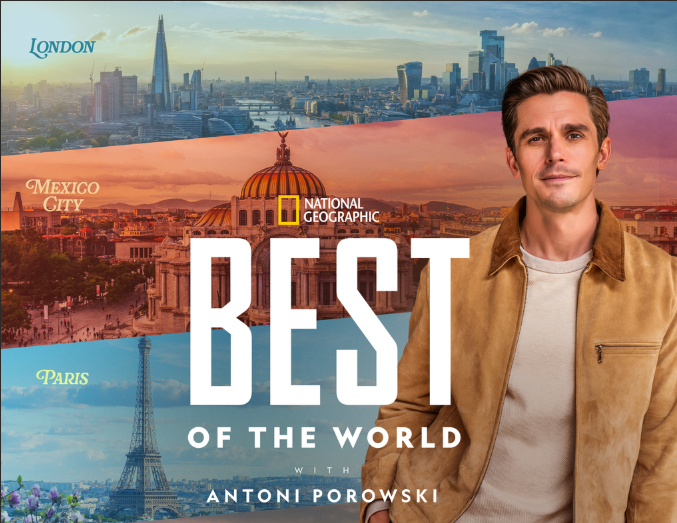
Travel television often faces a difficult challenge: how do you make viewers see familiar places with fresh eyes? In Best in the World with Antoni Porowski, executive producer Nic Patten and his team sought to do exactly that. Rather than treating London, New York, Paris, and Mexico City as collections of landmarks and bucket-list attractions, the series explores them through the people, traditions, and evolving cultural identities that give each city its character. Guided by Porowski’s curiosity and talent for conversation, the show looks beyond postcard imagery to uncover stories of immigration, reinvention, heritage, and community. In this conversation, Patten discusses the creative philosophy behind the series, the challenge of reimagining some of the world’s most filmed destinations, and why the most revealing way to understand a city is often through the people who call it home.
I really enjoyed Best in the World with Antoni Porowski. The London segment was fantastic. What was the original creative vision behind the series, and how did you want it to differ from other travel shows?
Best of the World was already an established National Geographic brand, so the challenge was figuring out how to turn it into a fresh travel series in a very crowded genre.
What made the difference was Antoni. He became our route to finding the voice of the show. We wanted to celebrate extraordinary places, but we also wanted viewers to experience them through Antoni’s perspective and personality.
The series combines iconic landmarks with lesser-known discoveries. We wanted it to feel eclectic and surprising rather than like a checklist of destinations. Just as importantly, Antoni is an incredibly natural people person. One of his greatest strengths is the way he connects with others, so we built the series around those interactions.
For Antoni, cities are best understood through the people who live there. They embody the spirit of a place as much as its landmarks do. That became central to the series and helped distinguish it from more conventional travel programs.
At the same time, we wanted to deliver everything audiences expect from National Geographic—beautiful visuals, rich storytelling, and a sense of wonder—while ensuring the show remained driven by Antoni’s own sensibilities.
These are all destinations that have been covered extensively. Was it difficult to find a fresh visual and storytelling approach?
Absolutely. These are some of the world’s most visited cities. Our production team is largely based in London, so we felt that challenge particularly strongly there. How do you tell the story of a city you walk through every day in a way that feels new?
The answer was to move beyond the postcard version of these places. We wanted locals to recognize their city in what we were showing. We wanted them to feel we were getting beneath the surface rather than simply hitting the standard tourist attractions.
That’s why, in London, we began in Brick Lane rather than somewhere more obvious. Most visitors wouldn’t start there, but it speaks to a broader story about London itself. Once we committed to telling stories through local experiences and perspectives, the cities began to reveal themselves in more unexpected ways.

I loved the way you approached the Sunday roast through an immigrant perspective. It gave a familiar tradition a completely different context. How did you go about selecting destinations, stories, and contributors?
It was a collaborative process. We had our production team, local researchers and crews in each city, National Geographic, and Antoni himself all contributing ideas.
The first step was always identifying the story we wanted to tell about a city. Once we understood that, we could begin finding experiences and contributors that reflected it.
In New York, for example, immigration emerged as a central theme because it is so fundamental to the city’s identity. That guided both the locations we visited and the people we spoke with.
Antoni was heavily involved throughout the process. We had regular meetings with him during development, production, and post-production. We wanted the series to feel authentically his, so he was involved in shaping virtually every creative decision.
That authenticity was important to us. The goal was never simply to show viewers a city; it was to show them Antoni’s experience of that city.
One thing I noticed is that many of the food stories involve chefs taking traditional dishes and reinventing them. It almost feels like a recurring theme across the series. Was that intentional?
It’s an interesting observation. It wasn’t something we consciously set out to do, but it emerged naturally from the stories we were drawn to.
Take the Japanese-Polish restaurant in New York. What attracted us wasn’t simply the food itself but the story behind it. The chef shared a Polish heritage with Antoni, and the restaurant reflected larger themes of migration, identity, and cultural exchange.
In Paris, we featured FIEF, a restaurant that challenges traditional expectations of French fine dining. The chef uses exclusively French ingredients but approaches them in a contemporary way. That story resonated because it reflected a broader theme we encountered throughout the city: pride in French heritage coupled with a willingness to reinterpret it.
Even when we featured more traditional foods—Brick Lane bagels in London or tacos in Mexico City—we were always interested in the deeper story. With the tacos, for example, the focus wasn’t simply on the filling but on the tortillas themselves and what they revealed about Mexico City’s history and culture.
Every location had to offer more than great visuals. It had to tell a story.
Looking back, you’re right that many of these stories involved a conversation between tradition and innovation. But that’s also the story of cities themselves. Cities are constantly reinventing themselves while remaining connected to their past. Restaurants happen to be one of the most visible places where that process unfolds.



Leave a Reply