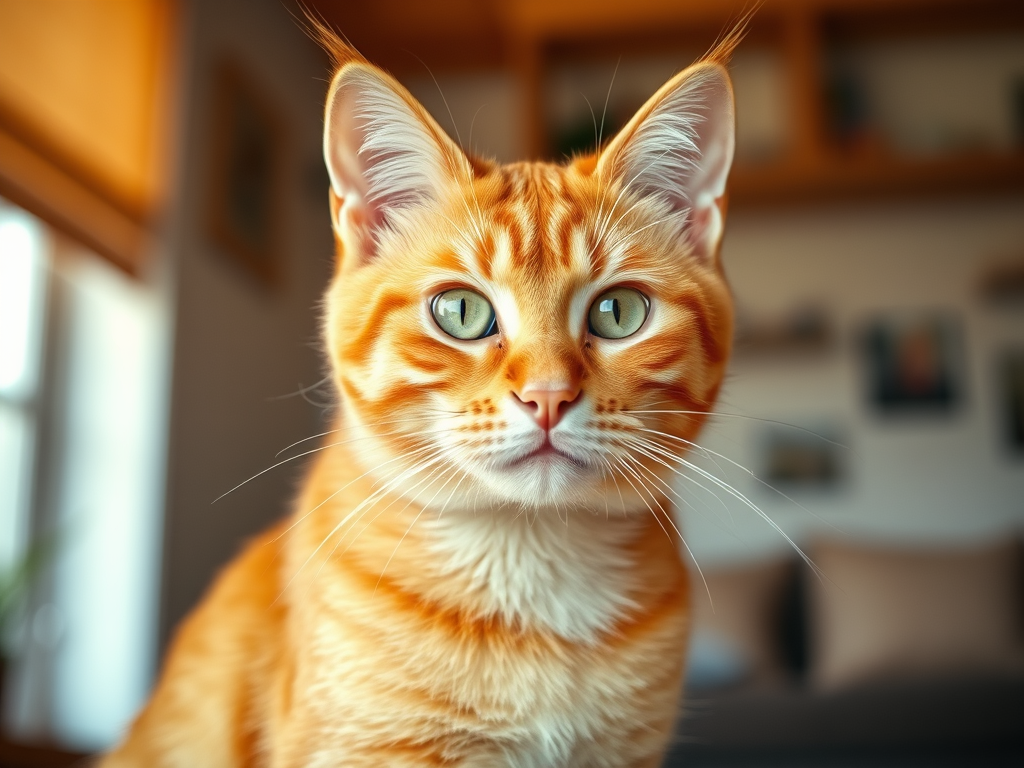
Many an orange cat-affiliated human will vouch for their cat’s, let’s say, specialness. But now scientists have confirmed that there is, in fact, something unique about ginger-hued domestic felines. In a new study, Stanford Medicine researchers have discovered the long-posited but elusive genetic mutation that makes orange cats orange — and it appears to occur in no other mammal.
The finding adds to our understanding of how subtle genetic changes give rise to new traits, the researchers said.
Lots of mammals come in shades of orange — think tigers, golden retrievers, orangutans and red-headed humans — but only in domestic cats is orange coloration linked to sex, appearing much more often in males.
“In a number of species that have yellow or orange pigment, those mutations almost exclusively occur in one of two genes, and neither of those genes are sex-linked,” said Christopher Kaelin, PhD, a senior scientist in genetics and lead author of the study to be published online May 15 in Current Biology.
Greg Barsh, MD, PhD, emeritus professor of genetics and of pediatrics, is the study’s senior author.
While scientists have pinpointed the typical mutations that induce pigment cells in the skin to produce yellow or orange pigment instead of the default brown or black, they had only a rough idea of where to find the corresponding mutation in cats.
Sign up for the Daily Dose Newsletter and get every morning’s best science news from around the web delivered straight to your inbox? It’s easy like Sunday morning.
They knew from the preponderance of male orange cats that the mutation — dubbed sex-linked orange — was somewhere on the X chromosome. (As in most mammals, females have XX while males have XY sex chromosomes.) Any male cat with sex-linked orange will be entirely orange, but a female cat needs to inherit sex-linked orange on both X chromosomes to be entirely orange — a less likely occurrence.
Female cats with one copy of sex-linked orange appear partially orange — with a mottled pattern known as tortoiseshell, or with patches of orange, black and white known as calico. That’s due to a genetic phenomenon in females, called random X inactivation, in which one X chromosome is inactivated in each cell. The result is a mosaic of pigment cells, some that express sex-linked orange and others that do not.
A genetic puzzle
Scientists have taken advantage of the wide variety of cat colors and patterns to study genetics since the turn of the 20th century, yet the molecular identity of the peculiar orange mutation remained hazy.
“It’s a genetic exception that was noticed over a hundred years ago,” Kaelin said. “It’s really that comparative genetic puzzle that motivated our interest in sex-linked orange.”
Building on a prior study that had begun to narrow down the region of the X chromosome containing the mutation, Kaelin and his colleagues zeroed in on sex-linked orange using a step-by-step process.
“Our ability to do this has been enabled by the development of genomic resources for the cat that have become available in just the last 5 or 10 years,” he said. That includes the complete sequenced genomes of a wide assortment of cats. The researchers also collected DNA samples from cats at spay and neuter clinics.
First, they looked for variants on the X chromosome shared by male orange cats and found 51 candidates. They eliminated 48 of these, as they were also found in some non-orange cats. Of the three remaining variants, one stood out as likely having a role in gene regulation: It was a small deletion that increased the activity of a nearby gene known as Arhgap36.
Unusual expression
“At the time we found it, the Arhgap36 gene had no connection to pigmentation,” Kaelin said.
The gene, which is highly conserved in mammalian species, was being studied by researchers in cancer and developmental biology. Arhgap36 is normally expressed in neuroendocrine tissues, where overexpression can lead to tumors. It was not known to do anything in pigment cells.
Except, Kaelin and colleagues discovered, in pumpkin-colored cats.
“Arghap36 is not expressed in mouse pigment cells, in human pigment cells or in cat pigment cells from non-orange cats,” Kaelin said. “The mutation in orange cats seems to turn on Arghap36 expression in a cell type, the pigment cell, where it’s not normally expressed.”
This rogue expression in pigment cells inhibits an intermediate step of a well-known molecular pathway that controls coat color — the same one that operates in other orange-shaded mammals. In those species, typical orange mutations disrupt an earlier step in that pathway; in cats, sex-linked orange disrupts a later step.
“Certainly, this is a very unusual mechanism where you get misexpression of a gene in a specific cell type,” Kaelin said.
Molecular evolution
These efforts to learn how domestic cats acquired different colors and patterns are an entry point to understanding the emergence of other physical traits, from cheetah spots to the streamlined bodies of dolphins. Sex-linked orange is a novel example of how evolution happens on the molecular scale.
“We think it’s an example of how genes acquire new functions that allow for adaptation,” said Kaelin, who has also studied colors and patterns in dogs, cheetahs, tigers, bears, zebras and hamsters.
In the case of orange cats, the “adaptation” could simply be to our whims. Centuries ago, the rare orange, calico or tortoiseshell cat may have caught the attention of humans, who encouraged their proliferation. Orange cats are now widely distributed throughout the world.
“This is something that arose in the domestic cat, probably early on in the domestication process,” Kaelin said. “We know that because there are paintings that date to the 12th century where you see clear images of calico cats. So, the mutation is quite old.”
Only skin deep
Besides a marmalade coat, could sex-linked orange be responsible for other qualities in orange cats? “The expectation, based on our observations, is this is highly specific to pigment cells,” Kaelin said.
To verify, the researchers also measured Arhgap36 expression in several non-skin tissues — the kidney, heart, brain and adrenal gland — and found no differences between orange and non-orange cats.
“I don’t think we can exclude the possibility that there is altered expression of the gene in some tissue we haven’t tested that might affect behavior,” Kaelin conceded. But he thinks orange cats’ reputation as friendly agents of chaos is more likely due to most of them being male.
“There are not many scientific studies of the personality of orange cats,” he added.



Leave a Reply