An international team of researchers may have answered one of space science’s long-running questions – and it could change our understanding of how life began.
Carbon-rich asteroids are abundant in space yet make up less than 5 per cent of meteorites found on Earth.
An international team of scientists from Curtin University’s School of Earth and Planetary Sciences, the International Centre for Radio Astronomy (ICRAR), the Paris Observatory and more scoured the globe to find an answer.
Published today in Nature Astronomy, researchers analysed close to 8500 meteoroids and meteorite impacts, using data from 19 fireball observation networks across 39 countries — making it the most comprehensive study of its kind.
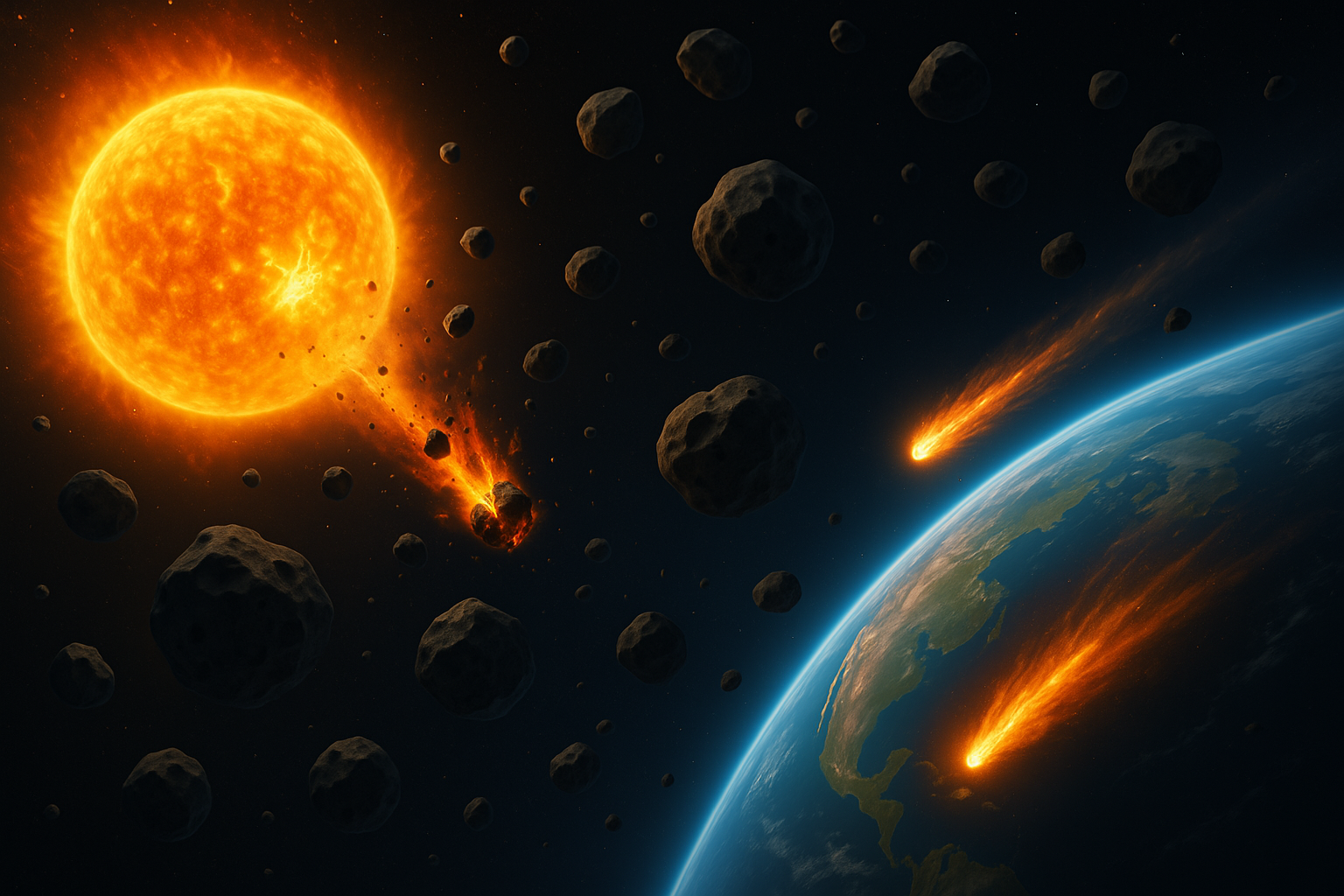
Co-author Dr Hadrien Devillepoix from Curtin’s Space Science and Technology Centre and Curtin Institute of Radio Astronomy (CIRA) said the team discovered Earth’s atmosphere and the Sun act like giant filters, destroying fragile, carbon-rich (carbonaceous) meteoroids before they reach the groqund.
“We’ve long suspected weak, carbonaceous material doesn’t survive atmospheric entry,” Dr Devillepoix said.
Sign up for the Daily Dose Newsletter and get every morning’s best science news from around the web delivered straight to your inbox? It’s easy like Sunday morning.
“What this research shows is many of these meteoroids don’t even make it that far: they break apart from being heated repeatedly as they pass close to the Sun.
“The ones that do survive getting cooked in space are more likely to also make it through Earth’s atmosphere.”
Carbonaceous meteorites are particularly important because they contain water and organic molecules — key ingredients linked to the origin of life on Earth.
Paris Observatory’s Dr Patrick Shober said the findings reshape how scientists interpret meteorites collected so far.
“Carbon-rich meteorites are some of the most chemically primitive materials we can study — they contain water, organic molecules and even amino acids,” Dr Shober said.
“However, we have so few of them in our meteorite collections that we risk having an incomplete picture of what’s actually out there in space and how the building blocks of life arrived on Earth.
“Understanding what gets filtered out and why is key to reconstructing our solar system’s history and the conditions that made life possible.”
The study also found meteoroids created by tidal disruptions — when asteroids break apart from close encounters with planets — are especially fragile and almost never survive atmospheric entry.
“This finding could influence future asteroid missions, impact hazard assessments and even theories on how Earth got its water and organic compounds to allow life to begin,” Dr Shober said.
Other institutions involved in the study were the Astronomical Institute of the Romanian Academy, National Museum of National History and Aix-Marseilles University.



Leave a Reply