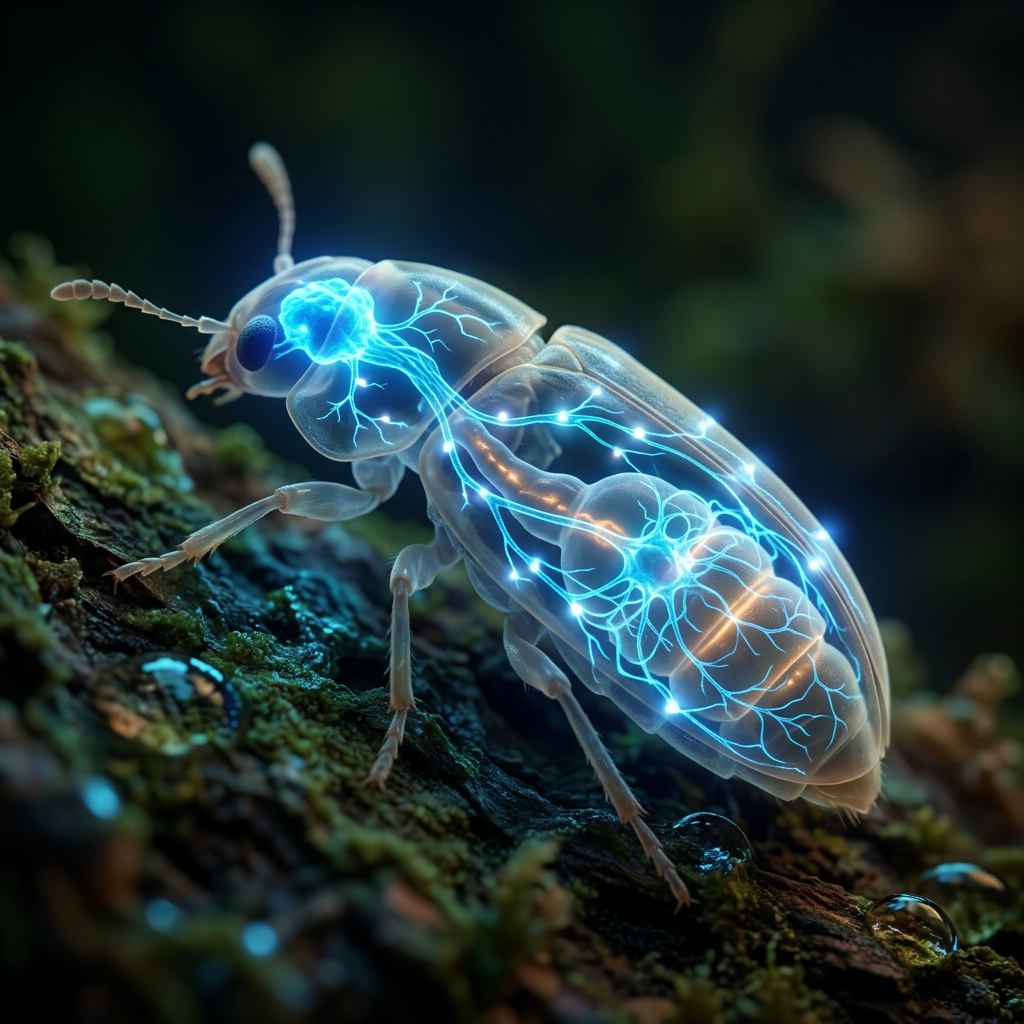
In the first hours after hatching, a fruit fly faces two urgent tasks: expel the metabolic waste accumulated during its pupal development, and start eating. Get the sequence wrong, and the consequences are lethal. Now, researchers at the University of Basel have shown exactly why that sequence matters — and in doing so, they have resolved a biological puzzle that has lingered unsolved for more than a century.
The study, published in Science Advances, traces the premature death of flies carrying a defective apterous (ap) gene to a structural blockage in the hindgut. That blockage, which the authors have named the Reinger’s knot after first author Cindy Reinger, prevents the flies from expelling their meconium — the dark, viscous developmental waste analogous to the substance newborn mammals must clear in the hours after birth. Without clearing it, the flies cannot eat. And rather than foraging hungrily, they retreat into an unusual and prolonged sleep state, moving their mouthparts rhythmically while immobile, until they die within three days.
“We have now identified the cause of early death and resolved a question that has puzzled researchers for more than a century. The gene defect not only affects wing development but also proper hindgut development, leading to intestinal blockage,” said Prof. Anissa Kempf, University of Basel.
The apterous gene has been a fixture of Drosophila genetics since 1914, when Charles Metz first described flies that lacked wings and halteres and died young. For decades, research focused almost entirely on the gene’s role in wing compartmentalization, where it separates dorsal and ventral cell populations during development. The early-death phenotype was noted but never explained.
The Basel team found that the culprit is a cis-regulatory element they call the life-span enhancer (LSE), embedded in the noncoding region of the ap locus. When the LSE is deleted — leaving the gene’s protein-coding sequence intact — flies develop normally in most respects but die within three days, a mortality curve that closely mimics starvation in wild-type flies. Restoring a single copy of the LSE fully rescues survival.
A Knot in the Plumbing
The mechanism turned out to lie in the hindgut. In healthy flies, four cone-shaped rectal papillae develop during early metamorphosis inside the rectal ampulla — the terminal structure of the intestine. These papillae are not decorative; they function analogously to mammalian kidneys, actively reabsorbing water and ions from waste material before excretion.¹ In mutant flies lacking the LSE, the papilla precursor cells fail to separate and properly differentiate. Instead, they cluster into a plug-like mass at the posterior end of the ampulla — the Reinger’s knot — completely occluding the hindgut.
Micro-computed tomography scans of developing pupae showed the divergence taking shape as early as 30 hours after pupa formation, when control flies begin assembling four distinct papillae while mutant pupae retain a central obstructing mass. By 46 hours, the blockage is complete.

The consequences cascade quickly after hatching. Control flies begin excreting their greenish meconium within the first hour of adult life and initiate feeding around three hours post-eclosion, once partial clearance has occurred. Mutant flies excrete nothing. Their midguts remain packed with retained developmental waste, leaving no room — physically or physiologically — for food to pass beyond the crop into the midgut.
“We think that the flies sleep more in order to conserve energy and thus survive longer. While sleeping, flies also move their proboscis rhythmically, which may help stimulate gut motility. Perhaps this is a desperate attempt to get rid of the meconium,” said Reinger.
A Distinct Deep Sleep State
The sleep the researchers observed is not ordinary rest. The mutant flies predominantly enter proboscis extension sleep (PES), a deep sleep state previously characterized in Drosophila in which flies extend their mouthparts rhythmically while immobile.² More than 80 percent of proboscis extension events in mutant flies occurred during sleep, compared to roughly 90 percent directed at food in healthy controls.
Notably, acute starvation alone does not produce this shift. When the team deprived newly hatched control flies of food immediately after eclosion, those flies remained active and did not drift into PES. The distinction matters: the mutant flies are not simply hungry and giving up. They are responding to something specific about gut blockage — something that overrides the normal behavioral response to energy deficit, which in Drosophila typically involves hyperactivity thought to facilitate food-seeking.³
Insulin-like peptide 2 (Ilp2) accumulation in insulin-producing cells — a standard readout of nutrient availability in the fly — was elevated in mutant flies to levels matching those of starved controls, confirming that the flies are metabolically depleted. Yet they do not seek food. The gut signal appears to suppress feeding-approach behavior while promoting rest.
Plugging and Unplugging: Experimental Controls
To confirm that the hindgut blockage — not some other consequence of the gene deletion — was driving the behavioral phenotypes, the team deployed two complementary approaches.
First, they used the brachyenteron-Gal4 driver to express a repressor isoform of cubitus interruptus in the hindgut, a manipulation that prevents rectal papillae formation entirely. Expressing this construct in ap mutant flies eliminated the Reinger’s knot, restored normal midgut morphology, rescued feeding behavior and survival, and abolished the PES phenotype — despite the flies having no rectal papillae at all. The knot was the problem, not the absence of normal papillae per se.
Second, they glued the anuses of freshly hatched wild-type flies shut with a drop of superglue. The result was a near-perfect recapitulation of the mutant phenotype: roughly 80 percent of anus-sealed flies died within three days, feeding was suppressed, and time spent in PES increased significantly. Sham-glued controls showed no such effects. The experiment established that physical intestinal obstruction, not genetic background, is sufficient to reproduce the full syndrome.
An Insect Model for Ileus?
The clinical resonance of these findings is not lost on the authors. In human medicine, a mechanical ileus — intestinal obstruction — presents with a recognizable constellation of symptoms: constipation, loss of appetite, lethargy, abdominal distension, and, if untreated, intestinal rupture and death.⁴ The mutant flies display a strikingly parallel progression: meconium retention, feeding suppression, lethargy, midgut bloating, and eventual tissue decay by day two.
The parallels extend across animal taxa. In horses, meconium retention in neonates is associated with reduced nursing interest. Myliobatiform stingrays clear their meconium before initiating feeding. Human infants with meconium plug syndrome show feeding difficulties.⁵ The Drosophila work suggests these observations may reflect an evolutionarily conserved principle: gut clearance and feeding initiation are not merely sequential events but actively coupled.
According to a University of Basel press release, “Many of the symptoms seen in fruit flies resemble intestinal obstruction in humans, including constipation, loss of appetite, lethargy, swelling of the gut, and tissue damage that can lead to intestinal rupture.”
Drosophila and vertebrates share the foundational architecture of digestive physiology more deeply than their phylogenetic distance might suggest. Studies over the past decade have used the fly gut to illuminate stem cell dynamics, hormonal regulation of feeding, and the mechanics of gut-brain signaling through enteric neurons — work by several authors on the current paper, including Irene Miguel-Aliaga’s group, has been central to that effort.⁶
Open Questions and a Gut-Brain Frontier
The study is candid about what it cannot yet answer. The authors acknowledge they cannot disentangle whether the behavioral phenotypes arise specifically from meconium retention or from the broader physiological consequences of intestinal blockage — accumulation of waste products, mechanical tension, metabolic imbalance, and systemic stress. The anus-gluing experiment, which induces complete obstruction rather than selective meconium retention, cannot resolve this distinction.
More pressing is the question of mechanism. How does a blocked gut suppress feeding-approach behavior and induce deep sleep? The intestine is known to communicate with the brain through multiple channels in both vertebrates and invertebrates — hormonal, neural, and metabolic — and the Drosophila enteric nervous system is increasingly tractable for circuit-level analysis.⁷ Identifying which signals travel from the obstructed hindgut to feeding and sleep circuits in the brain is the obvious next step.
The finding that proboscis extension sleep involves rhythmic mouthpart movements that might stimulate gut motility also raises an intriguing possibility: that the sleep state is not purely energy conservation but an active, if likely futile, attempt at intestinal clearance. Whether PES in other contexts serves analogous functions in waste management — a 2021 study suggested it may be involved in glymphatic-like waste clearance in the Drosophila brain² — is now an open and productive question.
What is no longer open is the cause of death in apterous mutants. A mystery that entered the literature in 1914, when Metz described wingless flies dying young on normal food, has finally been laid to rest in a rectal knot.
ENDNOTES
1. Cohen, E., Sawyer, J.K., Peterson, N.G., Dow, J.A.T., Fox, D.T. (2020). “Physiology, development, and disease modeling in the Drosophila excretory system.” Genetics, 214(2), 235–264.
2. van Alphen, B., Semenza, E.R., Yap, M., van Swinderen, B., Allada, R. (2021). “A deep sleep stage in Drosophila with a functional role in waste clearance.” Science Advances, 7(4), eabc2999.
3. Rion, S., Kawecki, T.J. (2007). “Evolutionary biology of starvation resistance: What we have learned from Drosophila.” Journal of Evolutionary Biology, 20(5), 1655–1664.
4. Plusczyk, T., Bolli, M., Schilling, M. (2006). “Ileus disease.” Chirurg, 77(10), 898–903. Also: Wang, Y., et al. (2024). “Mortality risk of patients with intestinal obstruction.” BMC Cancer, 24, 1062.
5. Tomita, T., Nakamura, M., Kobayashi, Y., Yoshinaka, A., Murakumo, K. (2020). “Viviparous stingrays avoid contamination of the embryonic environment through faecal accumulation mechanisms.” Scientific Reports, 10, 7378. Also: Messina, M., Angotti, R., Molinaro, F. (2016). In Neonatology: A Practical Approach to Neonatal Diseases. Springer.
6. Hadjieconomou, D., et al. (2020). “Enteric neurons increase maternal food intake during reproduction.” Nature, 587, 455–459. Also: Miguel-Aliaga, I., Jasper, H., Lemaitre, B. (2018). “Anatomy and physiology of the digestive tract of Drosophila melanogaster.” Genetics, 210(2), 357–396.
7. Miroschnikow, A., Schlegel, P., Pankratz, M.J. (2020). “Making feeding decisions in the Drosophila nervous system.” Current Biology, 30(15), R831–R840.
8. Primary source: Reinger, C., et al. (2026). “Intestinal obstruction impairs feeding and promotes sleep in Drosophila melanogaster.” Science Advances, 12, eady2183. DOI: 10.1126/sciadv.ady2183. Press release: University of Basel / EurekAlert!, June 11, 2026.




Leave a Reply