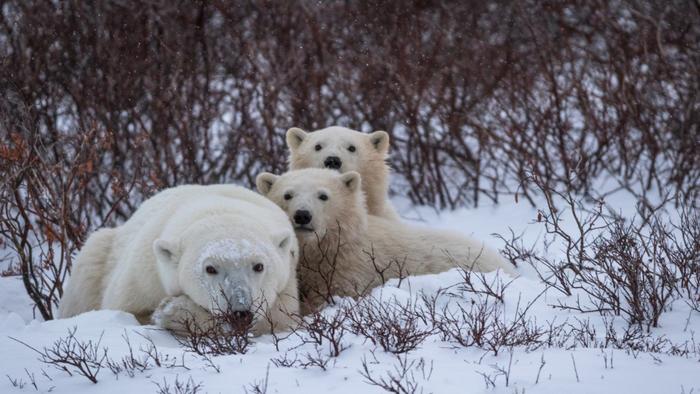
For the first time, researchers have combined satellite collar data with specialized cameras to shed light on one of the most mysterious and important stages in polar bears’ lives – maternal denning, when bears give birth then emerge with their cubs.
Past research has shown that how long polar bear mothers remain at their dens impacts cubs’ odds of survival. Yet why they stick around for so long and what they’re doing remains poorly understood, and the tracking devices researchers are increasingly using hadn’t been tested against real-life observations of the bears — until now.
“The Arctic’s warming two to four times faster than the rest of the world, humans are expanding into areas that might be important for polar bear denning, and we know they’re sensitive to disturbance during this time,” says Louise Archer, lead author of the study and U of T Scarborough postdoc.
“We need healthy cubs to sustain populations. We’re trying to develop tools to better monitor and understand their behavior, so we can better protect them.”
Denning begins with pregnant polar bears sealing themselves inside dens dug out under the snow, where they give birth. Polar bears are born about as pathetic as humans, and the den protects them from the frigid weather as they grow 20 times their size in just a few months of nursing. Though the mother loses about half her body weight, after breaking out of the snow she doesn’t immediately return to hunting. She and the cubs hang around the den for a few weeks, popping in and out and doing something presumably more important than eating.
Historically, researchers studied denning with binoculars, then remote cameras, and they’re now primarily using satellite collars that can track location, activity, and ambient temperature. All these methods have their limitations, and the study notes that while collars are gaining prominence because they can monitor the movements of polar bears over several years, most collars only gather data every few hours, and they’re not ideal for observing more minute behaviours or short trips outside the den.
Sign up for the Daily Dose Newsletter and get every morning’s best science news from around the web delivered straight to your inbox? It’s easy like Sunday morning.
In a new study, Archer and her colleagues studied bears over six years. Using satellite collars on 13 members of the Barents Sea subpopulation of polar bears, the researchers located and installed cameras outside nine dens in Svalbard, Norway. They found estimates of when polar bears had hit key stages in denning sometimes differed by several days to over a week, depending on whether they looked solely at data from the collars or the cameras.
Each time they gathered collar data, they matched it with the exact image on the camera to confirm what the bears were doing. They then made three statistical models, which other researchers can plug collar data into to accurately predict not just what the bears are doing, but what they will likely do. The models can predict when they’ll first break out, the times they’ll emerge from the den, and when they’ll finally leave. One model can also predict how external factors like temperature influence the behaviour of moms and cubs.
“Collars do a good job at picking out these broader behaviours, like when the bears first come out of the den and when they depart. We found they corresponded pretty well to what we were seeing on camera,” Archer says. “But it was difficult to tease out the finer scale behaviours we saw on camera.”
Bears emerged from their dens almost always in the daytime, on trips that averaged about 27 minutes (ranging from less than a minute to almost eight hours). About half the time mothers had their cubs in tow, most often staying within 40 metres of the den. Bears were more likely to be seen outside the den with each degree the temperature warmed, and with each day that passed since they’d first broken out. Warmer temperatures meant they were more likely to be seen outside the den and they stayed outside longer the higher the temperature and longer since they’d first broken out.
Their data suggests these weeks around the den are mainly for cubs to acclimatize to the outside world, and supports other research that found a faster departure after their breakout means cubs likely didn’t spend enough time outside the den and are less likely to survive.
“The Arctic is a really fast-changing area. We’ve got a lot of sea ice being lost, so seeing what polar bears are doing and how they’re responding to these changes gives us an insight into what we might expect in other parts of the Arctic down the line,” says Archer, who recently completed a study linking a decline in polar bear populations to shrinking sea ice caused by climate change.
“That’s why we’re so invested in trying to build out this data set and continue monitoring bears in this region.”
IMAGE CREDIT: Dmytro Cherkasov, Polar Bears International.



Leave a Reply