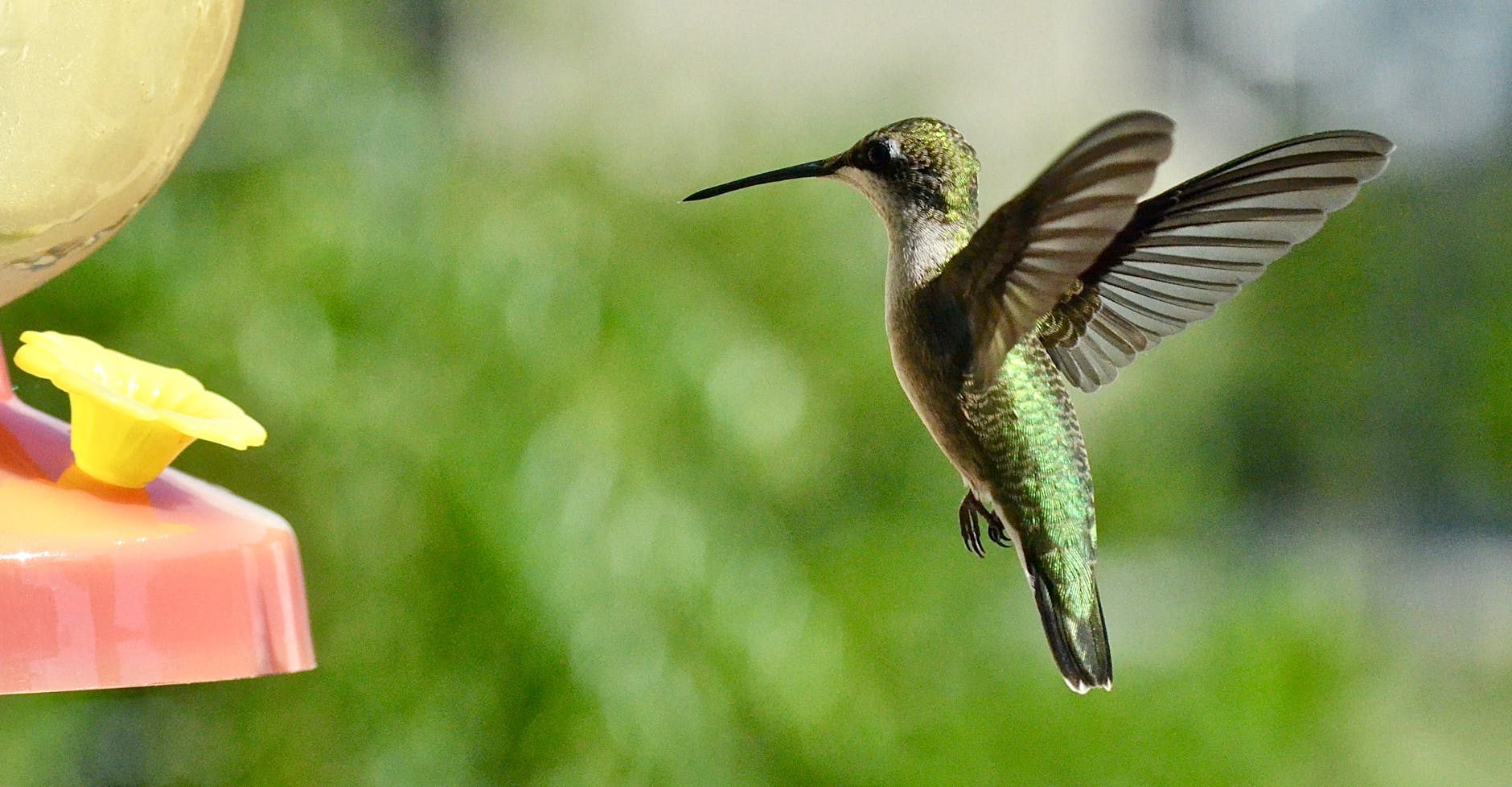
Hummingbird bills — their long, thin beaks — look a little like drinking straws. The frenetic speed at which they get nectar out of flowers and backyard feeders may give the impression that the bills act as straws, too. But new research shows just how little water, or nectar, that comparison holds.
In a paper published online by the Proceedings of the Royal Society Interface, an international team led by Alejandro Rico-Guevara, an assistant professor of biology at the University of Washington, reveals the surprising flexibility of the hummingbird bill. The team discovered that a drinking hummingbird rapidly opens and shuts different parts of its bill simultaneously, engaging in an intricate and highly coordinated dance with its tongue to draw up nectar at lightning speeds.
To human eyes, these movements are barely perceptible. But for hummingbirds, they’re a lifeline.
“Most hummingbirds drink while they’re hovering mid-flight,” said Rico-Guevara, who is also curator of ornithology at the UW’s Burke Museum of Natural History and Culture. “Energetically, that is very expensive. Flying straight at commuting speeds uses up less energy than hovering to drink. So, hummingbirds are trying to minimize energy and drink as fast as they can — all from these hard-to-reach spaces — which requires special adaptations for speed and efficiency.”
Previous research showed that hummingbirds extend their tongues in rapid-fire movements when drinking nectar. But scientists did not know what role the bill itself played in feeding. The team collected high-speed video footage of individual hummingbirds from six different species drinking at transparent feeders at field sites in Colombia, Ecuador and the U.S. By analyzing the footage and combining it with data from micro-CT scans of hummingbird specimens at the Yale Peabody Museum, researchers discovered the intricate bill movements that underlie drinking:
- To extend its tongue, the hummingbird opens just the tip of its bill
- After the tongue brings in nectar, the bill tip closes
- To draw nectar up the bill, the hummingbird keeps the bill’s midsection shut tightly, while opening the base slightly
- Then, it opens its tip again to extend the tongue for a new cycle, a process many hummingbird species can do 10-15 times a second
- Hummingbirds have intricately shaped tongues, some resembling origami-like patterns for unfolding and collecting nectar.
This new research shows just how important the bill is for drinking and that, despite its rigid outward appearance, it is remarkably flexible.
Sign up for the Daily Dose Newsletter and get every morning’s best science news from around the web delivered straight to your inbox? It’s easy like Sunday morning.
“We already knew that hummingbird bills have some flexibility, for example bending their lower bill while catching insects,” said Rico-Guevara. “But now we know that the bill plays this very active and essential role in drawing up nectar that the tongue collects.”
The bill’s role also makes hummingbirds unique among animals by relying on two types of fluid collection and transport methods: the lapping mechanism — formally known as Couette flow — which animals like dogs and cats use to drink, and Poiseuille flow, a suction-driven mechanism used, for example, by mosquitoes drinking blood or by humans drinking through a straw. Often, animals employ one approach or the other. Hummingbirds are a rare example of using both.
“It makes sense that they would have to use both, given the pressure to reach the nectar deep within the flower and to feed quickly and efficiently,” said Rico-Guevara.
Future research could try to find the muscles that control these movements, and investigate how other uses for the bill — such as catching insects — impact its flexibility.
“As plants evolved flowers of different lengths and shapes, hummingbird bills have evolved accordingly,” said Rico-Guevara. “Every time we answer one set of questions about hummingbird adaptation, new ones arise. There’s so much more to learn.”
IMAGE CREDIT: NASA.



Leave a Reply