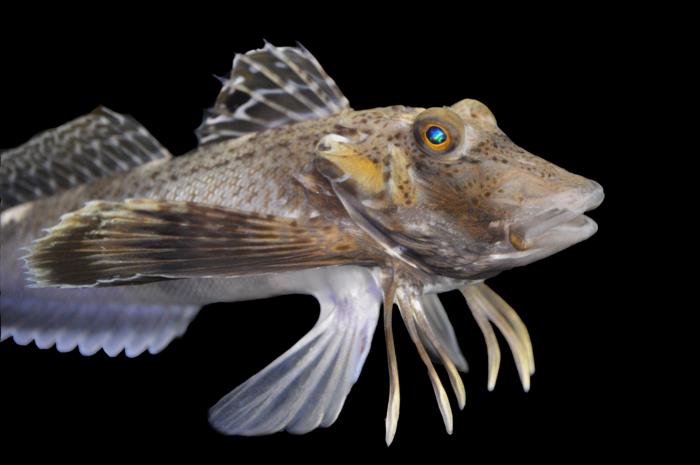
Sea robins are ocean fish particularly suited to their bottom-dwelling lifestyle: Six leg-like appendages make them so adept at scurrying, digging, and finding prey that other fish tend to hang out with them and pilfer their spoils.
A chance encounter in 2019 with these strange, legged fish at Cape Cod’s Marine Biological Laboratory was enough to inspire Corey Allard to want to study them.
“We saw they had some sea robins in a tank, and they showed them to us, because they know we like weird animals,” said Allard, a postdoctoral fellow in the lab of Nicholas Bellono, professor in the Department of Molecular and Cellular Biology. The Bellono lab investigates sensory biology and cellular physiology of many marine animals, including octopuses, jellyfish, and sea slugs.
“Sea robins are an example of a species with a very unusual, very novel trait,” Allard continued. “We wanted to use them as a model to ask, ‘How do you make a new organ?’”
Allard’s ensuing deep dive into sea robin biology led to a collaboration with Stanford researchers studying the fish’s developmental genetics and culminated in back-to-back papers in Current Biology, co-authored by Bellono and Amy Herbert and David Kingsley at Stanford University, and others. The studies provide the most comprehensive understanding to date on how sea robins use their legs, what genes control the emergence of those legs, and how these animals could be used as a conceptual framework for evolutionary adaptations.
Sea robin “legs” are actually extensions of their pectoral fins, of which they have three on each side. Allard first sought to determine whether the legs are bona fide sensory organs, which scientists had suspected but never confirmed. He ran experiments observing captive sea robins hunting prey, in which they alternate between short bouts of swimming and “walking.” They also occasionally scratch at the sand surface to find buried prey, like mussels and other shellfish, without visual cues. The researchers realized that the legs were sensitive to both mechanical and chemical stimuli. They even buried capsules containing only single chemicals, and the fish could easily find them.
Sign up for the Daily Dose Newsletter and get every morning’s best science news from around the web delivered straight to your inbox? It’s easy like Sunday morning.
Serendipity led to another chance discovery. They received a fresh shipment of fish mid-study that looked like the originals, but the new fish, Allard said, did not dig and find buried prey or capsules like the originals could. “I thought they were just some duds, or maybe the setup didn’t work,” Bellono recalled, laughing.
It turned out the researchers had acquired a different species of sea robin. In their studies, they ended up characterizing them both – Prionotus carolinus, which dig to find buried prey and are highly sensitive to touch and chemical signals, and P. evolans, which lack these sensory capabilities and use their legs for locomotion and probing, but not for digging.
Examining the leg differences between the two fish, they found that the digging variety’s were shovel-shaped and covered in protrusions called papillae, similar to our taste buds. The non-digging fish’s legs were rod-shaped and lacked papillae. Based on these differences, the researchers concluded that papillae are evolutionary sub-specializations.
Allard’s paper describing the evolution of sea robins’ novel sensory organs included analysis of sea robin specimens from the Museum of Comparative Zoology to examine leg morphologies across species and time. The digging species are restricted to only a few locations, he found, suggesting a relatively recent evolution of this trait.
Studying sea robin legs wasn’t just about hanging out with weird animals (although that was fun too). The walking fish are a potentially powerful model organism to compare specialized traits, and to teach us about how evolution allows for adaptation to very specific environments.
About 6 million years ago, humans evolved the ability to walk upright, separating from their primate ancestors. Bipedalism is a defining feature of our species, and we only know so much about how, when, and why that change occurred. Sea robins and their adaptation to living on the ocean floor could offer clues. For example, there are genetic transcription factors that control the development of the sea robins’ legs that are also found in the limbs of other animals, including humans.
The second study that was focused on genetics included the Kingsley lab at Stanford; Italian physicist Agnese Seminara; and biologist Maude Baldwin from the Max Planck Institute in Germany; and comprehensively examined the genetic underpinnings of the walking fish’s unusual trait. The researchers used techniques including transcriptomic and genomic editing to identify which gene transcription factors are used in leg formation and function in the sea robins. They also generated hybrids between two sea robin species with distinct leg shapes to explore the genetic basis for these differences.
“Amy and Corey did a lot to describe this animal, and I think it’s pretty rare to go from the description of the behavior, to the description of the molecules, to the description of an evolutionary hypothesis,” Bellono said. “I think this is a nice blueprint for how one poses a scientific question and rigorous follows it with a curious and open mind.”
IMAGE CREDIT: Anik Grearson

Leave a Reply