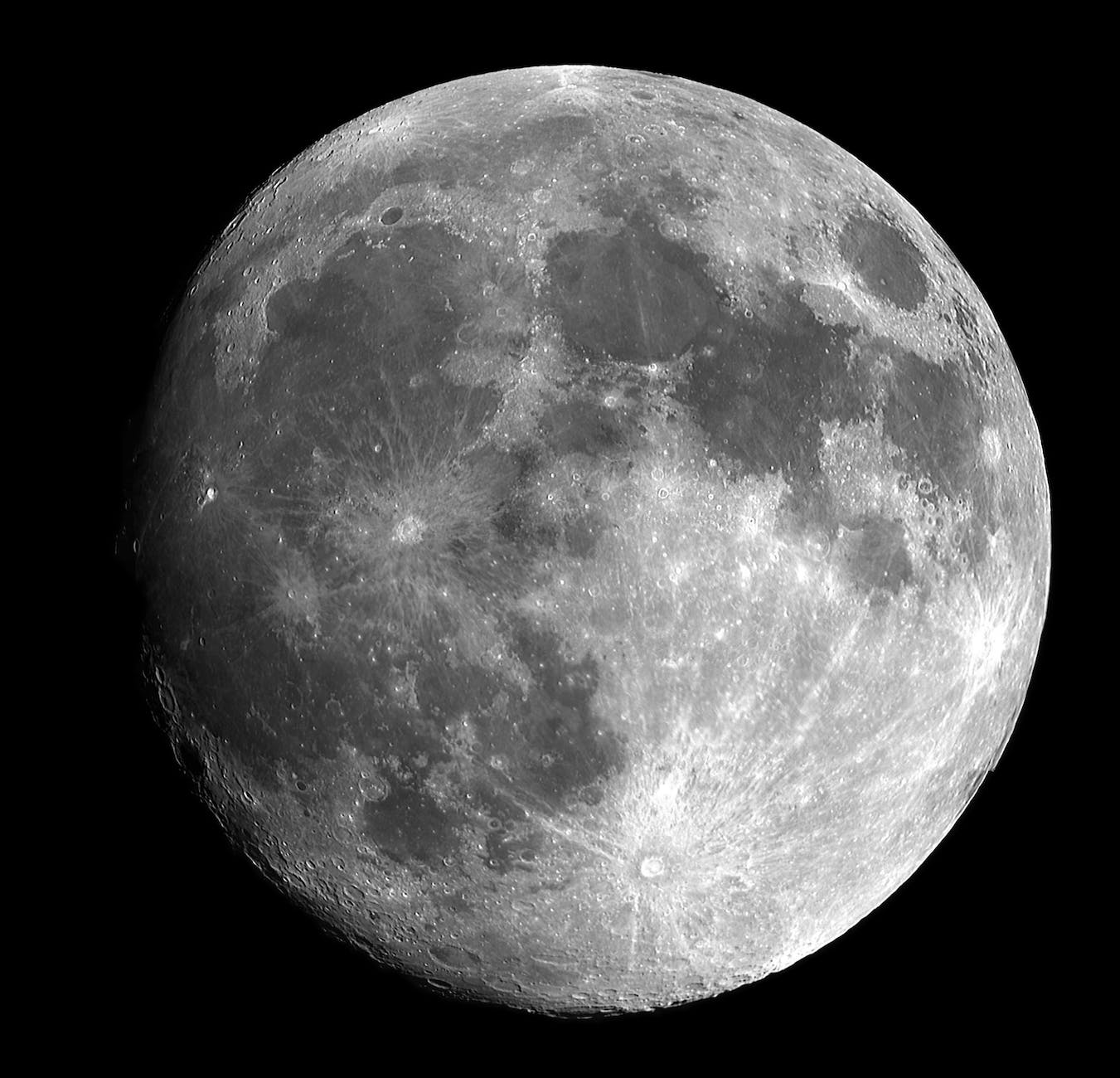
Extensive geologic evidence of ancient volcanic activity can be found on the Moon, but how long this volcanism persisted has been unclear. However, Prof. LI Qiuli’s Lab at the Institute of Geology and Geophysics of the Chinese Academy of Sciences (IGGCAS) has recently identified three volcanic glass beads from lunar soil samples collected by the Chang’e-5 mission. Their research shows that the beads were formed 123±15 million years ago (Ma), thus representing the youngest lunar volcanism confirmed by radioisotope dating so far.
The study was published in Science.
Dating of lunar volcanic basalt samples returned to Earth by the Apollo and Luna missions or delivered to Earth as lunar meteorites has shown that lunar basaltic volcanism continued until at least 2.9–2.8 billion years ago (Ga). However, analysis of lunar samples returned by China’s Chang’e-5 mission has demonstrated that basaltic volcanism persisted until at least 2.0 Ga.

Remote sensing observations have indicated potentially even younger volcanism during the late Copernican era (<0.8 Ga) on the Moon. However, none of these remote observations provide a precise date for the potential volcanism. In addition, the proposed extrusions of late-Copernican mare basalt cover only restricted areas, no samples of which are available.
Eruptions of gas-rich magma can generate magma fountains, which produce submillimeter glass beads. Such beads could potentially be deposited over wide areas and subsequently be transported further across the lunar surface by impact. The volcanic glasses could be a trace component in existing samples.
Under the guidance of Profs. LI Qiuli and HE Yuyang, graduate student WANG Biwen and postdoctoral researcher ZHANG Qian investigated ~3000 glass beads in lunar soil samples and identified three volcanic glass beads, based on their textures, major- and trace-element compositions, and in situ sulfur isotope analyses.
The δ34S values of the three volcanic glass beads apparently differs from impact glass beads, thus providing criteria for distinguishing volcanic glasses from impact glasses. Uranium-lead dating of the three volcanic glass beads shows that they formed 123±15 million years ago (Ma).
The radioisotope dating of the three Chang’e-5 volcanic glass beads provides definitive evidence for 120-million-year-old volcanism on the Moon. The presence of such young lunar volcanism implies that small celestial bodies, such as the Moon, could maintain sufficient heat to sustain internal vitality until a very late stage. These results contribute additional constraints for geophysical models on the thermal history of the Moon’s deep interior.
This study was conducted in collaboration with Nanjing University and the State University of New York at Albany.
The samples used in this study were provided by the China National Space Administration.
IMAGE CREDIT: Pixabay
Leave a Reply