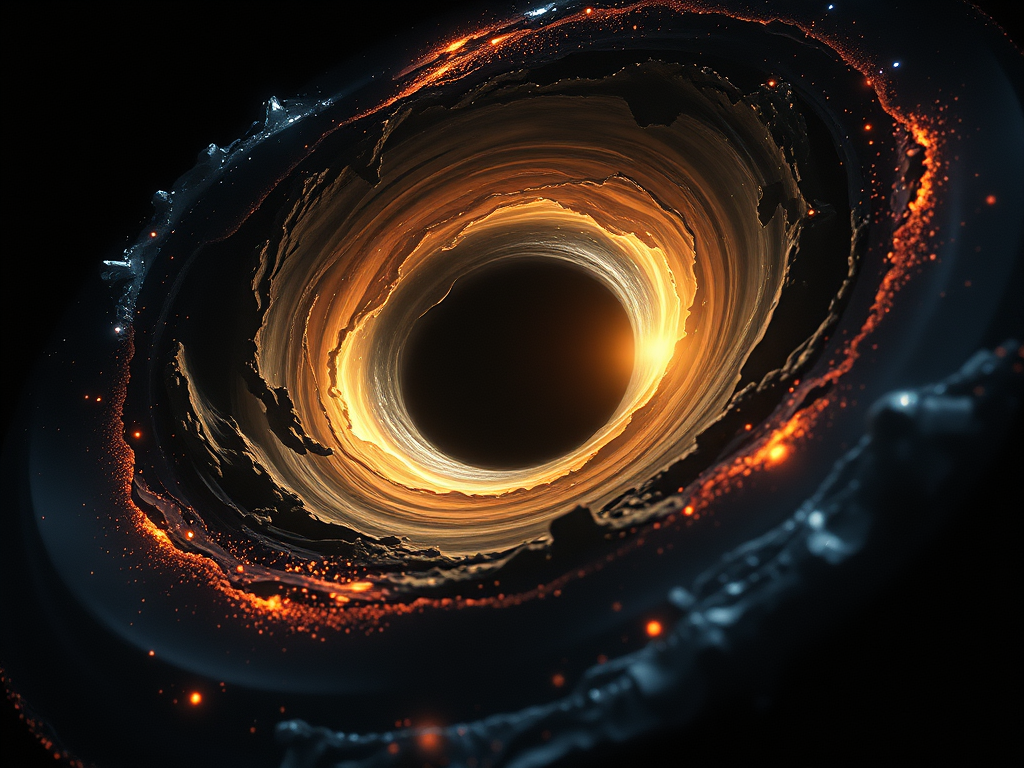
It takes a long time for supermassive black holes, like the one at the center of our Milky Way galaxy, to form. Typically, the birth of a black hole requires a giant star with the mass of at least 50 of our suns to burn out – a process that can take a billion years – and its core to collapse in on itself.
Even so, at only about 10 solar masses, the resulting black hole is a far cry from the 4 million-solar-masses black hole, Sagittarius A*, found in our Milky Way galaxy, or the billion-solar-mass supermassive black holes found in other galaxies. Such gigantic black holes can form from smaller black holes by accretion of gas and stars, and by mergers with other black holes, which take billions of years.
Why, then, is the James Webb Space Telescope discovering supermassive black holes near the beginning of time itself, eons before they should have been able to form? UCLA astrophysicists have an answer as mysterious as the black holes themselves: Dark matter kept hydrogen from cooling long enough for gravity to condense it into clouds big and dense enough to turn into black holes instead of stars. The finding is published in the journal Physical Review Letters.

“How surprising it has been to find a supermassive black hole with a billion solar mass when the universe itself is only half a billion years old,” said senior author Alexander Kusenko, a professor of physics and astronomy at UCLA. “It’s like finding a modern car among dinosaur bones and wondering who built that car in the prehistoric times.”
Some astrophysicists have posited that a large cloud of gas could collapse to make a supermassive black hole directly, bypassing the long history of stellar burning, accretion and mergers. But there’s a catch: Gravity will, indeed, pull a large cloud of gas together, but not into one large cloud. Instead, it gathers sections of the gas into little halos that float near each other but don’t form a black hole.
The reason is because the gas cloud cools too quickly. As long as the gas is hot, its pressure can counter gravity. However, if the gas cools, pressure decreases, and gravity can prevail in many small regions, which collapse into dense objects before gravity has a chance to pull the entire cloud into a single black hole.
“How quickly the gas cools has a lot to do with the amount of molecular hydrogen,” said first author and doctoral student Yifan Lu. “Hydrogen atoms bonded together in a molecule dissipate energy when they encounter a loose hydrogen atom. The hydrogen molecules become cooling agents as they absorb thermal energy and radiate it away. Hydrogen clouds in the early universe had too much molecular hydrogen, and the gas cooled quickly and formed small halos instead of large clouds.”
Lu and postdoctoral researcher Zachary Picker wrote code to calculate all possible processes of this scenario and discovered that additional radiation can heat the gas and dissociate the hydrogen molecules, altering how the gas cools.
“If you add radiation in a certain energy range, it destroys molecular hydrogen and creates conditions that prevent fragmentation of large clouds,” Lu said.
But where does the radiation come from?
Only a very tiny portion of matter in the universe is the kind that makes up our bodies, our planet, the stars and everything else we can observe. The vast majority of matter, detected by its gravitational effects on stellar objects and by the bending of light rays from distant sources, is made of some new particles, which scientists have not yet identified.
The forms and properties of dark matter are therefore a mystery that remains to be solved. While we don’t know what dark matter is, particle theorists have long speculated that it could contain unstable particles which can decay into photons, the particles of light. Including such dark matter in the simulations provided the radiation needed for the gas to remain in a large cloud while it is collapsing into a black hole.
Dark matter could be made of particles that slowly decay, or it could be made of more than one particle species: some stable and some that decay at early times. In either case, the product of decay could be radiation in the form of photons, which break up molecular hydrogen and prevent hydrogen clouds from cooling too quickly. Even very mild decay of dark matter yielded enough radiation to prevent cooling, forming large clouds and, eventually, supermassive black holes.
“This could be the solution to why supermassive black holes are found very early on,” Picker said. “If you’re optimistic, you could also read this as positive evidence for one kind of dark matter. If these supermassive black holes formed by the collapse of a gas cloud, maybe the additional radiation required would have to come from the unknown physics of the dark sector.”



Leave a Reply