Raising squid in aquaculture has been a challenge that researchers have tried to address for many decades without meaningful success. Squid are highly sensitive to changes in water flow, are vulnerable to disease, have complex life cycles and hard-to-meet food preferences, and can become aggressive towards each other, all of which make them difficult to rear. At the same time, the population of wild squid is plummeting due to overfishing and climate change, and in Japan alone, it’s estimated that the population of wild squid is just 10% compared to the 1980s. Amidst this situation, in 2022, a team of researchers at the Okinawa Institute of Science and Technology (OIST) has managed to create the most efficient cephalopod aquaculture system for research to date. With this system, they have managed to rear 10 successive generations of squid, an unparalleled achievement in the field.
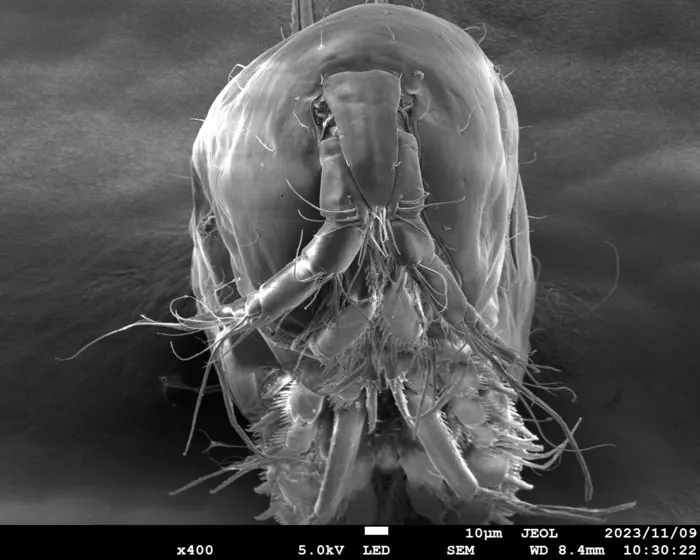
And now, a serious threat has been identified and removed – or more accurately, treated. OIST researchers have recently discovered a new species of parasitic copepod, which was responsible for the death of a large proportion of squid eggs in the tanks, and they have also developed an eco-friendly treatment of these parasites. Their findings have now been published in Scientific Reports.
“Disease management is the most important aspect of aquaculture” says co-author Dr. Zdenek Lajbner from the Physics and Biology Unit at OIST, led by Professor Jonathan Miller. Dr. Lajbner has been instrumental in the creation of the squid aquaculture program at OIST. “And I’m glad to see that we have managed to eliminate a serious threat to the health of squids.”

Unmasking a killer
While a new research aquaculture system without precedent is bound to encounter challenges, one problem kept persisting despite constant improvements to the system. “Only about 70% of the squid eggs hatched, and the young squids would often die within 1-3 days from damage and infection,” as Dr. Lajbner recalls. The cause remained elusive, until the unit was joined by Dr. Mehmet Arif Zoral, who, with his background in aquatic animal health, quickly determined the cause: “we found an infestation of parasitic copepods on the squid egg clutches, which were feeding on the eggs.”
Copepods are a group of crustaceans, and they come in many different forms: living freely in the ocean, forming symbiotic relationships with other species, or subsisting as parasites on or inside of other marine life. The species discovered in the experimental facility, scientifically named Ikanecator primus from the Japanese word for squid (‘ika’) and the Latin necator meaning murderer, lives on the squid eggs, chewing them up and breaking them down using a variety of enzymes, often leading to the death of the egg or premature hatching. Even if the egg did survive, the parasite was also observed latching onto hatchlings as they were exiting the egg, further damaging the young squids. In addition to the mechanical damage to the squids, they were also prone to bacterial infections, which the researchers speculate might also be triggered by the copepods.
Sign up for the Daily Dose Newsletter and get every morning’s best science news from around the web delivered straight to your inbox? It’s easy like Sunday morning.
“The copepods are very prolific,” explains Dr. Zoral. “Each female carries 50-60 eggs, and these eggs hatch within three weeks. The average incubation time for the squids is one month, meaning that you have many hundreds of copepods per squid egg clutch.” While squid eggs in aquaculture are especially vulnerable to infestations like this due to their proximity to one another, the copepods were also found on eggs retrieved from the wild.
United front
In addition to carefully describing the appearance and behavior of the copepods, the researchers also worked to help the hatchlings. They found an ally in peracetic acid (PAA), which is widely used in a variety of industries, from fish aquaculture to veterinary medicine and food processing. “We tested various solutions of PAA and found one that kills 100% of the parasites in under two minutes, with zero effect on the squids or their subsequent generations,” explains Dr. Zoral. Dr. Lajbner adds that “PAA is entirely biodegradable, unlike many of the treatments currently in use in Japan, like hypochlorite or boric acid, which are significantly more damaging to the environment.”
The discovery of the copepod and the creation of the eco-friendly treatment was a joint effort between fields, and between OIST and local fisheries. As Dr. Zoral puts it, “we combined three fields to make this discovery and treatment possible – aquaculture, veterinary science, and fundamental molecular biology.” Co-author Dr. Lucia Zifcakova adds that “we utilized the latest sequencing technologies to uncover the enzymatic composition of the copepods and successfully identified the specific enzymes they use to destroy cephalopod eggs.” The unit researchers were aided throughout their research by the OIST Core Facilities, who provided much of the experimental equipment that the scientists used to keep the squids and to identify and describe the copepods. The research unit also has a fruitful partnership with the local Onna Village Fisheries, and they have since cooperated with the Nago Fisheries as well, who provided the researchers with wild squids and their eggs from the East China Sea and assisted them throughout the study. “We hope to help cephalopod aquaculture systems across the world. For example, squids are often studied in neuroscience, and keeping the animals healthy is the top concern of researchers,” says Dr. Zoral.
The unit has now filed a patent for the PAA solution, and they are hoping to show through future research that the treatment is effective across cephalopod species, and for a variety of different parasite infections. “Aquaculture will never be perfected, as there will always be new disease or other complications to research and treat,” summarizes Dr. Lajbner, “but with advances in disease management like these, we’re happy to improve the health of squids in aquaculture.”
IMAGE CREDIT: Zoral et al (2024)
If you enjoy the content we create and would like to support us, please consider becoming a patron on Patreon! By joining our community, you’ll gain access to exclusive perks such as early access to our latest content, behind-the-scenes updates, and the ability to submit questions and suggest topics for us to cover. Your support will enable us to continue creating high-quality content and reach a wider audience.
Join us on Patreon today and let’s work together to create more amazing content! https://www.patreon.com/ScientificInquirer

Leave a Reply