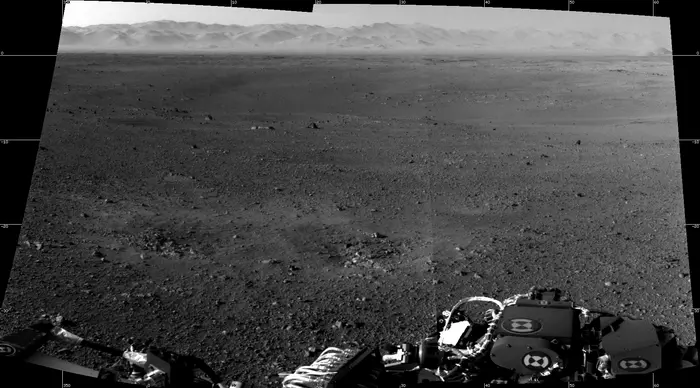
The question of whether Mars ever supported life has captivated the imagination of scientists and the public for decades. Central to the discovery is gaining insight into the past climate of Earth’s neighbor: was the planet warm and wet, with seas and rivers much like those found on our own planet? Or was it frigid and icy, and therefore potentially less prone to supporting life as we know it? A new study finds evidence to support the latter by identifying similarities between soils found on Mars and those of Canada’s Newfoundland, a cold subarctic climate.
The study, published July 7th in Communications Earth and Environment, looked for soils on Earth with comparable materials to Mars’ Gale Crater. Scientists often use soil to depict environmental history, as the minerals present can tell the story of landscape evolution through time. Understanding more about how these materials formed could help answer long-standing questions about historical conditions on the red planet. The soils and rocks of Gale Crater provide a record of Mars’ climate between 3 and 4 billion years ago, during a time of relatively abundant water on the planet – and the same time period that saw life first appear on Earth.
“Gale Crater is a paleo lakebed—there was obviously water present. But what were the environmental conditions when the water was there?” says Anthony Feldman, a soil scientist and geomorphologist now at DRI. “We’re never going to find a direct analog to the Martian surface, because conditions are so different between Mars and Earth. But we can look at trends under terrestrial conditions and use those to try to extrapolate to Martian questions.”

NASA’s Curiosity Rover has been investigating Gale Crater since 2011, and has found a plethora of soil materials known as “X-ray amorphous material.” These components of the soil lack the typical repeating atomic structure that defines minerals, and therefore can’t be easily characterized using traditional techniques like X-ray diffraction. When X-rays are shot at crystalline materials like a diamond, for example, the X-rays scatter at characteristic angles based on the mineral’s internal structure. However, X-ray amorphous material does not produce these characteristic “fingerprints.” This X-ray diffraction method was used by the Curiosity Rover to demonstrate that X-ray amorphous material comprised between 15 and 73% of the soil and rock samples tested in Gale Crater.
“You can think of X-Ray amorphous materials like Jello,” Feldman says. “It’s this soup of different elements and chemicals that just slide past each other.”
The Curiosity Rover also conducted chemical analyses on the soil and rock samples, finding that the amorphous material was rich in iron and silica but deficient in aluminum. Beyond the limited chemical information, scientists don’t yet understand what the amorphous material is, or what its presence implies about Mars’ historical environment. Uncovering more information about how these enigmatic materials form and persist on Earth could help answer persistent questions about the red planet.
Sign up for the Daily Dose Newsletter and get every morning’s best science news from around the web delivered straight to your inbox? It’s easy like Sunday morning.
Feldman and his colleagues visited three locations in search of similar X-ray amorphous material: the Tablelands of Gros Morne National Park in Newfoundland, Northern California’s Klamath Mountains, and western Nevada. These three sites had serpentine soils that the researchers expected to be chemically similar to the X-ray amorphous material at Gale Crater: rich in iron and silicon but lacking in aluminum. The three locations also provided a range of rainfall, snowfall, and temperature that could help provide insight into the type of environmental conditions that produce amorphous material and encourage its preservation.
At each site, the research team examined the soils using X-ray diffraction analysis and transmission electron microscopy, which allowed them to see the soil materials at a more detailed level. The subarctic conditions of Newfoundland produced materials chemically similar to those found in Gale Crater that also lacked in crystalline structure. The soils produced in warmer climates like California and Nevada did not.
“This shows that you need the water there in order to form these materials,” Feldman says. “But it needs to be cold, near-freezing mean annual temperature conditions in order to preserve the amorphous material in the soils.”
Amorphous material is often considered to be relatively unstable, meaning that at an atomic level, the atoms haven’t yet organized into their final, more crystalline forms. “There’s something going on in the kinetics –or the rate of reaction– that is slowing it down so that these materials can be preserved over geologic time scales,” Feldman says. “What we’re suggesting is that very cold, close to freezing conditions, is one particular kinetic limiting factor that allows for these materials to form and be preserved.”
“This study improves our understanding of the climate of Mars,” Feldman says. “The results suggest that the abundance of this material in Gale Crater is consistent with subarctic conditions, similar to what we would see in, for instance, Iceland.”
IMAGE CREDIT: NASA.
If you enjoy the content we create and would like to support us, please consider becoming a patron on Patreon! By joining our community, you’ll gain access to exclusive perks such as early access to our latest content, behind-the-scenes updates, and the ability to submit questions and suggest topics for us to cover. Your support will enable us to continue creating high-quality content and reach a wider audience.
Join us on Patreon today and let’s work together to create more amazing content! https://www.patreon.com/ScientificInquirer




Leave a Reply