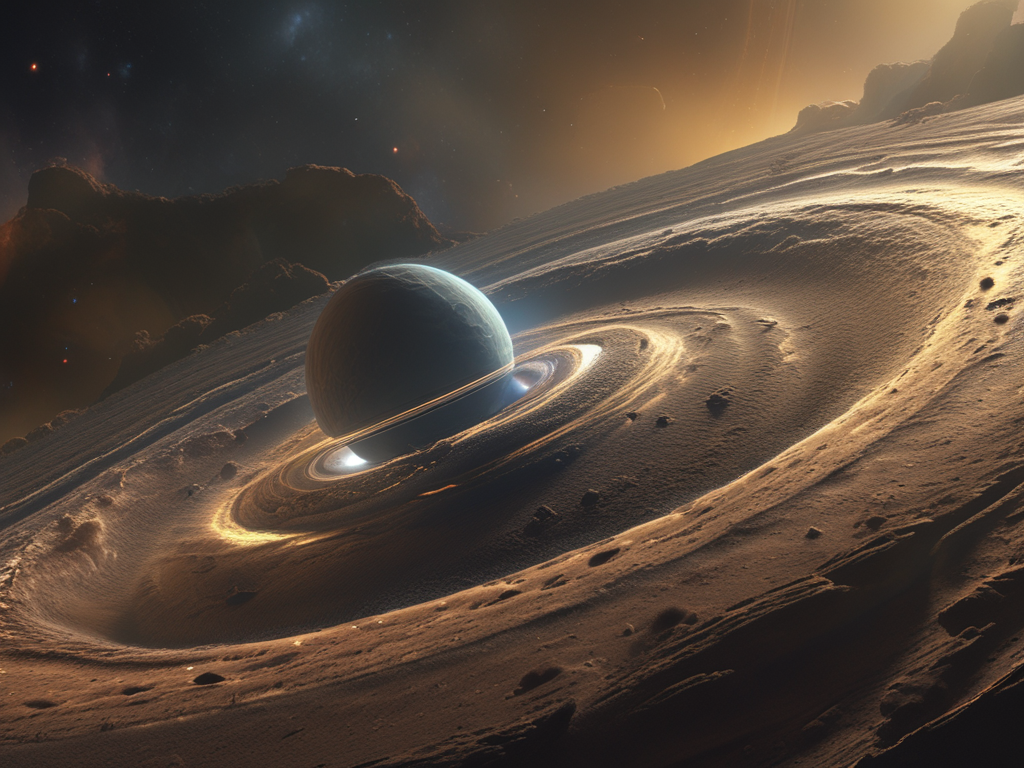
Four and a half billion years ago, our solar system was a cloud of gas and dust swirling around the sun, until gas began to condense and accrete along with dust to form asteroids and planets. What did this cosmic nursery, known as a protoplanetary disk, look like, and how was it structured? Astronomers can use telescopes to “see” protoplanetary disks far away from our much more mature solar system, but it is impossible to observe what ours might have looked like in its infancy — only an alien billions of light years away would be able to see it as it once was.
Fortunately, space has dropped a few clues — fragments of objects that formed early in solar system history and plunged through Earth’s atmosphere, called meteorites. The composition of meteorites tells stories of the solar system’s birth, but these stories often raise more questions than answers.
In a paper published in Proceedings of the National Academy of Sciences, a team of planetary scientists from UCLA and Johns Hopkins University Applied Physics Laboratory reports that refractory metals, which condense at high temperatures, such as iridium and platinum, were more abundant in meteorites formed in the outer disk, which was cold and far away from the sun. These metals should have formed close to the sun, where the temperature was much higher. Was there a pathway that moved these metals from the inner disk to the outer?

Most meteorites formed within the first few million years of solar system history. Some meteorites, called chondrites, are unmelted conglomerations of grains and dust left over from planet formation. Other meteorites experienced enough heat to melt while their parent asteroids were forming. When these asteroids melted, the silicate part and the metallic part separated due to their difference in density, similar to how water and oil don’t mix.
Today, most asteroids are located in a thick belt between Mars and Jupiter. Scientists think that Jupiter’s gravity disrupted the course of these asteroids, causing many of them to smash into each other and break apart. When pieces of these asteroids fall to Earth and are recovered, they are called meteorites.
Iron meteorites are from the metallic cores of the earliest asteroids, older than any other rocks or celestial objects in our solar system. The irons contain molybdenum isotopes that point toward many different locations across the protoplanetary disk in which these meteorites formed. That allows scientists to learn what the chemical composition of the disk was like in its infancy.
Previous research using the Atacama Large Millimeter/submillimeter Array in Chile has found many disks around other stars that resemble concentric rings, like a dartboard. The rings of these planetary disks, such as HL Tau, are separated by physical gaps, so this kind of disk could not provide a route to transport these refractory metals from the inner disk to the outer.
The new paper holds that our solar disk likely didn’t have a ring structure at the very beginning. Instead, our planetary disk looked more like a doughnut, and asteroids with metal grains rich in iridium and platinum metals migrated to the outer disk as it rapidly expanded.
But that confronted the researchers with another puzzle. After the disk expansion, gravity should have pulled these metals back into the sun. But that did not happen.
“Once Jupiter formed, it very likely opened a physical gap that trapped the iridium and platinum metals in the outer disk and prevented them from falling into the sun,” said first author Bidong Zhang, a UCLA planetary scientist. “These metals were later incorporated into asteroids that formed in the outer disk. This explains why meteorites formed in the outer disk – carbonaceous chondrites and carbonaceous-type iron meteorites – have much higher iridium and platinum contents than their inner-disk peers.”
Zhang and his collaborators previously used iron meteorites to reconstruct how water was distributed in the protoplanetary disk.
“Iron meteorites are hidden gems. The more we learn about iron meteorites, the more they unravel the mystery of our solar system’s birth,” Zhang said.


Leave a Reply