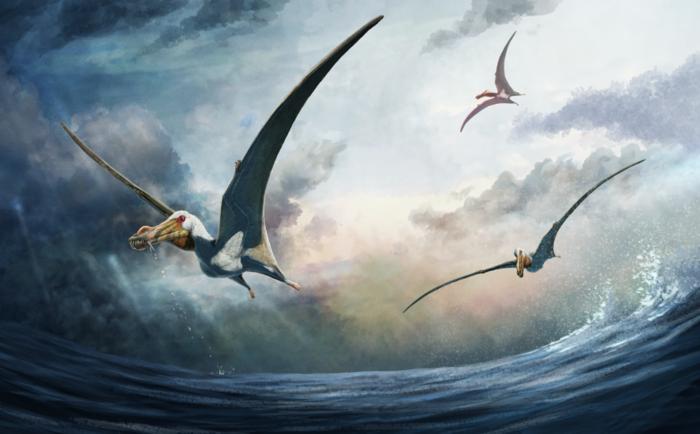
New Curtin University-led research has identified 100-million-year-old fossilised bones discovered in western Queensland as belonging to a newly identified species of pterosaur, which was a formidable flying reptile that lived among the dinosaurs.
Unearthed in 2021 by Kronosaurus Korner museum curator Kevin Petersen, the fossilised remains have been found to belong to Haliskia peterseni, a new genus and species of anhanguerian pterosaur.
Based on the shape of its skull, arrangement of teeth and shape of the shoulder bone, a research team led by PhD student Adele Pentland, from Curtin’s School of Earth and Planetary Sciences, identified the specimen as an anhanguerian, which is a group of pterosaurs known to have lived across the world, including in what is now Brazil, England, Morocco, China, Spain and the United States.

“With a wingspan of approximately 4.6m, Haliskia would have been a fearsome predator around 100 million years ago when much of central western Queensland was underwater, covered by a vast inland sea and globally positioned about where Victoria’s southern coastline is today,” Ms Pentland said.
“Careful preparation by Mr Petersen has provided the remains of the most complete specimen of an anhanguerian, and of any pterosaur, discovered in Australia to date.
“Haliskia is 22 per cent complete, making it more than twice as complete as the only other known partial pterosaur skeleton found in Australia.
Sign up for the Daily Dose Newsletter and get every morning’s best science news from around the web delivered straight to your inbox? It’s easy like Sunday morning.
“The specimen includes complete lower jaws, the tip of the upper jaw, 43 teeth, vertebrae, ribs, bones from both wings and part of a leg. Also present are very thin and delicate throat bones, indicating a muscular tongue, which helped during feeding on fish and cephalopods.”
Haliskia peterseni joins several significant marine fossil specimens on display at Kronosaurus Korner, including Kronosaurus queenslandicus, the largest marine reptile with a skull at least 2.4m long, the most complete plesiosaur from Australia and bones from the plesiosaur Eromangasaurus and the ichthyosaur Platypterygius.
Mr Petersen said this latest discovery was an exciting boost for science, education and regional tourism.
“I’m thrilled that my discovery is a new species, as my passion lies in helping shape our modern knowledge of prehistoric species,” Mr Petersen said.
IMAGE CREDIT: Gabriel Ugueto
If you enjoy the content we create and would like to support us, please consider becoming a patron on Patreon! By joining our community, you’ll gain access to exclusive perks such as early access to our latest content, behind-the-scenes updates, and the ability to submit questions and suggest topics for us to cover. Your support will enable us to continue creating high-quality content and reach a wider audience.
Join us on Patreon today and let’s work together to create more amazing content! https://www.patreon.com/ScientificInquirer


Leave a Reply