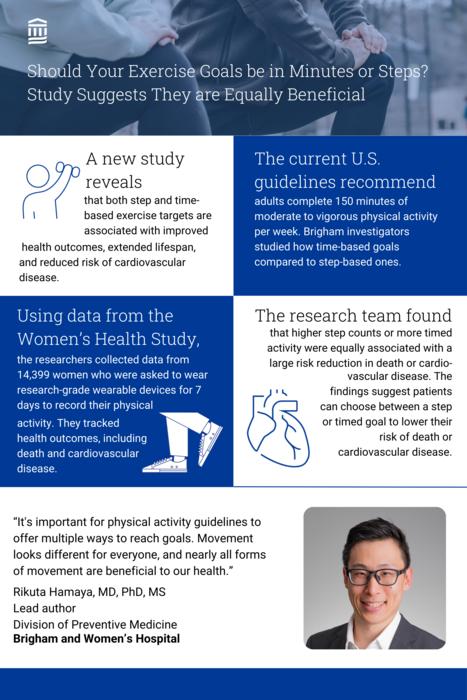
In the age of smartwatches, monitoring step counts has never been easier, but current physical activity guidelines do not explicitly recommend specific step counts for health. A new study from researchers at Brigham and Women’s Hospital, a founding member of Mass General Brigham, suggests that both step and time-based exercise targets are equivalently associated with lower risks of early death and cardiovascular disease. Thus, whether one chooses a time or step goal may not be as important as choosing a goal aligned with personal preferences. Results are published in JAMA Internal Medicine.

Physical activity reduces the risk of acquiring chronic illness and infection, and promotes longevity. The current U.S. guidelines, last updated in 2018, recommend that adults engage in at least 150 minutes of moderate to vigorous physical activity (e.g., brisk walking) or 75 minutes of vigorous activity (e.g., jogging) per week. At that time, most of the existing evidence on health benefits came from studies where participants self-reported their physical activity. Few data points existed on the relationship between steps and health. Fast forward to the present – with wearables being ubiquitous, step counts are now a popular metric among many fitness tracking platforms. How do time-based goals stack up against step-based ones? Investigators sought to answer this question.
“We recognized that existing physical activity guidelines focus primarily on activity duration and intensity but lack step-based recommendations,” said lead author Rikuta Hamaya, MD, PhD, MS, a researcher in the Division of Preventive Medicine at BWH. “With more people using smartwatches to measure their steps and overall health, we saw the importance of ascertaining how step-based measurements compare to time-based targets in their association with health outcomes – is one better than the other?”
Sign up for the Daily Dose Newsletter and get every morning’s best science news from around the web delivered straight to your inbox? It’s easy like Sunday morning.
For this study, investigators collected data from 14,399 women who participated in the Women’s Health Study, and who were healthy (free from cardiovascular disease and cancer). Between 2011 and 2015, participants aged 62 years and older were asked to wear research grade wearables for seven consecutive days to record their physical activity levels, only removing the devices for sleep or water-related activities. Throughout the study period, annual questionnaires were administered to ascertain health outcomes of interest, in particular, death from any cause and cardiovascular disease. Investigators followed up with participants through the end of 2022.
At the time of device wear, researchers found that participants engaged in a median of 62 minutes of moderate-to-vigorous intensity physical activity per week and accumulated a median of 5,183 steps per day. During a median follow-up of 9 years, approximately 9% of participants had passed and roughly 4% developed cardiovascular disease. Higher levels of physical activity (whether assessed as step counts or time in moderate-to-vigorous activity) were associated with large risk reductions in death or cardiovascular disease – the most active quarter of women had 30-40% risk reductions compared with the least active quarter. And, individuals in the top three quartiles of physical activity outlived those in the bottom quartile by an average of 2.22 and 2.36 months respectively, based on time and step-based measurements, at nine years of follow-up. This survival advantage persisted regardless of differences in body mass index (BMI).
While both metrics are useful in portraying health status, Hamaya explained that each has its advantages and downsides. For one, step counts may not account for differences in fitness levels. For example, if a 20-year-old and 80-year-old both walk for 30 minutes at moderate intensity, their step counts may differ significantly. Conversely, steps are straightforward to measure and less subject to interpretation compared to exercise intensity. Additionally, steps capture even sporadic movements of every day life, not just exercise, and these kinds of daily life activities likely are those carried out by older individuals.
“For some, especially for younger individuals, exercise may involve activities like tennis, soccer, walking, or jogging, all of which can be easily tracked with steps. However, for others, it may consist of bike rides or swimming, where monitoring the duration of exercise is simpler. That’s why it’s important for physical activity guidelines to offer multiple ways to reach goals. Movement looks different for everyone, and nearly all forms of movement are beneficial to our health,” said Hamaya.
The authors note that this study incorporates only a single assessment of time and step-based physical activity metrics. Further, most women included in the study were white and of higher socioeconomic status. Finally, this study was observational, and thus causal relations cannot be proven. In the future, Hamaya aims to collect more data via a randomized controlled trial to better understand the relationship between time and step-based exercise metrics and health.
Senior author I-Min Lee, MBBS, ScD, an epidemiologist in the Division of Preventive Medicine at BWH, concluded, “The next federal physical activity guidelines are planned for 2028. Our findings further establish the importance of adding step-based targets, in order to accommodate flexibility of goals that work for individuals with differing preferences, abilities and lifestyles.”
IMAGE CREDIT: Brigham and Women’s Hospital
If you enjoy the content we create and would like to support us, please consider becoming a patron on Patreon! By joining our community, you’ll gain access to exclusive perks such as early access to our latest content, behind-the-scenes updates, and the ability to submit questions and suggest topics for us to cover. Your support will enable us to continue creating high-quality content and reach a wider audience.
Join us on Patreon today and let’s work together to create more amazing content! https://www.patreon.com/ScientificInquirer



Leave a Reply