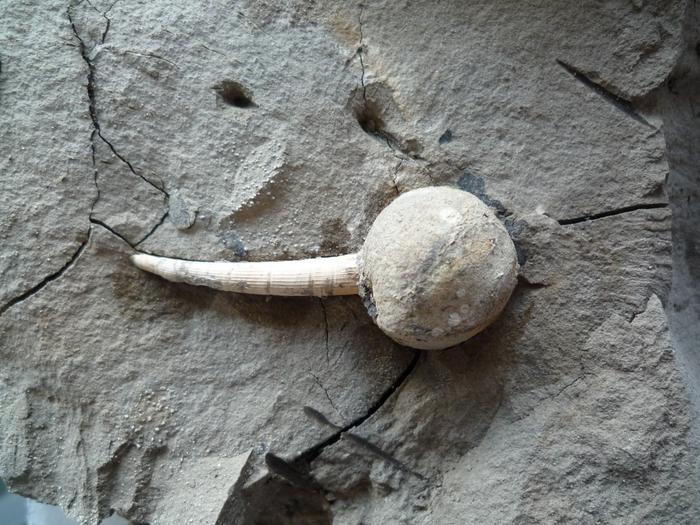
Various forms of underground activity, such as deep wells or the disposal of hazardous materials, require the long-term sealing of rocks. A team of researchers has developed an innovative method based on fossilization processes to seal cracks and fractures in rock using a “concretion-forming resin”. The results were published in Communications Engineering.
The underground disposal of pollutants, such as radioactive waste and carbon dioxide, poses unique challenges. To avoid their release, it is necessary to seal the shafts and boreholes used for investigations and ensure that there are no leaks from the rock for long periods of time. Unfortunately, current cement-based sealing materials do not offer long-term functionality and durability. Especially in earthquake-prone countries, such as Japan, this may cause future complications, such as leaks.
To find a solution, lead researcher Hidekazu Yoshida of the Nagoya University Museum turned to his expertise in fossil preservation in calcium carbonate concretions. He understood that such concretions form quite rapidly within a few weeks to years, and fossils in concretions remain remarkably intact for millions of years, even when extracted from locations prone to weathering and seismic disturbances. He mused about the potential use of a similar approach in an industrial context.
“I realized that well-preserved fossils in concretions had withstood weathering and the like for tens to hundreds of thousands of years in the natural environment,” Yoshida said. “I became inspired by studying how fast concretions were formed and why the fossils inside were preserved so well.”
One reason for the durability of fossils is the concretion process. This is a natural fossilization process in which minerals in groundwater precipitate out of the water and accumulate around the organic material. Calcite in the groundwater seals the remains by forming crystals around them, binding the surrounding sediments. This mechanism creates an almost impenetrable fossil, with the crystals blocking even small, micrometer-sized openings.
Based on the concretion-forming process, the researchers mixed two agents to develop a “concretion-forming resin”. The resin holds the ions needed to form calcite when water is introduced. Calcite forms impenetrable crystals in cracks and holes, reproducing the concretion formation process seen in nature, only much faster.

During a test in an underground laboratory 350 meters below the surface in Hokkaido, the northernmost island of Japan, the researchers discovered that their resin-based material had remarkable sealing abilities. When applied to flow-paths in the rock, it sealed them completely and rapidly.
The area experienced six earthquakes in the space of two days, including a magnitude 5.4 earthquake, putting their resin to the ultimate test. Despite a further five earthquakes during the test period, the cracks remained sealed. In fact, open cracks even resealed as the crystals reformed.
“The earthquakes were coincidence; something we never expected and planned for”, Yoshida said. “They were a surprise to us, but it was such a great opportunity to see the material’s performance. Such a fast-acting and sustained sealing effect of rock fractures, including post-earthquake crack repair, has never been reported before. Conventional cement materials cannot achieve this result.”
The group is working closely with the Japan Atomic Energy Agency, Sekisui Chemical Co., and Chubu Electric Power Co., Ltd. to ensure that the resin will be commercially viable. Following their successful test, the team anticipates a wide range of applications, including long-term underground sequestration of radioactive waste and carbon dioxide, sealing abandoned oil wells, groundwater control during rock and mine excavation, and repair of cracks in ageing infrastructure such as roads and buildings.
IMAGE CREDIT: Hidekazu Yoshida
Sign up for the Daily Dose Newsletter and get the morning’s best science news from around the web delivered straight to your inbox? It’s easy like Sunday morning.



Leave a Reply