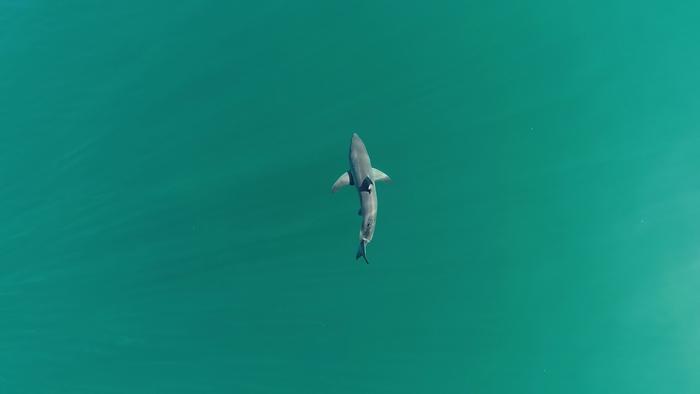
Remember #BabyShark? And no, this was not the very catchy song for kids that took the internet by storm. Earlier this year, social media was abuzz with stunning footage of a newborn great white shark, captured by a flying drone.
Now, marine scientists have shown for the first time that juvenile great white sharks select warm and shallow waters to aggregate within one kilometer from the shore. These results, published in Frontiers in Marine Science, are important for conservation of great white sharks – especially as ocean temperatures increase due to climate change – and for protecting the public from negative shark encounters.

Nurseries off central California
Baby great white sharks (‘pups’) don’t receive any maternal care after birth. In the studied population off Padaro Beach near Santa Barbara in central California, pups and juveniles gather in ‘nurseries’, unaccompanied by adults.
“This is one of the largest and most detailed studies of its kind. Because around Padaro Beach, large numbers of juveniles share near-shore habitats, we could learn how environmental conditions influence their movements,” said senior author Dr Christopher Lowe, a professor at California State University.
Sign up for the Daily Dose Newsletter and get every morning’s best science news from around the web delivered straight to your inbox? It’s easy like Sunday morning.
“You rarely see great white sharks exhibiting this kind of nursery behavior in other locations.”
In 2020 and 2021, Lowe and his team used darts to tag a total of 22 juveniles with sensor-transmitters. These were females and males aged between one and six years old. Great white sharks can live for up to 40 to 70 years.
The sensor-transmitters measured local water pressure and temperature in real time, and tracked each juvenile’s position by sending acoustic ‘pings’ into an array of receivers, spread out over approximately 5.5 sq km along the shoreline. These methods had been approved by the university’s Animal Care and Use Committee and California’s Department of Fish and Wildlife.
Tracking was halted during the winter months, when juveniles temporarily left for offshore waters. The researchers gathered further data on the temperature distribution throughout the local water column with an autonomous underwater vehicle. They then used artificial intelligence to train a 3D model of the juveniles’ temperature and depth preferences.
The results showed that the juveniles dived to the greatest depths around dawn and dusk, when they were likely foraging on skates, rays, schooling fish, and other small bony fish. They moved closest to the surface – between zero and four meters deep – in the afternoon when the sun was hottest, possibly to increase their body temperature.
First author Emily Spurgeon, a former master’s student and current research technician in Lowe’s team, said: “We showed that juveniles directly altered their vertical position in the water column to stay between 16 and 22 °C, and if possible between 20 and 22 °C. This may be their optimum to maximize growth efficiency within the nursery.”
Preference for shallow waters
The results showed that the temperature distribution in these waters is ever changeable, which means that juveniles have to be constantly on the move to remain within this optimal range.
The authors concluded that juvenile great white sharks spend most of their time in much shallower water than adults. The latter were rarely observed in the nursery.
The results also showed that the temperature distribution across three dimensions strongly impacted the horizontal distribution of the juveniles, which spread out at greater depths when seafloor temperatures were higher, and moved closer together towards the surface when deeper water was cooler.
What the researchers don’t yet know is what benefits pups and juveniles get from gathering in nurseries in the first place. One advantage might be to avoid predators.
“Our results show that water temperature is a key factor that draws juveniles to the studied area. However, there are many locations across the California coast that share similar environmental conditions, so temperature isn’t the whole story. Future experiments will look at individual relationships, for example to see if some individuals move among nurseries in tandem,” said Spurgeon.
IMAGE CREDIT: Patrick Rex
If you enjoy the content we create and would like to support us, please consider becoming a patron on Patreon! By joining our community, you’ll gain access to exclusive perks such as early access to our latest content, behind-the-scenes updates, and the ability to submit questions and suggest topics for us to cover. Your support will enable us to continue creating high-quality content and reach a wider audience.
Join us on Patreon today and let’s work together to create more amazing content! https://www.patreon.com/ScientificInquirer


Leave a Reply