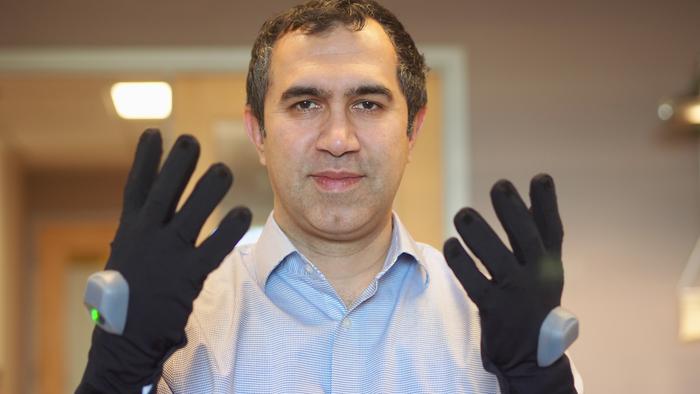
This month, a group of stroke survivors in B.C. will test a new technology designed to aid their recovery, and ultimately restore use of their limbs and hands.
Participants will wear a new groundbreaking “smart glove” capable of tracking their hand and finger movements during rehabilitation exercises supervised by Dr. Janice Eng, a leading stroke rehabilitation specialist and professor of medicine at UBC.
The glove incorporates a sophisticated network of highly sensitive sensor yarns and pressure sensors that are woven into a comfortable stretchy fabric, enabling it to track, capture and wirelessly transmit even the smallest hand and finger movements.
“With this glove, we can monitor patients’ hand and finger movements without the need for cameras. We can then analyze and fine-tune their exercise programs for the best possible results, even remotely,” says Dr. Eng.
UBC electrical and computer engineering professor Dr. Peyman Servati, PhD student Arvin Tashakori and their team at their startup, Texavie, created the smart glove for collaboration on the stroke project. Dr. Servati highlighted a number of breakthroughs, described in a paper published last week in Nature Machine Intelligence.
“This is the most accurate glove we know of that can track hand and finger movement and grasping force without requiring motion-capture cameras. Thanks to machine learning models we developed, the glove can accurately determine the angles of all finger joints and the wrist as they move. The technology is highly precise and fast, capable of detecting small stretches and pressures and predicting movement with at least 99-per-cent accuracy – matching the performance of costly motion-capture cameras.”

Unlike other products in the market, the glove is wireless and comfortable, and can be easily washed after removing the battery. Dr. Servati and his team have developed advanced methods to manufacture the smart gloves and related apparel at a relatively low cost locally.
Dr. Servati envisions a seamless transition of the glove into the consumer market with ongoing improvements, in collaboration with different industrial partners. The team also sees potential applications in virtual reality and augmented reality, animation and robotics.
“Imagine being able to accurately capture hand movements and interactions with objects and have it automatically display on a screen. There are endless applications. You can type text without needing a physical keyboard, control a robot, or translate American Sign Language into written speech in real time, providing easier communication for individuals who are deaf or hard of hearing.”
IMAGE CREDIT: Lou Bosshart/UBC Media Relations.
Sign up for the Daily Dose Newsletter and get the morning’s best science news from around the web delivered straight to your inbox? It’s easy like Sunday morning.


Leave a Reply