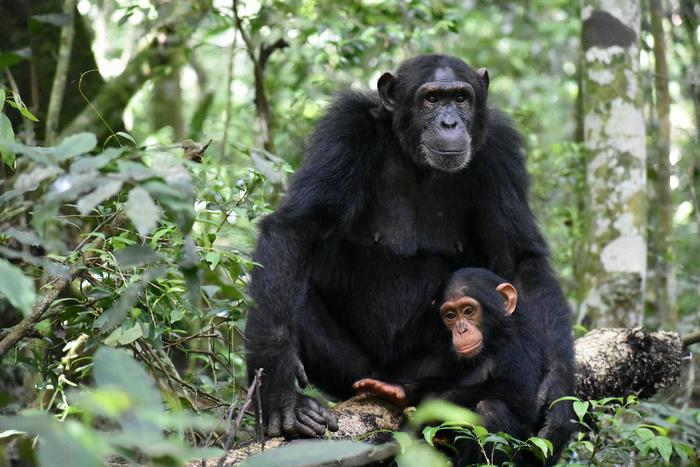
When it comes to nurturing their young, mother chimpanzees go the extra mile, according to a new study. Using 10 years of observational data on wild chimpanzees, researchers found that while adults often play, and young chimps play a lot, when food gets scarce, the adults put mutual play aside and focus on survival.
But in the meantime, mother chimps continue to be their offspring’s primary playmate, tickling, chasing, playing ‘airplane’. That suggests the mother chimps take on an indispensable role fostering their young’s physical and social development even when they are under food stress.
The study observations took place in Kibale National Park in Uganda, and the study analysis, published in Current Biology, was led by Zarin Machanda, an assistant professor of anthropology and biology, and her former postdoctoral associate Kris Sabbi, who is currently a college fellow in human evolutionary biology at Harvard University.
Kibale is the most primate-dense forest in the world, with thirteen species living there including over 1,000 chimpanzees. Researchers started habituating the chimps to the presence of humans in 1987. Over the decades, teams of researchers took detailed field notes of almost every observable behavior— including climbing, feeding, grooming, calling, aggression, and play.
Through their previous work, Machanda and Sabbi were familiar with the playfulness of chimpanzees and decided to look deeper into the patterns of play behavior. They expected seasonal variations in food availability would affect adult chimps’ time spent playing.
For example, when supplies of quality fruits were low, the chimps focused on finding and gathering figs and leaves, and put play time aside. Surprisingly, although chimp mothers had the same challenge in finding food, they continued devoting a lot of their time to nurturing their offspring’s development through play.

“The research on play ties into an effort to understand the evolution of leadership among chimps,” said Machanda. “We were trying to see whether chimps have only one pathway to leadership, which has always been assumed to be aggressiveness, or whether play and other behaviors build multiple dimensions of character that might make them more or less successful.”
Play is not very common in the wild, at least among adult animals. Young mammals do play often, but mostly with each other, or at the expense of an exasperated and passive adult. Exceptions include dolphins, monkeys, and apes. Natural selection tends to suppress the costly exercise after it serves its purpose for development, and time comes to focus on finding food, watching out for predators, and mating. With chimps, however, adult play serves to cement social bonds.
Why do some primates play throughout life and other mammals don’t? “I think what sets primates apart is that they spend more time growing up compared to other mammals,” said Machanda. “They also have highly developed brains and live in structured groups, with very specific rules governing interactions between individuals. Play permits them to build not only physical skills, but also the skills of social interaction.”
Social structure in the chimpanzee world may also explain why mother chimps sometimes become the primary play partners for their young. The chimpanzees have a very fluid social system called fission-fusion, which means a group of 60 chimps, for example, may have smaller groups break away for days or weeks, which then merge again while other groups break off.

When food becomes scarce, chimp mothers tend to break away into smaller groups or solo with their babies. “But when they’re doing that, they are also limiting the ability of their young ones to play with others, and the moms become the primary playmates,” said Sabbi. “They’re trading off that lower feeding competition in the larger group for more time and energy being spent playing with their little ones.”
By comparison, a troop of 60 baboons always sticks together, so baby baboons always have other baboons close to their age nearby to play with. Baboon mothers usually do not play with their babies.
Types of Play
Play among the chimps often divides depending on their sex. “It’s not uncommon to see male chimps to engage in more aggressive types of play, while females are doing a type of play related to parenting,” said Machanda. “You see them practice carrying things—a kind of preparation for future maternal behavior. Males often size each other up, and when they hit their second birthday, play style changes and can get rougher.”
Mothers are often the ones that juveniles and older infants come back to. “If they’re playing with somebody and it starts to get a little bit too rough, they’ll switch it up and go back to playing with mom, because at the end of the day it’s a very safe place,” said Sabbi.
“If we compare to humans, it’s very easy to find lots of evidence in the child psychology literature for how important it is for human mothers and fathers to be playing with their children, especially at really young ages. Moms and dads are important first play partners before kids branch out into their own social networks,” she said.
“As a mom, it’s impossible to watch my kids and not see them as primates,” said Machanda. “I can see the incredible value of play in the lives of my own kids, when I’m playing with them or when I’m seeing them play with their friends. I can see how they’re using it to develop certain skills. I can also relate to the chimp moms and the energy cost of play when their kids are jumping on them, and they just want to take a nap. But watching the chimps has made me a better parent.”
IMAGE CREDIT: Dr. Kris Sabbi
Sign up for the Daily Dose Newsletter and get the morning’s best science news from around the web delivered straight to your inbox? It’s easy like Sunday morning.



Leave a Reply