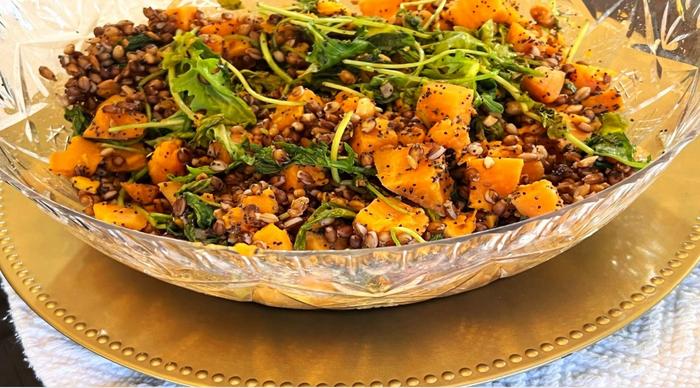
Imagine blasting off on a multiyear voyage to Mars, fueled by a diet of bland, prepackaged meals. As space agencies plan for longer missions, they’re grappling with the challenge of how to best feed people. Now, researchers reporting in ACS Food Science & Technology have designed the optimal “space meal”: a tasty vegetarian salad. They chose fresh ingredients that meet male astronauts’ specialized nutritional needs and can be grown in space.
Astronauts in space burn more calories than humans on Earth and require extra micronutrients, such as calcium, to stay healthy during extended exposure to microgravity. Additionally, future long-term missions will require growing food in a sustainable, circular way within the spacecraft or space colonies. While researchers have explored methods of growing food in space and what nutrients astronauts require to stay healthy, specific fresh meals have not been developed. So, Volker Hessel and coworkers wanted to optimize a space meal that meets those unique requirements of spaceflight and tastes good.

First, the researchers assessed combinations of fresh ingredients, using a method called linear programming, which computationally balances different variables to meet a specific goal. In this case, their model identified how well the combinations of different foods could meet a male astronaut’s daily nutritional needs while minimizing the water required to grow the foods. The team was also concerned about the sustainability of the foods in space, selecting ingredients that needed little fertilizer, time and area to grow and whether inedible portions could be recycled. Of the 10 scenarios the researchers examined, they found that a vegetarian meal made up of soybeans, poppy seeds, barley, kale, peanuts, sweet potato and/or sunflower seeds provided the most efficient balance of maximal nutrients and minimal farming inputs. While this combination couldn’t quite provide all the micronutrients an astronaut needs, those missing could be added in a supplement, the researchers suggest.
To make sure that the identified combination was tasty, the team whipped up the ideal space meal as a salad for four people to taste test here on Earth. One tester gave rave reviews and “wouldn’t mind eating this all week as an astronaut.” Other people were more muted in their praise, even though they went back for second helpings. In the future, the researchers plan to see what their computer model dishes up as options for female astronauts and expand the variety of crops in their database.
IMAGE CREDIT: Adapted from ACS Food Science & Technology.
Sign up for the Daily Dose Newsletter and get the morning’s best science news from around the web delivered straight to your inbox? It’s easy like Sunday morning.

Leave a Reply