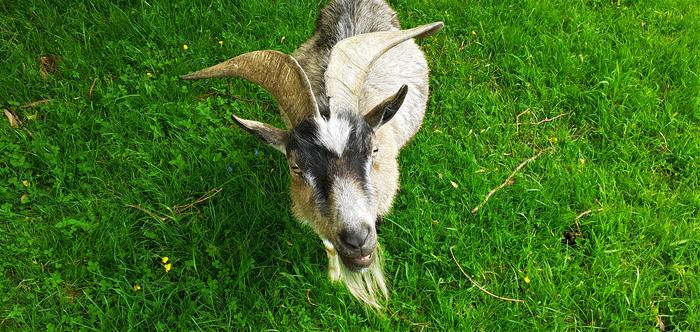
Goats can tell the difference between a happy-sounding human voice and an angry-sounding one, according to research co-led by Professor Alan McElligott, an expert in animal behaviour and welfare at City University of Hong Kong (CityUHK).
The study reveals that goats may have developed a sensitivity to our vocal cues over their long association with humans, according to the study published in Animal Behaviour.

Long known for their own sonorous vocal skills, goats in the study tended to spend longer gazing towards the source of the sound after a change in the valence of a human voice, i.e., when the playback switched from a happier to an angrier sounding voice or vice versa.
“This study offers the first evidence that goats can discriminate between cues expressed in the human voice, namely, emotional valence,” said Professor McElligott. “These findings contribute to the limited literature available indicating livestock, like companion animals, are sensitive to human emotional cues.”
Sign up for the Daily Dose Newsletter and get every morning’s best science news from around the web delivered straight to your inbox? It’s easy like Sunday morning.
The rationale for the experiment is that research previously conducted by Professor McElligott and his collaborators has already shown that goats can read human emotional expressions, suggesting that companion animals like dogs and horses are not the only ones to perceive different human facial cues. He and his team have also demonstrated that goats encode their bleating with information related to their individual identity and emotional experiences.
The next question to investigate was, can goats distinguish the emotional valence of the human voice?
In the experiment, goats listened to a series of voice playbacks expressing either a positive (happy) or a negative (angry) valence during the habituation phase, i.e., when the goat becomes accustomed to the human voice and valence, so they would respond less as the phase progressed. The recording was then switched from a positive to a negative valence (or vice versa) before being reversed.
“We predicted that if goats could discriminate emotional content conveyed in the human voice, they would dishabituate, looking faster and for longer towards the source of the sound, following the first shift in valence,” said Dr Marianne Mason, University of Roehampton, UK.
The results indicated that 75% of the goats that looked at the speaker following a change in valence looked for more extended periods, suggesting these goats had perceived the shift in the emotional content of human voice playbacks.
Not all goats responded to the auditory human voice cues in the same way. Many goats failed to respond to the change in valence, which might be due to variations in cognitive abilities among goats to perceive human emotional cues, among other external factors.
Also, the researchers didn’t notice any significant physiological changes among the goats, such as a raised heartbeat when exposed to changes in voice valence.
However, the results are essential for adding to our understanding of animal behaviour, welfare and emotional experiences, especially since goats and other livestock will hear the human voice in their daily lives. Negatively valenced voices, like angry ones, may cause fear in animals. In contrast, positive ones may be perceived as calming and may even encourage animals to approach and help with human-animal bonding.
“The observed differences in goat responses to human emotional cues may emphasise the importance of individual experiences and learning, particularly interspecific emotional communication,” Professor McElligott concluded. “Further research is needed to understand the importance of the human voice on the emotional lives and welfare of goats and other domesticated species.”
The research was supported by CityUHK’s Centre for Animal Health and Welfare, set up in 2020, and comprised a multidisciplinary team of veterinary researchers with complementary expertise and shared core values of excellence, integrity, and compassion.
The Centre’s mission is to improve the quality of life of animals by producing high-impact research that brings evidence-based solutions to address significant health and welfare problems in Hong Kong and beyond.
IMAGE CREDIT: Dr Marianne Mason
If you enjoy the content we create and would like to support us, please consider becoming a patron on Patreon! By joining our community, you’ll gain access to exclusive perks such as early access to our latest content, behind-the-scenes updates, and the ability to submit questions and suggest topics for us to cover. Your support will enable us to continue creating high-quality content and reach a wider audience.
Join us on Patreon today and let’s work together to create more amazing content! https://www.patreon.com/ScientificInquirer




Leave a Reply