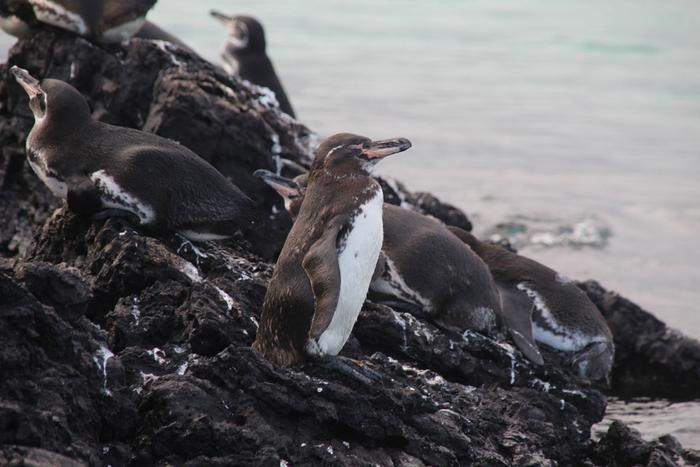
Microplastics, with a size from 1 micron to < 5 millimeters, are pervasive pollutants that have been found in all parts of the global ocean, and have made their way into the marine food webs. Researchers, led by University of British Columbia UBC’s Institute for the Oceans and Fisheries scientists and Ecuadorian researchers from Galápagos and the ESPOL Polytechnic School (Guayaquil, Ecuador), looked closely at how microplastic bioaccumulation was affecting the endangered Galápagos penguin (Spheniscus mendiculus) as an indicator species to trace how deeply microplastic bioaccumulation has entered the food web in the isolated Galápagos Islands.
An analysis of seawater collected around Santa Cruz Island, a human-populated island, with nearby Galápagos penguin colonies revealed plastic particles. Using models that focused on the Galápagos penguin diet (barracuda, sardine, herring, salema, and anchovy), and on penguin scat, researchers intuited a unique Galapagos penguin food web model using Ecopath and Ecosim (EwE) ecosystem modeling with the Ecotracer approach to track the bioaccumulation potential of microplastics in the penguins’ foodweb. They also applied a wider model for Bolivar Channel Ecosystem (between Fernandina and Isabela islands) and part of the penguin’s habitats, located at the western regions of the Galápagos Islands.

The model predictions showed a rapid increase in microplastic accumulation and contamination across the penguins’ prey organisms resulting in Galápagos penguin showing the highest level of microplastics per biomass, followed by barracuda, anchovy, sardine, herring, and salema and predatory zooplankton.
“The model predictions highlight the accumulation behavior and residence time of microplastics in the gut,” said Karly McMullen, first author and a former MSc student at the Institute for the Oceans and Fisheries at the University of British Columbia. “With microplastics emerging as a prominent ocean pollutant, entering the environment every day, there is a growing concern for marine fauna and coastal wildlife, particularly if this anthropogenic threat is reaching even the most remote and protected areas such as the Galápagos Archipelago.”
Sign up for the Daily Dose Newsletter and get every morning’s best science news from around the web delivered straight to your inbox? It’s easy like Sunday morning.
Senior autho, honorary research associate, and Principal Investigator of the Ocean Pollution Research Unit at Institute for the Oceans and Fisheries at the University of British Columbia, Dr. Juan Jose Alava, agreed. “The goal of this food web bioaccumulation modeling work was to provide science and data to support risk management of hazardous plastic waste, reduce microplastic emissions in the oceans and marine remote UNESCO Heritage sites such as the Galapagos Islands, and inform local and international marine policy to conserve endangered, endemic seabird species of Galapagos Marine Reserve.”
“It is imperative that we prioritizing efforts to reduce the input of microplastics into vulnerable ecosystems and food webs, particularly such as that of the endangered Galapagos penguin.”
IMAGE CREDIT: Karly McMullen, CC-BY 4.0 (https://creativecommons.org/licenses/by/4.0/)
If you enjoy the content we create and would like to support us, please consider becoming a patron on Patreon! By joining our community, you’ll gain access to exclusive perks such as early access to our latest content, behind-the-scenes updates, and the ability to submit questions and suggest topics for us to cover. Your support will enable us to continue creating high-quality content and reach a wider audience.
Join us on Patreon today and let’s work together to create more amazing content! https://www.patreon.com/ScientificInquirer

Leave a Reply