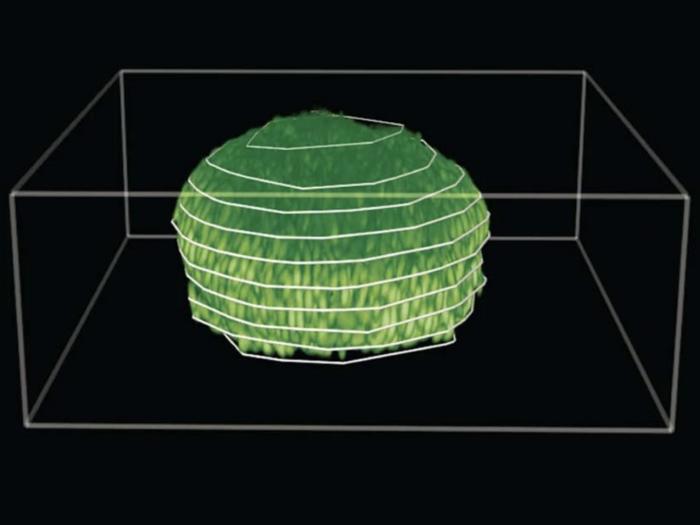
Dental plaque, gut bacteria and the slippery sheen on river rocks are all examples of biofilms, organized communities of microorganisms that colonize our bodies and the world around us. A new study led by Penn State researchers reveals exactly how growing biofilms shape their environments and fine-tune their internal architecture to fit their surroundings. The findings may have implications for a wide variety of applications, from fighting disease to engineering new types of living active materials.
“In the case of bacteria, they grow, divide, and apply forces to each other and their surroundings,” said Sulin Zhang, professor of engineering science and mechanics and of biomedical engineering at Penn State and corresponding author on a paper about the discovery, recently published in the journal Nature Physics. “As such, growing bacteria have the potential to shape the environment, changing the environment they live in, so we were interested in understanding the reciprocal interactions between the growing biofilm and environment where it grows.”
Zhang collaborated with an interdisciplinary team of researchers from the Massachusetts Institute of Technology and Yale to study that interaction on all fronts: theoretically, experimentally and computationally. The researchers used biofilms made by Vibrio cholerae, which can cause cholera, as a model system to demonstrate the self-shaping and self-organizing capability of a 3D growing system.

In nature, biofilms tend to grow in tight, confined spaces, Zhang explained, so the team grew the biofilm between a soft hydrogel and a stiff glass substrate. They analyzed the growing biofilm using single-cell imaging, agent-based simulations and continuum mechanics theory. The researchers found that the biofilms shape both themselves and their boundary into an efficient formation known as “active nematics,” the arrangement of self-propelled molecules in parallel lines instead of layers.
“We found that biofilms take advantage of growth-induced stresses to shape their environment and create a nematic structure,” said Jing Yan, assistant professor of molecular, cellular and developmental biology at Yale University and co-corresponding author on the paper. “This takes us a lot closer to being able to control the morphology, the packing and ordering of the biofilm.”
Zhang explained that understanding the feedback loop between biofilm growth, growth generated stress, and its environment could pave the way for controlled growth of beneficial biofilms, the elimination of harmful ones and even the potential development of new classes of active growing materials that can respond to — and actively alter — their environment.”
Yan added that this is especially valuable information in the field of health care. Biofilms play a substantial role in disease growth in humans and animals, as they can evade the immune response. The coordinated nature of bacterial biofilms makes them highly resistant to conventional antibiotics, so they are extremely difficult to treat. In fact, the majority of chronic antibiotic resistant-infections are caused by biofilms, according to the American Society for Microbiology.
“When a bacteria enter into the body, they grow into an infection as biofilms — and they’re in a confined environment: your gut,” Yan said.
A better understanding of how biofilm-driven disease can grow in such an environment will allow researchers to develop new ways to disrupt such growth, he added.
“What we’ve learned will aid in developing strategies to tackle these infections,” said Changhao Li, a doctoral candidate in computational mechanics at Penn State and co-author on the paper. “The phenomena discovered here could lead to new strategies to suppress the growth of harmful biofilms and give us the ability to design and program beneficial ones.”
IMAGE CREDIT: Jing Yan.
Sign up for the Daily Dose Newsletter and get the morning’s best science news from around the web delivered straight to your inbox? It’s easy like Sunday morning.


Leave a Reply