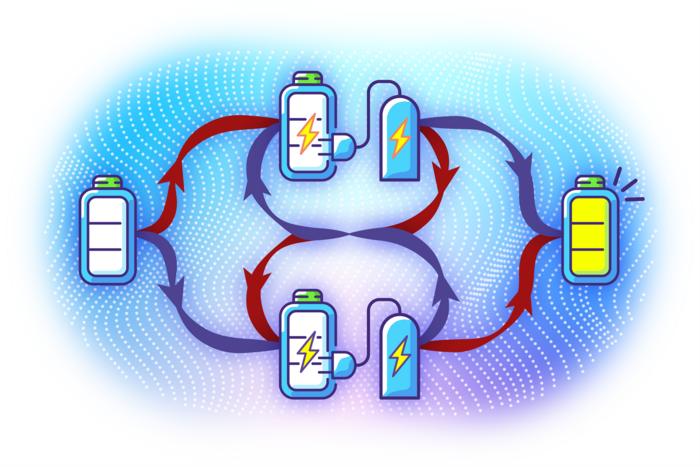
Batteries that exploit quantum phenomena to gain, distribute and store power promise to surpass the abilities and usefulness of conventional chemical batteries in certain low-power applications. For the first time, researchers including those from the University of Tokyo take advantage of an unintuitive quantum process that disregards the conventional notion of causality to improve the performance of so-called quantum batteries, bringing this future technology a little closer to reality.
When you hear the word “quantum,” the physics governing the subatomic world, developments in quantum computers tend to steal the headlines, but there are other upcoming quantum technologies worth paying attention to. One such item is the quantum battery which, though initially puzzling in name, holds unexplored potential for sustainable energy solutions and possible integration into future electric vehicles. Nevertheless, these new devices are poised to find use in various portable and low-power applications, especially when opportunities to recharge are scarce.
At present, quantum batteries only exist as laboratory experiments, and researchers around the world are working on the different aspects that are hoped to one day combine into a fully functioning and practical application. Graduate student Yuanbo Chen and Associate Professor Yoshihiko Hasegawa from the Department of Information and Communication Engineering at the University of Tokyo are investigating the best way to charge a quantum battery, and this is where time comes into play. One of the advantages of quantum batteries is that they should be incredibly efficient, but that hinges on the way they are charged.

“Current batteries for low-power devices, such as smartphones or sensors, typically use chemicals such as lithium to store charge, whereas a quantum battery uses microscopic particles like arrays of atoms,” said Chen. “While chemical batteries are governed by classical laws of physics, microscopic particles are quantum in nature, so we have a chance to explore ways of using them that bend or even break our intuitive notions of what takes place at small scales. I’m particularly interested in the way quantum particles can work to violate one of our most fundamental experiences, that of time.”
In collaboration with researcher Gaoyan Zhu and Professor Peng Xue from Beijing Computational Science Research Center, the team experimented with ways to charge a quantum battery using optical apparatuses such as lasers, lenses and mirrors, but the way they achieved it necessitated a quantum effect where events are not causally connected the way everyday things are. Earlier methods to charge a quantum battery involved a series of charging stages one after the other. However, here, the team instead used a novel quantum effect they call indefinite causal order, or ICO. In the classical realm, causality follows a clear path, meaning that if event A leads to event B, then the possibility of B causing A is excluded. However, at the quantum scale, ICO allows both directions of causality to exist in what’s known as a quantum superposition, where both can be simultaneously true.
“With ICO, we demonstrated that the way you charge a battery made up of quantum particles could drastically impact its performance,” said Chen. “We saw huge gains in both the energy stored in the system and the thermal efficiency. And somewhat counterintuitively, we discovered the surprising effect of an interaction that’s the inverse of what you might expect: A lower-power charger could provide higher energies with greater efficiency than a comparably higher-power charger using the same apparatus.”
The phenomenon of ICO the team explored could find uses beyond charging a new generation of low-power devices. The underlying principles, including the inverse interaction effect uncovered here, could improve the performance of other tasks involving thermodynamics or processes that involve the transfer of heat. One promising example is solar panels, where heat effects can reduce their efficiency, but ICO could be used to mitigate those and lead to gains in efficiency instead.
IMAGE CREDIT: Chen et al.
Sign up for the Daily Dose Newsletter and get the morning’s best science news from around the web delivered straight to your inbox? It’s easy like Sunday morning.



Leave a Reply