Researchers at Nagoya University’s Graduate School of Bioagricultural Sciences and the National Institute of Physiological Sciences in Japan have demonstrated how a specific type of neuron in the brain affects the release of hormones that control ovarian function, such as follicular development and ovulation in females. These findings, published in the journal Scientific Reports, could help researchers understand and treat reproductive disorders in both animals and humans.
Kisspeptin neurons in the brain regulate the release of hypothalamic gonadotropin-releasing hormone (GnRH) and pituitary follicle-stimulating hormone/luteinizing hormone (LH). This process is important for reproduction, as pituitary hormones stimulate the ovaries to perform their reproductive functions. Examples include follicular development and ovulation in all mammals, including humans.
There are two main areas of the brain involved in the process: the arcuate nucleus (ARC), in which kisspeptin neurons maintain the regular rhythmic (pulsatile) secretion of GnRH/LH that maintains normal follicular development and sex steroid production; and the anteroventral periventricular nucleus (AVPV), in which kisspeptin neurons trigger a surge of GnRH/LH that leads to ovulation.

The researchers focused on the fact that kisspeptin neurons in the ARC produce and respond to dynorphin, an inhibitory substance. “Kisspeptin neurons in the ARC express both dynorphin and its receptor, whereas those in the AVPV express the receptor only, suggesting a particular role of such kisspeptin neurons in fertilization,” Mayuko Nagae, a postdoctoral fellow, and Yoshihisa Uenoyama, an associate professor at Nagoya University in Japan and corresponding author of the paper, explained in a joint statement. “However, the exact role of dynorphin and its receptor in the regulation of kisspeptin neurons was not clearly understood.”
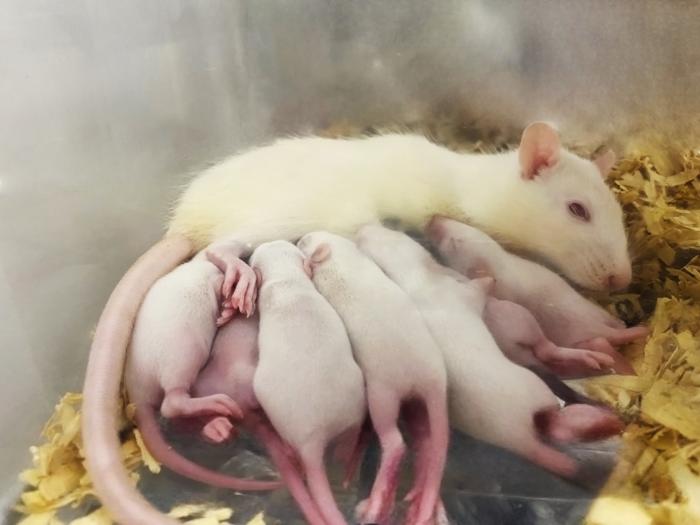
To investigate this, the researchers genetically modified female rats to delete Kiss1, a gene that codes for kisspeptin, only in neurons that expressed the dynorphin receptor. They found that the genetically modified rats with deleted Kiss1 in dynorphin receptor-expressing cells had only 3% of kisspeptin neurons in the ARC and 50% in the AVPV. The rats were still fertile, but they had a longer estrous cycle, lower ovarian weight, and fewer pups than normal rats.
The results indicate that kisspeptin neurons with dynorphin receptors are important for normal female rat reproduction, as they allow proper hormone secretion and ovulation. “This is the first report to show that kisspeptin neurons receiving direct input of dynorphin are needed to fully generate the GnRH/LH pulse and surge in female rats,” says Professor Hiroko Tsukamura from Nagoya University, the principal investigator of the research group and another corresponding author of the paper.
Professor Tsukamura is excited about the prospect of more studies to understand the molecular mechanism that controls kisspeptin neuronal activity. She says, “Our findings can help our understanding of the central mechanism underlying reproduction and have applications in the treatment of ovarian disorders in livestock and infertility in humans.”
IMAGE CREDIT: YOSHIHISA UENOYAMA, GRADUATE SCHOOL OF BIOAGRICULTURAL SCIENCES, NAGOYA UNIVERSITY
Sign up for the Daily Dose Newsletter and get the morning’s best science news from around the web delivered straight to your inbox? It’s easy like Sunday morning.




Leave a Reply