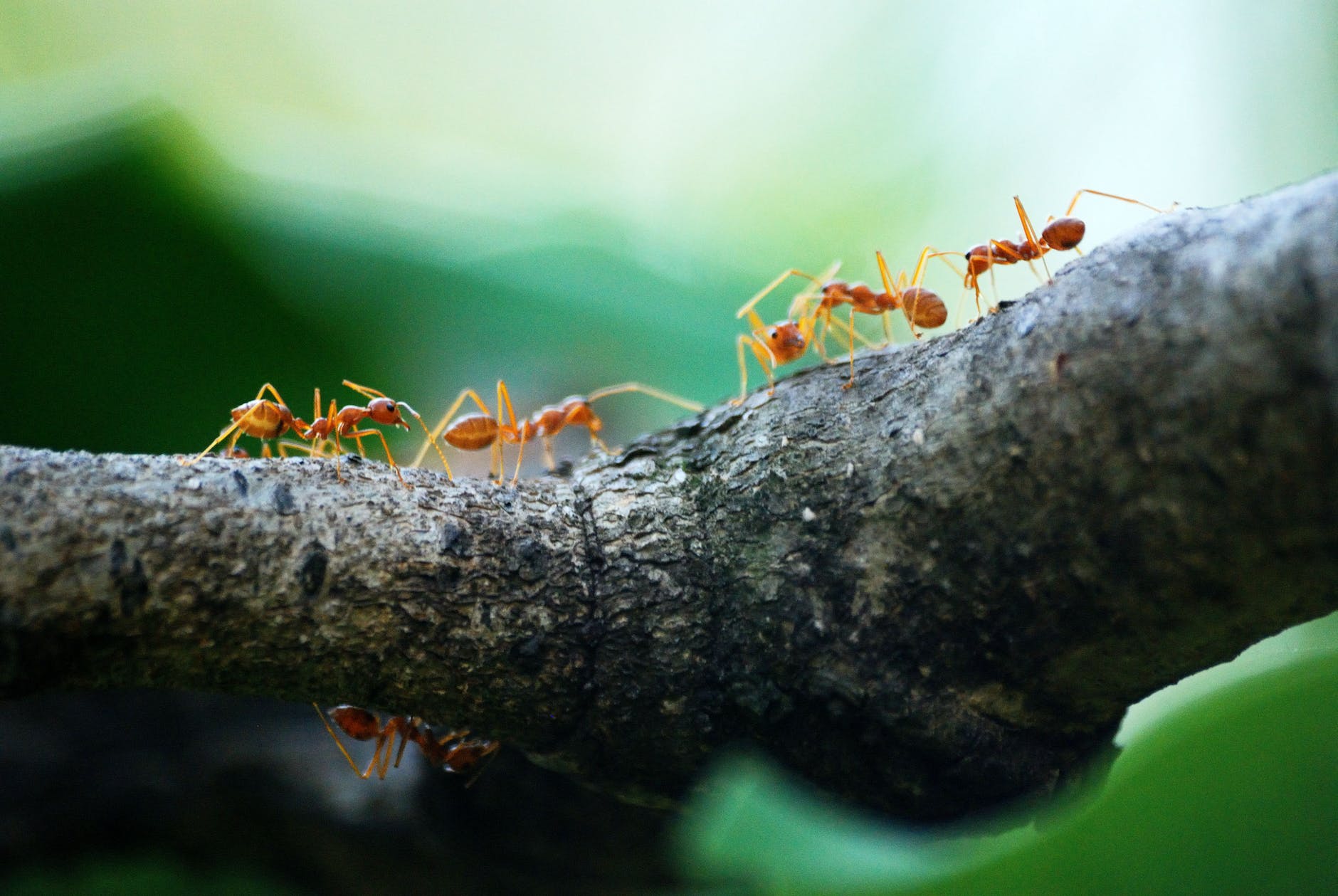
Could ants’ nests hold the secret to reducing traffic congestion on the 405 Freeway?
In a new study, UCLA biologists discovered insights about how ants build their nests that could be useful for designing more efficient human transportation systems.
The scientists were interested in learning whether the way ants build their nests is more influenced by the evolutionary history of each individual species or current ecological conditions. What they found was that evolution could not explain the variations they observed among different species’ nests. Rather, they found, the environments in which ants forage and the way they transport food are the main factors that dictate how each species builds its nests.
The lesson for humans? If roads were better tailored to the ways goods and people move through our cities, transportation networks could be more efficient. For example, congestion on Southern California’s freeways might be improved if there were dedicated lanes or roads for trucks traveling to and from major logistics hubs like ports, warehouses and distribution centers.

“Ants deal with the same issues we deal with when it comes to living in crowded spaces,” said Sean O’Fallon, a UCLA doctoral student in ecology and evolutionary biology, and the study’s first author. “We’re densely packed in cities, and ideally we should be densely connected, but there are constraints to how closely packed together we can be. There’s only so much space to construct buildings and roads.”
In the study, published in Philosophical Transactions of the Royal Society B, scientists analyzed information from two sources — details about 397 ant nests came from previously published data and images, and the authors conducted new studies of 42 other nests, all located at the Archbold Biological Reserve near Venus, Florida. In total, the 439 nests represented 31 different species of ants.
They discovered that nest structures were largely determined by factors like whether ants foraged alone or in groups, as well as the methods they used to recruit other ants to help find and carry food. In a nutshell, the animals’ activity and behavior play bigger roles in nest construction than any innate evolutionary template.
“You can think of the nest itself as a transportation network — it’s where ants live, but it’s also a kind of highway network they move things in and out of,” said Noa Pinter-Wollman, a UCLA professor of ecology and evolutionary biology and the paper’s corresponding author.
The researchers examined four common foraging strategies used by ants. In some species, individual ants hunt for food. In others, an ant brings food to the nest as a means of recruiting other ants to accompany it to the food source. Ants can also form a continuous trail between the food source and the nest that can persist for months. Or they can leave a pheromone trail that members of the colony can follow in large numbers — a phenomenon the researchers called “mass recruitment.”
Ants’ nests consist of a tunnel leading down to an entrance chamber, where ants enlist other members of their colony to help them find or transport food. From the entrance chamber, tunnels lead down to other chambers, which are connected by tunnels to still deeper chambers. Chambers serve different purposes, such as food and waste storage and rearing young.
The researchers expected that in ant species that use the mass recruitment style of foraging, the nests’ entrance chambers would be larger than they are in other species’ nests, because those spaces would need to allow larger numbers of ants to interact. And indeed, they found that to be the case.
However, the scientists also expected that nests for the mass recruitment foragers would have greater “network density” — meaning larger numbers of connections among the chambers — than nests built by other species. Greater network density, the scientists reasoned, would help facilitate more movement of ants and resources throughout the nest.
But the research revealed that for ants representing all four foraging strategies, network density was relatively low — even for large nests with hundreds of chambers. In fact, the study revealed, across all foraging strategies, nests with the most chambers tended to have the lowest network density.
In the paper, the researchers write that finding could be simply a function of architecture: Too many tunnels between chambers could weaken the structural integrity of the nest, which could cause the entire system to collapse.
“Ants have to balance the efficiency of highly connected nests with architectural stability,” Pinter-Wollman said. “On one hand, they want transportation to be faster, but if they start making too many connections, the nest will crumble.
IMAGE CREDIT: (ENTER NAMES)
Sign up for the Daily Dose Newsletter and get the morning’s best science news from around the web delivered straight to your inbox? It’s easy like Sunday morning.


Leave a Reply