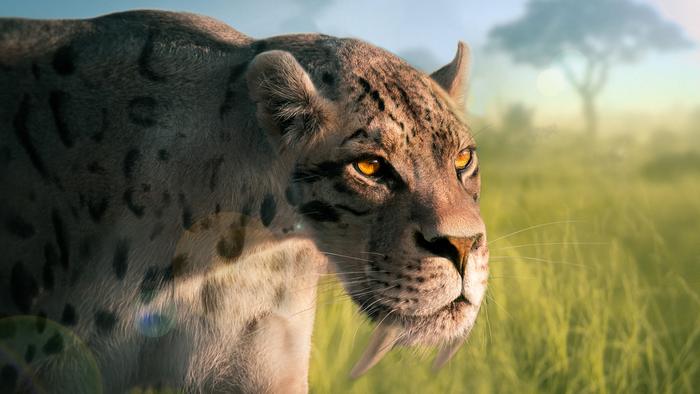
When a sabertooth tiger called out, what noise did it make – a mighty roar or a throaty purr? A new study from North Carolina State University examined the data behind the arguments for each vocalization and found that the answer was more nuanced than they thought – and that it could depend on the shape of a few small bones.
Modern cats belong to one of two groups: either the pantherine “big cats,” including the roaring lions, tigers and jaguars; or Felinae “little cats,” which include purring cats like lynxes, cougars, ocelots and domestic cats.
“Evolutionarily speaking, sabertooths split off the cat family tree before these other modern groups did,” says Adam Hartstone-Rose, professor of biological sciences at NC State and corresponding author of the research. “This means that lions are more closely related to housecats than either are to sabertooths.

“That’s important because the debate over the kind of vocalization a sabertooth tiger would have made relies upon analyzing the anatomy of a handful of tiny bones located in the throat,” Hartstone-Rose says. “And the size, shape and number of those bones differ between modern roaring and purring cats.”
Although vocalization is driven by the larynx and soft tissue in the throat, not bones, anatomists noticed that the bones responsible for anchoring those tissues in place – the hyoid bones – differed in size and number between roaring and purring cats.
“While humans have only one hyoid bone, purring cats have nine bones linked together in a chain and roaring cats have seven,” says Ashley Deutsch, a Ph.D. student at NC State and lead author of the research. “The missing bones are located toward the top of the hyoid structure near where it connects to the skull.”
“Because sabertooth tigers only have seven bones in their hyoid structure, the argument has been that of course they roared,” Hartstone-Rose says. “But when we looked at the anatomy of modern cats, we realized that there isn’t really hard evidence to support this idea, since the bones themselves aren’t responsible for the vocalization. That relationship between the number of bones and the sound produced hasn’t ever really been proven.”
The researchers looked at the hyoid structures of four species of roaring cats: lions, tigers, leopards and jaguars; and five species of purring cats: cougars, cheetahs, caracals, servals and ocelots. They compared these to 105 hyoid bones from the iconic sabertooth tiger Smilodon fatalis.
“You can argue that since the sabertooths only have seven bones they roared, but that’s not the whole story,” Hartstone-Rose says. “The anatomy is weird. They’re missing extra bones that purring cats have, but the shape and size of the hyoid bones are distinct. Some of them are shaped more like those of purring cats, but much bigger.”
According to the researchers, if the missing bones (called epihyoid bones) were key to different vocalizations, the bones most closely connected to them should look different between the two groups. However, those bones looked very similar in shape whether they came from purring or roaring cats.
In fact, the researchers saw more shape variation in the bones closer to the vocal apparatus; i.e., the thyrohyoid and basihyoid bones. The uniformity of the upper bones between the two groups suggests that if the hyoid structure plays a role in vocalization, the lower bones are more important than the upper ones. So having these key hyoid bones shaped like those of purring cats could indicate that they purred rather than roared.
“We found that despite what history has told us about the number of bones in the hyoid structure, no one has validated the significance of that difference,” Hartstone-Rose says. “If vocalization is about the number of bones in the hyoid structure, then sabertooths roared. If it’s about shape, they might have purred. Due to the fact that the sabertooths have things in common with both groups, there could even be a completely different vocalization.”
“It is perhaps most likely that the size of the hyoids plays a role in the pitch of vocalization,” says Deutsch. “Although Smilodon wasn’t quite as big as the largest modern cats, its hyoid bones are substantially larger than those of any of their living relatives, so potentially they had even deeper vocalizations than the largest tigers and lions.”
The work appears in the Journal of Morphology and was supported by NC State’s Office of Undergraduate Research. Brian Langerhans, associate professor of biology at NC State, and former NC State undergraduate Deanna Flores also contributed to the work.
IMAGE CREDIT: Adam Hartstone-Rose.
Sign up for the Daily Dose Newsletter and get the morning’s best science news from around the web delivered straight to your inbox? It’s easy like Sunday morning.



Leave a Reply