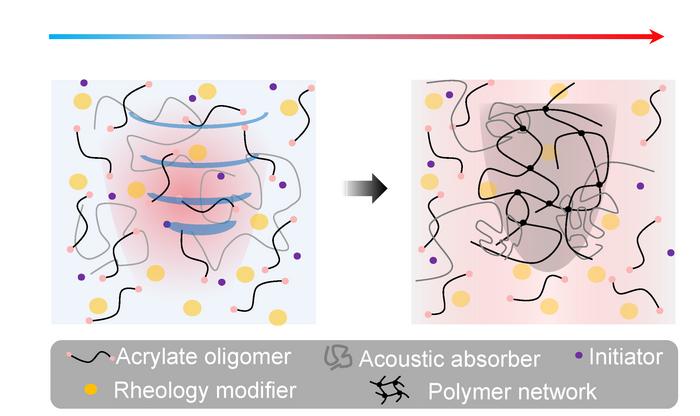
Engineers at Duke University and Harvard Medical School have developed a bio-compatible ink that solidifies into different 3D shapes and structures by absorbing ultrasound waves. Because it responds to sound waves rather than light, the ink can be used in deep tissues for biomedical purposes ranging from bone healing to heart valve repair.
This work appears on December 7 in the journal Science.
The uses for 3D-printing tools are ever increasing. Printers create prototypes of medical devices, design flexible, lightweight electronics, and even engineer tissues used in wound healing. But many of these printing techniques involve building the object point-by-point in a slow and arduous process that often requires a robust printing platform.
To circumvent these issues over the past several years, researchers developed a photo-sensitive ink that responds directly to targeted beams of light and quickly hardens into a desired structure. While this printing technique can substantially improve the speed and quality of a print, researchers can only use transparent inks for the prints, and biomedical purposes are limited, as light can’t reach beyond a few millimeters deep into tissue.

Now, Y. Shrike Zhang, associate bioengineer at Brigham and Women’s Hospital and associate professor at Harvard Medical School, and Junjie Yao, associate professor of biomedical engineering at Duke, have developed a new printing method called deep-penetrating acoustic volumetric printing, or DVAP, that resolves these problems. This new technique involves a specialized ink that reacts to soundwaves rather than light, enabling them to create biomedically useful structures at unprecedented tissue depths.
“DVAP relies on the sonothermal effect, which occurs when soundwaves are absorbed and increase the temperature to harden our ink,” explained Yao, who designed the ultrasound printing technology for DVAP. “Ultrasound waves can penetrate more than 100 times deeper than light while still spatially confined, so we can reach tissues, bones and organs with high spatial precision that haven’t been reachable with light-based printing methods.”
The first component of DVAP involves a sonicated ink, called sono-ink, that is a combination of hydrogels, microparticles and molecules designed to specifically react to ultrasound waves. Once the sono-ink is delivered into the target area, a specialized ultrasound printing probe sends focused ultrasound waves into the ink, hardening portions of it into intricate structures. These structures can range from a hexagonal scaffold that mimics the hardness of bone to a bubble of hydrogel that can be placed on an organ.
“The ink itself is a viscous liquid, so it can be injected into a targeted area fairly easily, and as you move the ultrasound printing probe around, the materials in the ink will link together and harden,” said Zhang, who designed the sono-ink in his lab at the Brigham. “Once it’s done, you can remove any remaining ink that isn’t solidified via a syringe.”
The different components of the sono-ink enable the researchers to adjust the formula for a wide variety uses. For example, if they want to create a scaffold to help heal a broken bone or make up for bone loss, they can add bone mineral particles to the ink. This flexibility also allows them to engineer the hardened formula to be more durable or more degradable, depending on its use. They can even adjust the colors of their final print.
The team conducted three tests as a proof-of-concept of their new technique. The first involved using the ink to seal off a section in a goat’s heart. When a human has nonvalvular atrial fibrillation, the heart won’t beat correctly, causing blood to pool in the organ. Traditional treatment often requires open-chest surgery to seal off the left atrial appendage to reduce the risk of blood clots and heart attack.
Instead, the team used a catheter to deliver their sono-ink to the left atrial appendage in a goat heart that was placed in a printing chamber. The ultrasound probe then delivered focused ultrasound waves through 12 mm of tissue, hardening the ink without damaging any of the surrounding organ. Once the process was complete, the ink was safely bonded to the heart tissue and was flexible enough to withstand movements that mimicked the heart beating.
Next, the team tested the potential for DVAP’s use for tissue reconstruction and regeneration. After creating a bone defect model using a chicken leg, the team injected the sono-ink and hardened it through 10 mm of sample skin and muscle tissue layers. The resulting material bonded seamlessly to the bone and didn’t negatively impact any of the surrounding tissues.
Finally, Yao and Zhang showed that DVAP could also be used for therapeutic drug delivery. In their example, they added a common chemotherapy drug to their ink, which they delivered to sample liver tissue. Using their probe, they hardened the sono-ink into hydrogels that slowly release the chemotherapy and diffuse into the liver tissue.
“We’re still far from bringing this tool into the clinic, but these tests reaffirmed the potential of this technology,” said Zhang. “We’re very excited to see where it can go from here.”
“Because we can print through tissue, it allows for a lot of potential applications in surgery and therapy that traditionally involve very invasive and disruptive methods,” said Yao. “This work opens up an exciting new avenue in the 3D printing world, and we’re excited to explore the potential of this tool together.”
IMAGE CREDIT: Junjie Yao, Duke University; Shrike Yu Zhang, Harvard Medical School.
Sign up for the Daily Dose Newsletter and get the morning’s best science news from around the web delivered straight to your inbox? It’s easy like Sunday morning.


Leave a Reply