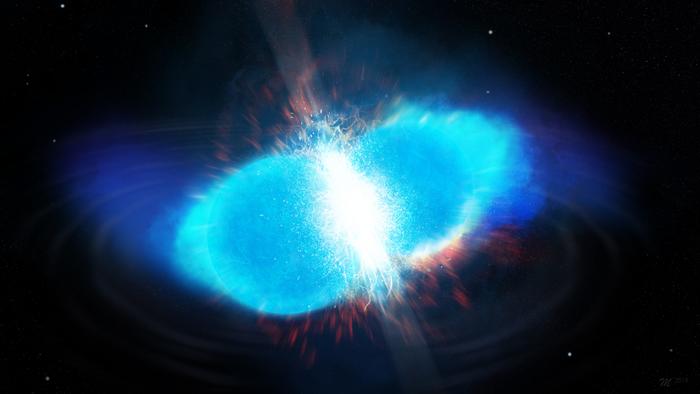
The elements above iron on the periodic table are thought to be created in cataclysmic explosions like the merger of two neutron stars or in rare classes of supernovae. New research suggests fission may operate in the cosmos during the creation of the heavy elements. Combing through data on a variety of elements that reside in very old stars, researchers have found a potential signature of fission, indicating that nature is likely to produce superheavy nuclei beyond the heaviest elements on the periodic table.
“People have thought fission was happening in the cosmos, but to date, no one has been able to prove it,” said Matthew Mumpower, a theoretical physicist at Los Alamos National Laboratory and co-author of a paper in Science presenting the research.
Using the latest observations, Mumpower said, the researchers found a correlation between light precision metals like silver and rare earth nuclei like europium. When one of these groups of elements goes up, the corresponding elements in the other group also increase — the correlation is positive.

“The only plausible way this can arise among different stars is if there is a consistent process operating during the formation of the heavy elements,” Mumpower said. The team tested all the possibilities and fission was the only explanation that was able to reproduce the trend.
“This is incredibly profound and is the first evidence of fission operating in the cosmos, confirming a theory we proposed several years ago,” Mumpower said. “As we’ve acquired more observations, the cosmos is saying hey, there’s a signature here, and it can only come from fission.”
The research also indicates that elements with an atomic mass (the number of protons plus neutrons) of 260 — heavier than those charted at the high end of the periodic table — may exist.
Mumpower developed the fission models used to predict and guide the observational findings, which were led by study author Ian Roederer of North Carolina State University.
Heavy research
Astrophysicists have long believed heavy elements beyond iron were formed in stellar explosions called supernova or when two neutron stars merged. As the name implies, the latter are composed largely of neutrons, which together with protons form the nuclei of all atoms. Through the rapid-neutron capture process, dubbed the r-process, atomic nuclei grab neutrons to form heavier elements. Whether some grow too heavy to hold together and split, or fission, forming two atoms of lighter but still heavy elements (and releasing tremendous energy) has remained a mystery for a half century.
In a 2020 paper, Mumpower first predicted the distributions of fission fragments for r-process nuclei. A subsequent study led by collaborator Nicole Vassh at TRIUMF predicted the co-production of light precision metals and rare earth nuclei. This co-production of elements like elements ruthenium, rhodium, palladium and silver, and those like europium, gadolinium, dysprosium and holmium, can be tested by comparing the prediction with elemental abundances in a collection of stars.
The new analysis led by Roederer combed through observational data from 42 stars and found precisely the predicted correlation. The pattern provides a clear signature of fission creating these elements and a similar pattern of elements slightly heavier and higher on the periodic table.
“The correlation is very robust in r-process enhanced stars where we have sufficient data. Every time nature produces an atom of silver, it’s also producing heavier rare earth nuclei in proportion. The composition of these element groups are in lock step,” Mumpower said. “We have shown that only one mechanism can be responsible — fission — and people have been racking brains about this since the 1950s.”
From stockpile stewardship to the stars
“At Los Alamos, we developed nuclear fission models because we can’t measure everything that’s relevant for weapons research as part of the Laboratory’s mission,” Mumpower said. The models allow physicists to interpret experiments and fill in data when measurements are lacking. Since the United States halted testing of nuclear weapons in 1992, experimental data on fission has been limited.
The models perform exceptionally well when compared to measured data and thus give credence to their extrapolations where there are no measurements. The nuclear inputs of both short-lived and long-lived species are required for studies of heavy element formation, Mumpower said. Fission yields are products of the process of splitting relatively heavy atoms into lighter ones — the same process used in nuclear weapons and reactors.
IMAGE CREDIT: Los Alamos National Laboratory (Matthew Mumpower).
Sign up for the Daily Dose Newsletter and get the morning’s best science news from around the web delivered straight to your inbox? It’s easy like Sunday morning.




Leave a Reply