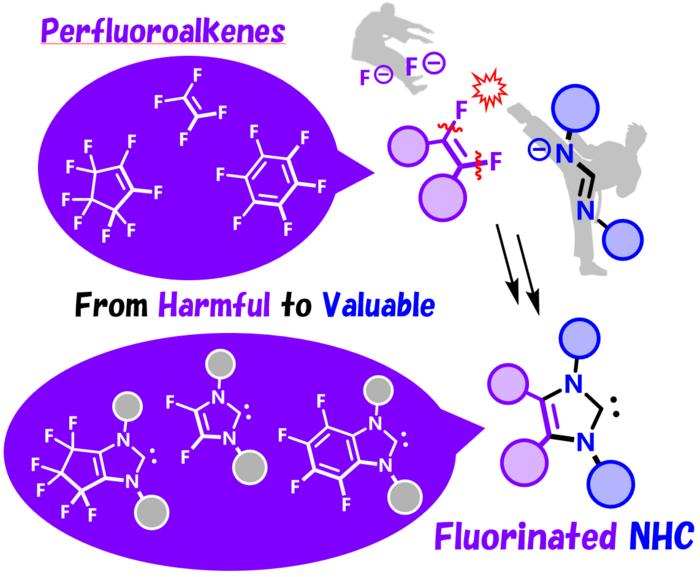
Commonly known as “forever chemicals,” PFAS are notorious for persisting in the environment and in our bodies. Osaka Metropolitan University chemists may put an end to the “forever” life of PFAS with their simple yet innovative technique that converts these harmful substances into valuable compounds.
A research group led by Professor Masato Ohashi and Assistant Professor Kenichi Michigami of the Graduate School of Science at Osaka Metropolitan University has successfully synthesized ligands called fluorine-decorated N-heterocyclic carbenes (NHCs) from perfluoroalkenes, a type of PFAS (Perfluoroalkyl and Polyfluoroalkyl Substances). The NHCs developed in this study play significant roles in stabilizing unstable molecules as well as enhancing the performance of their ligated transition metal complexes.

The synthesis of fluorinated NHCs was achieved simply by removing two fluorine atoms from 1,2-difluoroalkene derivatives. Owing to the small size of fluorine atoms, the electron-accepting ability of the NHC ligand can be enhanced without substantially changing its steric properties.
“Our results enable the easy transformation of harmful PFAS into functional NHCs,” explained Dr. Michigami. “The versatile applications of fluorinated NHCs show potential advantages in various fields such as fluorine chemistry, organometallic chemistry, catalysis chemistry, and materials science.”
IMAGE CREDIT: Kenichi Michigami, Osaka Metropolitan University.
Sign up for the Daily Dose Newsletter and get the morning’s best science news from around the web delivered straight to your inbox? It’s easy like Sunday morning.


Leave a Reply