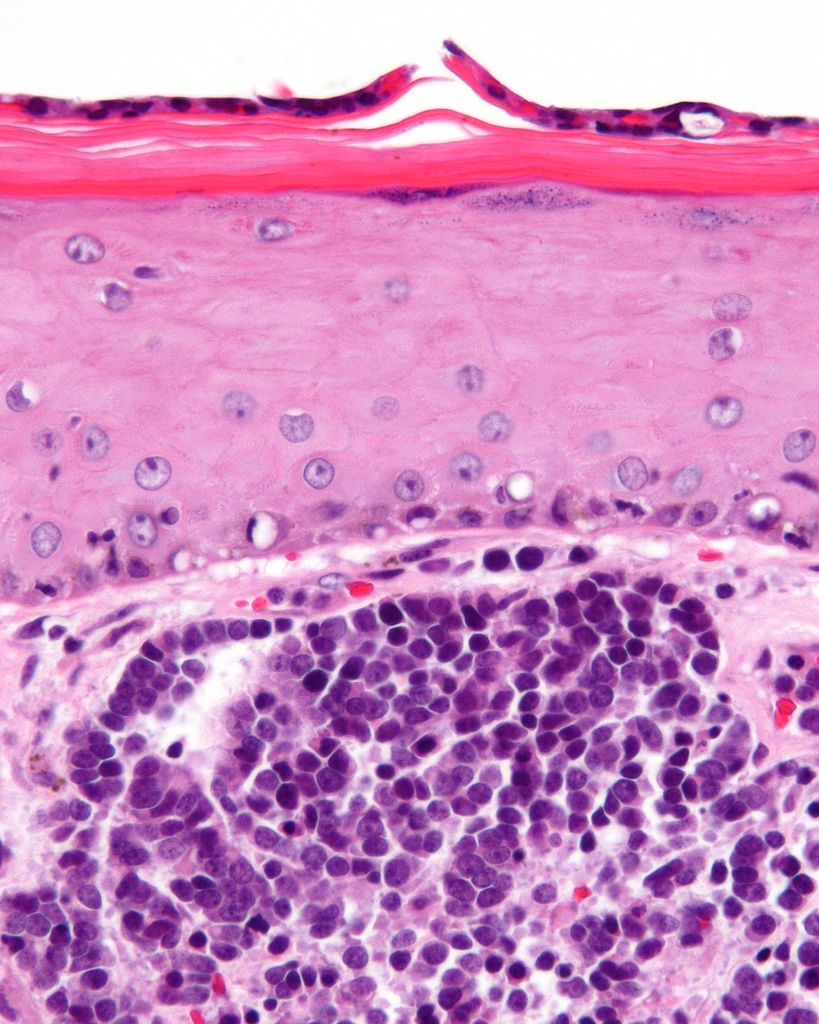
University of Pittsburgh researchers have shown for the first time how Merkel cell polyomavirus (MCV), which causes an aggressive skin cancer called Merkel cell carcinoma, initiates DNA replication in host cells.
Published today in the journal PNAS, the study sheds light on the fundamental question of how viruses override their host cells’ carefully regulated DNA replicating system to make hundreds of new copies of themselves.
“Understanding how MCV replicates gives us really important clues about how this virus can cause cancer,” said co-senior author Patrick Moore, M.D., distinguished professor in the Pitt School of Medicine’sDepartment of Microbiology and Medical Genetics and UPMC Hillman Cancer Center. “It also provides insight into other cancer-causing viruses and why some viruses don’t cause cancer. In the future, this might help us develop new therapeutics or vaccines against cancers caused by infection.”
If you enjoy the content we create and would like to support us, please consider becoming a patron on Patreon! By joining our community, you’ll gain access to exclusive perks such as early access to our latest content, behind-the-scenes updates, and the ability to submit questions and suggest topics for us to cover. Your support will enable us to continue creating high-quality content and reach a wider audience.
Join us on Patreon today and let’s work together to create more amazing content! https://www.patreon.com/ScientificInquirer
Moore and co-senior author Yuan Chang, M.D., distinguished professor in the Department of Pathology and UPMC Hillman Cancer Center first discovered MCV in 2008. According to Moore, most adults harbor this virus, which is usually harmless but occasionally causes Merkel cell carcinoma, a deadly form of skin cancer that is diagnosed in about 3,000 people in the U.S. each year.
In the new study, which was led by postdoctoral associate Li (James) Wan, Ph.D., the researchers teamed up with Bennett Van Houten, Ph.D., professor in Pitt’s Department of Pharmacology & Chemical Biology, and postdoctoral fellow Matthew Schaich, Ph.D., to study MCV replication in never-before-seen detail using an instrument called a C-trap and a technique called SMADNE.
“Until now, we’ve had to infer how viruses replicate from static images, which are essentially just a snapshot in time,” said Moore. “The C-trap allows us to watch proteins bind to a single molecule of DNA in real-time as little dots of light. It’s like watching a movie instead of looking at a photograph.”
During normal cell division, the first step of DNA replication involves proteins called helicases that form two sleeves around the DNA double helix. These sleeves push together to unzip the double-stranded DNA into single strands so that other proteins can bind and perform the next steps. This unzipping process requires cellular energy in the form of the molecule ATP.
“DNA replication is tightly controlled by the cell,” said Moore. “If any one of the 3 billion base pairs that make up our genome has a mutation, it can cause cancer or other diseases, so an enormous amount of energy is spent on checking for errors and making sure that conditions in the cell are correct for replication.”
Known as licensed DNA replication, this controlled process occurs only once each time a cell divides.
In contrast, when a virus hijacks a host cell’s DNA replication machinery, it replicates hundreds of times.
This “unlicensed” replication is not subject to the same quality control and is much more prone to errors. With MCV, certain mutations can cause the virus’s entire genetic code, or genome, to get inserted into its host’s genome, causing previously normal cells to undergo uninhibited growth and division to become cancerous. Moore and Chang’s team found that MCV’s version of helicase does not form sleeves around the DNA as they had expected. Instead, it directly pries apart the DNA molecule. The viral helicase can do this repeatedly without using ATP, enabling the virus to outcompete normal cellular replication.
According to Moore, this research could eventually lead to new antiviral therapies, not for MCV because it’s usually harmless, but for closely related viruses such as those known as JC and BK that are major problems for transplant patients or for other cancer-causing viruses.
In addition to MCV, six other human viruses are known to cause cancer, including human papillomavirus (HPV) that causes cervical and head-and neck cancer and Kaposi sarcoma herpesvirus — also discovered by Moore and Chang — which causes a type of cancer that forms in the lining of the blood and lymph vessels.
Going forward, the researchers plan to broaden their understanding of viral replication by studying some of these other cancer-causing viruses in comparison to MCV.
“Viruses are like tiny little robots, but they still have very complicated mechanisms that allow them to sense their environment and detect what’s happening in the host cell so they know when it’s most beneficial to go from a quiet, or latent, state to initiating replication,” said Moore. “Learning how they replicate is central for developing safe and effective antiviral medications or vaccines that target these proteins within a cancer cell.”
IMAGE CREDIT: NASA.



Leave a Reply