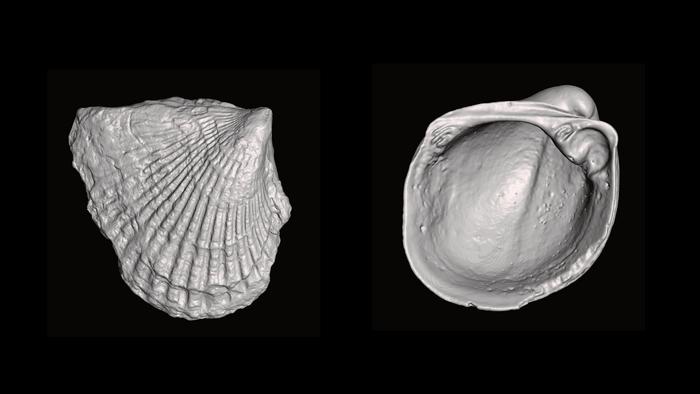
Every so often, life on Earth steps onto a nearly empty playing field and faces a spectacular opportunity. Something major changes—in the atmosphere or in the oceans, or in the organisms themselves —and the existing species begin to branch out into a brand-new world. Scientists are fascinated by this process, because it’s a unique look into evolution at pivotal moments in the history of life.
A new study led by scientists with the University of Chicago examined how bivalves—the group that includes clams, mussels, scallops, and oysters—evolved among many others in the period of rapid evolution known as the Cambrian Explosion. The team found that though many other lineages burst into action and quickly evolved a wide variety of forms and functions, the bivalves lagged behind, perhaps because they took too long to evolve a particular adaptation they needed to flourish.
The study has implications for how we understand evolution and the impact of extinctions, the scientists said.
If you enjoy the content we create and would like to support us, please consider becoming a patron on Patreon! By joining our community, you’ll gain access to exclusive perks such as early access to our latest content, behind-the-scenes updates, and the ability to submit questions and suggest topics for us to cover. Your support will enable us to continue creating high-quality content and reach a wider audience.
Join us on Patreon today and let’s work together to create more amazing content! https://www.patreon.com/ScientificInquirer
Shell and high water
A little more than 500 million years ago, the diversity of life on Earth suddenly exploded. Known as the Cambrian Explosion, this dramatic episode saw the emergence of many forms of life that persist today.
Among these were the bivalves—hard-twin-shelled organisms that live on the seafloor. A group of researchers decided to catalogue the rise of the bivalves to see how they fared in a nearly empty sea with a brand-new body design.
The research team, including Stewart Edie (PhD’18) with the Smithsonian’s National Museum of Natural History, Katie Collins with the U.K.’s Natural History Museum, and Sharon Zhou, a fourth-year undergraduate student at UChicago, went through the fossil record and painstakingly examined each known fossil species to get a picture of how the bivalves evolved new forms and ways of living—such as burrowing into the seafloor sediment versus attaching themselves to rocks. “For example, you can look at the shape of the shell and tell if they are likely digging into the seafloor sediment, because they become long and thin for burrowing,” explained Zhou.
They pieced together a comprehensive picture of the bivalves’ evolution—and were surprised.
“You might think that they would take immediate advantage of this new body design and go on to fame and biological fortune,” said David Jablonski, the William R. Kenan Jr. Distinguished Service Professor of Geophysical Sciences at UChicago and co-corresponding author on the paper. “But they didn’t.”
Instead, the bivalves branched out slowly compared to other groups that originated at the time. “It’s kind of amazing they made it through at all,” said Jablonski. “Even after they got their act together and began to diversify about 40 million years in, they never showed a true explosion in species or ecologies.”
One thing they wanted to check was whether this could be a false impression caused by some gap in the fossil record. Collins explained that fossils from that era are difficult to find in the first place—many rocks have since been metamorphized into other rock types—and also hard to identify where they do exist.
However, Edie and Zhou ran a series of tests and computer simulations and found this was unlikely to have affected the results: “We’d need a really extreme simulation to change the pattern we see in the rocks,” said Edie. “It’s much more likely that this slow start was the real story.”
It’s not clear why the bivalves lagged, but one possibility is that they hadn’t yet evolved a key organ that allowed them to take off: an enlarged gill to filter out plankton from water, as so many bivalves do today. By the time they came up with this adaptation, the seafloor was much more crowded. “If you show up early to the dance floor, you can do whatever you want, but if you show up late, it restricts the range of moves,” Jablonski said.
But the bivalves do survive and even thrive today, despite their lag. “It tells us there’s more than one pathway to success, even when you are starting at the very beginning of multicellular life,” said Jablonski.
Scientists are particularly interested in cataloguing these accounts of evolution, because they can suggest how life adapts and radiates in the wake of major disruptions or extinctions. The researchers plan to look at bivalves’ response to extinctions over time and see if similar patterns emerge.
“For all kinds of reasons, we want to understand what it means to repopulate after an extinction—for example, what could happen as a result of the major extinction we are undergoing right now,” said Jablonski.
The study was also a learning experience for Zhou, who is an undergraduate at the University of Chicago.
Zhou intended to major in math, but was hooked on evolutionary biology after she took a course to fulfill UChicago’s Core requirements in the sciences. She spent several years working in Jablonski’s lab, and now plans to attend graduate school in the subject.
“How life happens on earth—to me, that is one of the greatest mysteries we can try to solve,” said Zhou.
IMAGE CREDIT: Stewart Edie

Leave a Reply