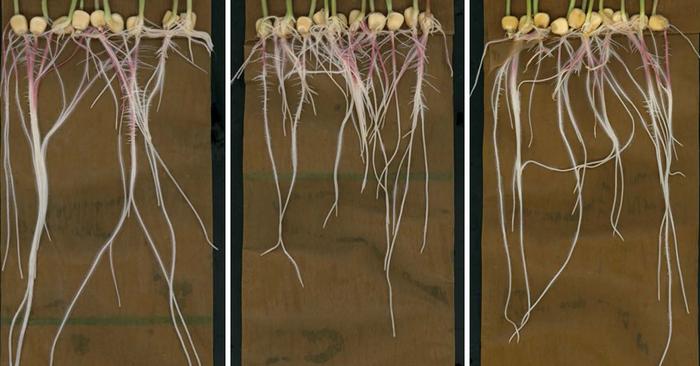
On a sunny springtime stroll through a park, it’s easy to ignore the parts of plants that are hidden from view. Plant biologists see things differently. They look below the surface where plant roots are organized in elaborate systems that are critical to the organism’s development. Intricately organized tree root systems, for example, can span as far underground as the tree grows high above the soil.
Applying an advanced imaging technology to plant roots, researchers at the University of California San Diego and Stanford University have developed a new understanding of essential root chemicals that are responsible for plant growth. Using a type of mass spectrometer, a study led by UC San Diego Biological Sciences Postdoctoral Scholar Tao Zhang and Assistant Professor Alexandra Dickinson produced a “roadmap” that profiles where key small molecules are distributed along stem cells of maize (corn) plant roots and how their placement factors into the plant’s maturation. The findings were published in the journal Nature Communications.
“This chemical roadmap provides a resource that scientists can use to find new ways of regulating plant growth,” said Dickinson, a faculty member in the Department of Cell and Developmental Biology. “Having more information about how roots grow could be useful in conservation as we think about protecting our plants in natural environments and making them more sustainable, especially in agriculture.”
If you enjoy the content we create and would like to support us, please consider becoming a patron on Patreon! By joining our community, you’ll gain access to exclusive perks such as early access to our latest content, behind-the-scenes updates, and the ability to submit questions and suggest topics for us to cover. Your support will enable us to continue creating high-quality content and reach a wider audience.
Join us on Patreon today and let’s work together to create more amazing content! https://www.patreon.com/ScientificInquirer
While working as a visiting scientist at Stanford University, Dickinson began collaborating with study co-first author Sarah Noll and Professor Richard Zare, who developed a mass spectrometry imaging system that helps surgeons distinguish between cancerous and benign tissue during tumor-removal operations.
Dickinson, Zare and Noll adapted the technology—called “desorption electrospray ionization mass spectrometry imaging” or DESI-MSI—to probe plant roots for the chemicals involved in growth and energy production. They initially focused on maize plants at the root tips, where stem cells play an active role in the plant’s development. Their method involved cutting through the center of the root to get a clear image of the chemicals inside.
“To help understand plant roots from the biology side, we needed to find out which chemicals are there,” said Zare. “Our imaging system sprays out droplets that strike different portions of the root and dissolve chemicals at that location. A mass spectrometer collects the droplet splash and tells us what those dissolved chemicals are. By systematically scanning the droplet target spot we make a spatial map of the root chemicals.”
The resulting images, believed to be some of the first to reveal the transition between stem cells and mature root tissue, show the foundational role of metabolites—molecules involved in the plant’s energy production. Tricarboxylic acid (TCA) cycle metabolites became the focus of the research since they were found to be a key player in controlling root development.
Coming into the study, the researchers expected a relatively uniform distribution of chemicals. Instead, with their chemical roadmap in hand, they found that TCA metabolites are clustered in patches across the root.
“I was surprised by how many chemicals are featured in really distinct patterns,” said Dickinson. “We can see that the plant is doing this on purpose—it needs these molecules in specific regions to grow properly.” The Dickinson lab showed that these TCA metabolites have predictable effects in development, not only in maize, but in another plant species as well (Arabidopsis). This is likely because TCA metabolites are highly conserved—they are made in all plants as well as animals.
Also emerging from the new images were previously unidentified chemical compounds. Dickinson says the mystery compounds could be critical for plant growth since they also are grouped in patterns at specific locations, suggesting a prominent role in development. Dickinson and her colleagues are now investigating these compounds and comparing varieties of maize that have different levels of stress resistance for adverse threats such as severe climate conditions and drought. The new information will help them develop novel chemical and genetic strategies for improving plant growth and stress resilience.
“We’re looking at different maize plants that have drought resistance to see if we’ve already found chemicals that are specific to that variety that we haven’t seen in other varieties,” said Dickinson. “We think that could be a way to find new compounds that can promote growth, especially in harsh conditions.”
IMAGE CREDIT: Dickinson Lab, UC San Diego


Leave a Reply