HAVE YOUR SAY.
Join us in The Bullpen, where the members of the Scientific Inquirer community get to shape the site’s editorial decision making. We’ll be discussing people and companies to profile on the site. On Wednesday, February 22 at 5:30pm EST, join us on Discord and let’s build the best Scientific Inquirer possible.
Just how hard should natural resource managers fight invasive species after they establish? A new University of Illinois study suggests some invaders – even highly successful ones – can die off naturally, leaving native communities to rebound with minimal management effort.
That’s the case for rusty crayfish in some Northern Wisconsin lakes. According to the 33-year study, many lakes in the region have seen steady declines of the crustacean, with a handful of lakes falling to nearly zero. Whether they’ve destroyed their own habitat or died off due to disease, the results are clear: when rusty crayfish decline, water plants and snails bounce back.
“This is one of the organisms that put invasive species on the map for freshwaters in the U.S. and North America. We’ve been studying the invasion and impacts of rusty crayfish since the 1970s, before zebra mussels and other major freshwater invasive species were introduced. This is really the landmark species that got managers and policy makers to recognize the accidental introduction of a crayfish could rewire an entire lake’s food web or cause declines of harvested fish populations.

“But now we’re seeing evidence in Midwestern lakes that the ecological impacts of rusty crayfish may be severe for a few decades, but may not be permanent, as we feared. While I think there’s still reason to worry about invasive species and prevent them from establishing in the first place, I see this as a real conservation optimism story,” says study co-author Eric Larson, associate professor in the Department of Natural Resources and Environmental Sciences (NRES), part of the College of Agricultural, Consumer and Environmental Sciences at U of I.
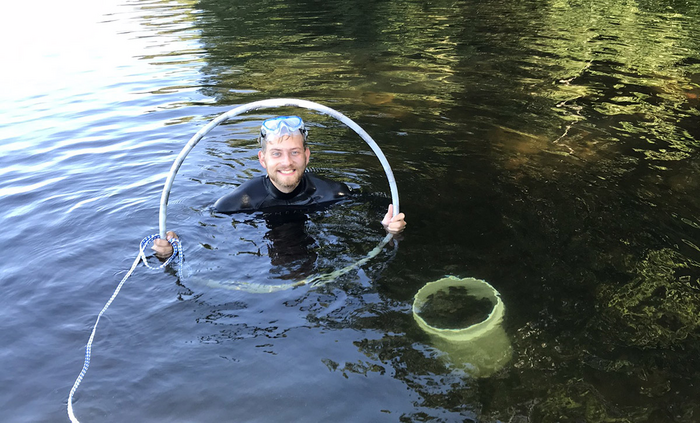
Lead study author Danny Szydlowski trapped crayfish and sampled for water plants and snails in ten northern Wisconsin lakes during the lonely 2020 summer, following protocols study predecessors at the University of Notre Dame first established in the mid-1980s. Repeated sampling by team members – in 1987, 2002, 2011, and 2020 – puts the study among the longest-running records of natural invasive species decline, a phenomenon not well documented by scientists.
“I worked with the people who started some of the initial lake monitoring back in the 1980s, trying to duplicate their exact sampling methods. It meant many phone calls and even having to search people’s garages for old equipment. I feel really lucky to have been part of this multi-generational effort to track rusty crayfish in this system,” says Szydlowski, who undertook the research as a master’s student in NRES.
Szydlowski identified four lakes where rusty crayfish had declined nearly to zero over the 33-year period: two that started out high and steadily decreased (bust lakes) and two that started low, rose to a peak between 2002 and 2011, and declined again (boom-bust lakes). He compared crayfish, water plant, and snail abundance and diversity in these lakes with six reference lakes nearby, three with low crayfish numbers through the years and three with high numbers.
As crayfish declined to low levels in the bust and boom-bust lakes, water plants flourished. Both the number and diversity of plants swelled far beyond reference lakes where crayfish abundance remained high and approached levels seen in low-crayfish reference lakes. Because water plants provide habitat for snails, young fish, and other aquatic creatures, their rise is good news and could be the start of greater ecosystem recovery.
While the number of snails did increase over time, they were slower to recover in the low-crayfish lakes. As the preferred food source for rusty crayfish, snails were decimated during boom periods in all the lakes. And since snails rely on water plants for food and habitat, plants have to come back first. Since the plants are trending in the right direction, Larson and Szydlowski are hopeful snails will follow (the team will keep checking every decade or so). For now, snail numbers and diversity are nowhere near that of the low-crayfish reference lakes, though they are higher than the high-crayfish reference lakes.
As food and habitat sources for the crayfish rebound, could the invaders make a comeback?
“That’s the question, isn’t it? Personally, I’m optimistic that diseases affecting the crayfish are going to be able to keep densities low, but only time will tell,” Szydlowski says.
Larson adds, “We don’t know if this is going to become an oscillating dynamic. But I will say I was pretty convinced that these lakes, where we were catching 30, 40, or 80 rusty crayfish per trap at their peak, were always going to be heavily invaded. It has been a nice surprise to see the plants coming back.”
The change isn’t just evident in the numbers. Lake residents have been noticing the lakes’ return to health, too.
“The folks who live on these lakes are uncommonly attuned to what’s happening in the water off their backyards. They know the lakes and care about them a great deal. People noticed when the crayfish boomed; the lakes changed, sunfish disappeared. Now they’re noticing the plants are coming back,” Larson says. “It’s one of the few places that if someone says the crayfish are gone, I could trust them that that was true.”
IMAGE CREDIT: Danny Szydlowski
.jpg)


Leave a Reply