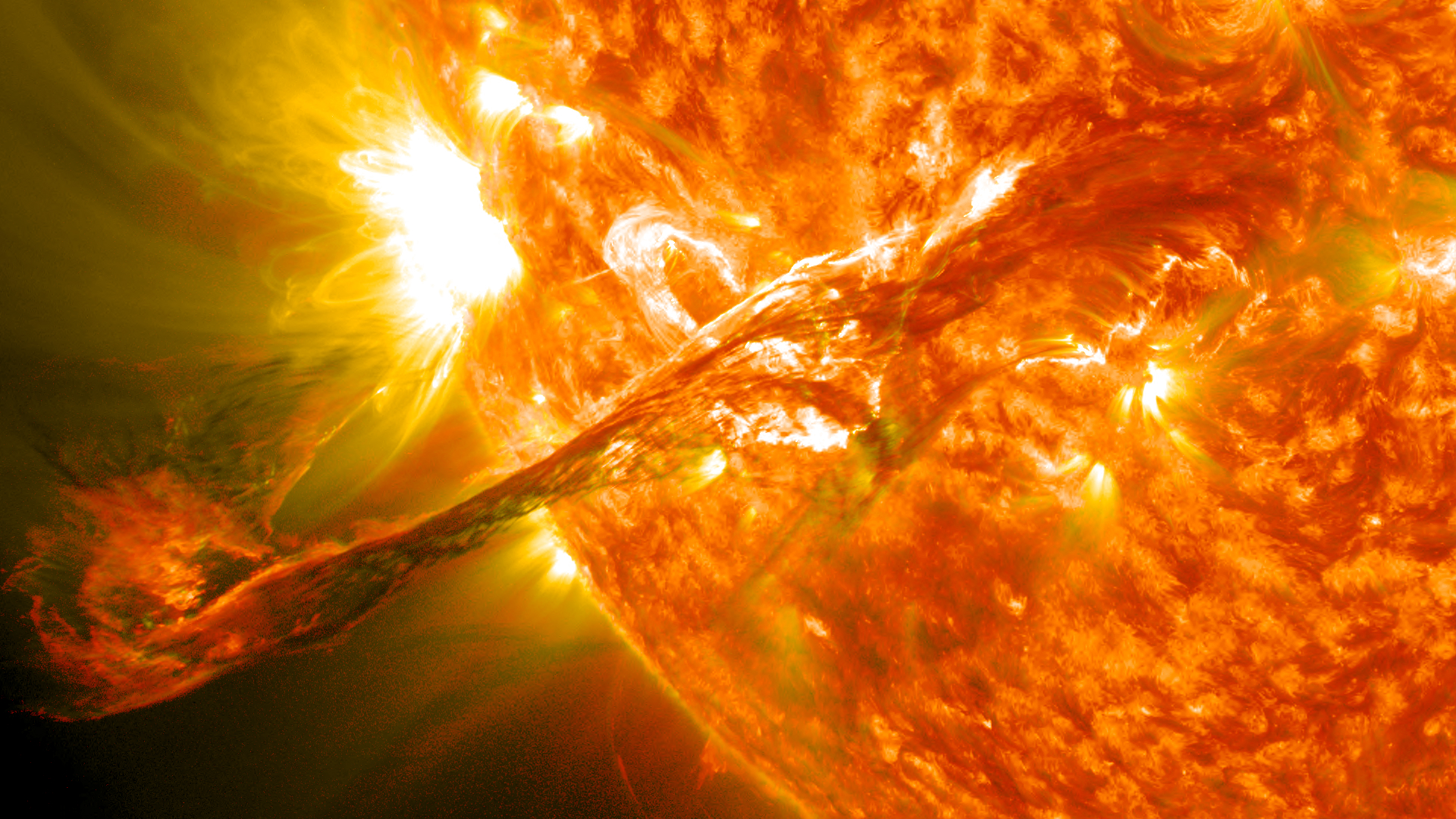
The Sun contains 55% more silver than previously estimated, according to new research from Uppsala University that resolves a long-standing discrepancy between solar measurements and primitive meteorites — both of which formed 4.6 billion years ago from the same cloud of gas and dust.
The “missing silver” problem had puzzled astronomers for years: chemically primitive meteorites, thought to preserve the original composition of the solar system, contained noticeably more silver than spectroscopic measurements of the Sun suggested it should have.
Sema Caliskan, a PhD student in the Department of Physics and Astronomy at Uppsala, led the effort to close that gap by developing a new three-dimensional, non-LTE (non-local thermodynamic equilibrium) model of the Sun’s atmosphere. The model combines dynamical simulations of the Sun’s outer layers with improved atomic physics, capturing how silver atoms interact with light and particles under conditions far from equilibrium — effects that earlier, simpler models missed.
The calculations were run on the Tetralith supercomputer at the National Supercomputer Centre, Linköping University.
Journal: Astronomy and Astrophysics
DOI: 10.1051/0004-6361/202659578
Article Title: Ag I model atom and the 3D non-LTE solar silver abundance
Publication Date: 17-Jul-2026
Source: EurekAlert



Leave a Reply