HAVE YOUR SAY.
Join us in The Bullpen, where the members of the Scientific Inquirer community get to shape the site’s editorial decision making. We’ll be discussing people and companies to profile on the site. On Wednesday, October 26 at 5:30pm EST, join us on Discord and let’s build the best Scientific Inquirer possible.
We might be inclined to think of invasive species as a modern problem of our own creation or carelessness.
But a University of Cincinnati graduate student says ecosystems around the world have had to contend with new invaders for hundreds of millions of years.
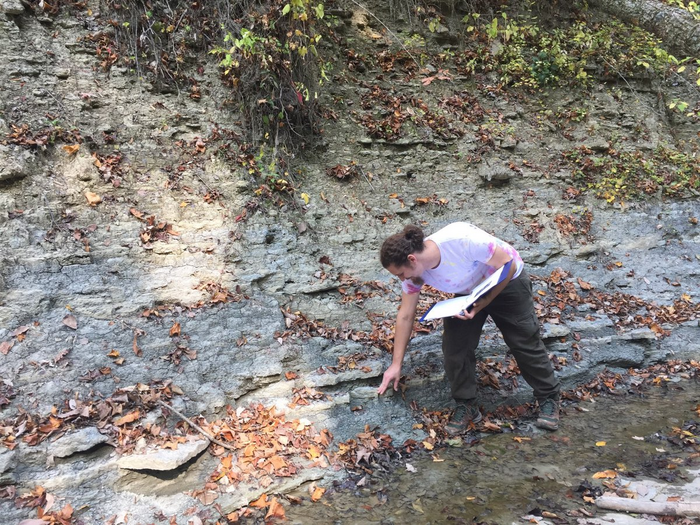
Ian Forsythe studies geology in UC’s College of Arts and Sciences. In his latest work in UC’s Department of Geosciences, he examined the fossil record to examine how one well-known invasion of animals that impacted surrounding animals in the vast shallow seas that covered the Midwestern United States during the Late Ordovician Period.

“We are a catalyst for these things today. But these biotic invasions happened in the past, too,” Forsythe said.
Forsythe presented his findings in October to the annual conference of the Geological Society of America.
Just how he can study changes in species over time is a testament to the amazing fossil record left behind from the Ordovician. Ohio, Indiana and Kentucky were covered in a salty sea filled with starfish, crinoids, brachiopods and other mollusks.
Today, it’s hard to find a rock in any southwestern Ohio creek that doesn’t bear evidence of these ancient marine fossils. Paleontologists from around the world come to Cincinnati to study its fossils.
“We have really incredible fossil deposits here. They’re globally exceptional,” Forsythe said. “The quantity of fossils gives us an awesome window to the past. It’s an amazing natural laboratory.”
Forsythe said one well-known phenomenon called the Richmondian Invasion about 446 million years ago brought a myriad of new species into contact with each other in these shallow seas.
But unlike some invaders like brown tree snakes that have wiped out entire populations of birds in places like Guam, the ocean invaders did not cause widespread extinctions, Forsythe said.
Instead, the native species were generalists that didn’t need specialized habitats or food requirements and were able to adapt and make room for the newcomers, he said.
“Generalists are more successful during invasions because they can contract their niche to accommodate novel competitors,” he said.
Since the invaders were low on the food chain, they didn’t cause a widespread disruption, he said.
Forsythe began the project at Ohio University in the lab of Alycia Stigall, now a professor at the University of Tennessee in Knoxville.
“The Richmondian invasion is one of the most intensively studied fossil invasion events in terms of ecosystem and species impacts,” Stigall told the Geological Society of America. “But Ian’s work is truly groundbreaking; he was able to examine changes at the community level at a very fine temporal level of a few thousand years and relate this directly to changes in sea level and the timing of the invaders’ arrival.”
Still, there is a lot we can learn about the resilience of today’s ecosystems by studying these changes millions of years ago, Forsythe said.
“That’s what drew me to invasion science. It’s a big issue today with so many outstanding questions,” he said. “We can’t answer how these things play out in longer timescales without a long data set.”
Forsythe said invaders higher on the food chain present a greater existential threat to native species, particularly those with specialized dietary or habitat needs.
“It’s a guiding principle for what imperiled species might require attention first,” Forsythe said.
IMAGE CREDIT: Ian Forsythe

.jpg)

Leave a Reply