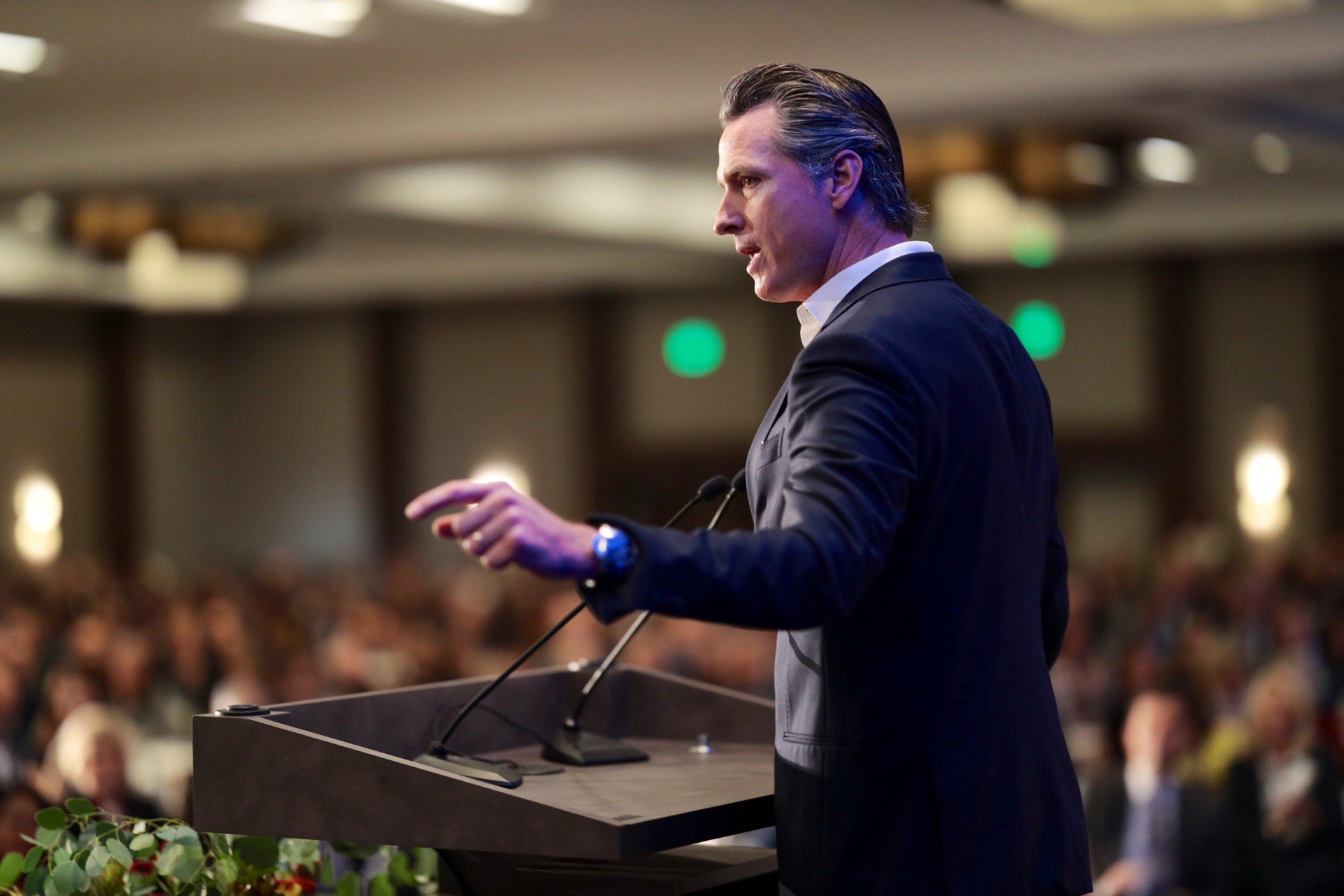
Single-payer health care didn’t stand a chance in California this year.
Even in this deep-blue bastion, Democratic lawmakers shied away from legislation that would have put state government in charge of health care and taxed Californians heavily to do so — a massive transformation that would have forced them to take on the powerful health care industry.
Gov. Gavin Newsom, who had promised to spearhead single-payer when he ran for governor four years ago, dashed its chances this year when he declined to publicly support it.
Instead, the first-term Democrat, who is running for reelection this November, is pushing for “universal health care,” which aims to provide all Californians with coverage but, unlike single-payer, would keep private health insurance intact.

Newsom’s retreat devastated progressive activists and the powerful California Nurses Association union, which championed the cause. The death of single-payer in the nation’s most populous state also deals a major blow to similar campaigns elsewhere in the nation — which had looked to California for inspiration and leadership — casting doubt on their ability to succeed.
“We’re also fighting in New York, but just like in California, there’s not 100% Democratic consensus among legislators,” said Ursula Rozum, co-director of the Campaign for New York Health, which is working to pass single-payer legislation. “It feels like a constant question of ‘Can we win this?’”
Health policy experts agree that California’s failure to adopt single-payer dampens momentum across the country.
“California, given its size and politics, has always been a bellwether for progressive policy, so this certainly sends a signal to other states about how hard this is,” said Larry Levitt, executive vice president for health policy at KFF.
But Rozum and single-payer activists in Colorado, Washington state, and elsewhere say that rather than giving up, they are taking key lessons from California’s failure: It is essential to win — and keep — support from the governor. Groups pushing single-payer must unite Democrats, bringing in business-friendly moderates and broader support from organized labor. And they say they must learn how to counter intense lobbying by doctors, hospitals, and health insurance companies fighting to preserve the status quo.
“We’ve seen what happened in California, so we are working hard to get our governor on the record in support of single-payer so she will sign it when it gets to her desk,” Rozum said. “And just like there, our union movement is divided. We know we need them to have any chance of moving forward with our bill.”
So far, single-payer proponents haven’t been able to broaden their movement beyond liberal activists or convince people that they should pay higher taxes in exchange for scrapping health care premiums, deductibles, and copays.
The only state that has passed single-payer, Vermont, didn’t implement it.
Vermont adopted a single-payer plan in 2011 with unequivocal support from its then-governor, Democrat Peter Shumlin. But he abandoned the effort in 2014 amid growing concerns about tax increases and runaway health care costs.
“There isn’t a political party in the world that’s going to raise their hands every year to increase taxes on hard-working citizens,” Shumlin told KHN. “That’s the big mistake I made in Vermont.”
But progressive dreams for single-payer didn’t die when Vermont retreated. “Medicare for All” became a liberal rallying cry for Democrats nationally when Vermont Sen. Bernie Sanders stumped for it during his presidential campaigns. After President Joe Biden was elected, the movement shifted to the states, in part because Biden has opposed Medicare for All.
Activists in Colorado are mobilizing for another single-payer campaign after the overwhelming defeat of a 2016 ballot initiative that failed partly because of intense health care industry opposition. Organizers in Washington state are pushing legislation and trying to get a single-payer initiative on the ballot next year.
Shumlin said Democrats must be prepared to take on deep-pocketed industry groups and rein in soaring health care spending — or they’ll be confronted with the political difficulty of constantly raising taxes.
“California is the best state to lead this because it has the fifth-biggest economy in the world. It’s all about scale,” Shumlin said. “And if California gets it right, other states and the federal government will follow. But this is hard stuff, so get ready to get bloodied.”
Some Democratic lawmakers and the California Nurses Association had hoped California would lead the way this year and that Newsom would be their champion.
State Assembly member Ash Kalra (D-San Jose) introduced legislation sponsored by the union that would have created government-run health insurance for all state residents while significantly raising taxes on employers, employees, and businesses to pay for it. State estimates pegged the cost at roughly $360 billion a year, with a little less than half coming from tax increases and the rest from the federal government.
On Newsom’s first day in office in 2019, he said, “I committed to this and I want folks to know I was serious.” But since then, he has distanced himself from single-payer.
Instead, he has created a commission to study the concept and asked the Biden administration for permission to collect federal money that flows to the state via the Affordable Care Act, Medicaid, and Medicare, which California could use to help finance a single-payer system. But Biden can’t simply approve the request — California would need complicated federal waivers and approval from Congress.
Newsom has shifted to a platform of “universal health care,” which includes Medicaid coverage for all income-eligible unauthorized immigrants and state-funded subsidies for Californians who buy health insurance from Covered California, the state’s Obamacare insurance exchange.
Newsom said in January that he has long believed single-payer is “inevitable” but signaled that the federal government should take the lead.
Kalra decided not to bring his bill up for a vote in the state Assembly, saying on Jan. 31 that he couldn’t muster enough support.
“It makes it harder to get the votes you need when I’m trying to convince my colleagues that there’s an absolute path to success,” Kalra said. “We have a governor who campaigned on single-payer, and if we’re going to successfully have single-payer health care in California, at some point we need his engagement and it needs to be genuine.”
Kalra said he’s considering introducing another bill next year but conceded that he must shift his strategy to bring more Democrats and unions into the campaign.
These are lessons other states are heeding.
“There’s no question that had California passed a single-payer health care plan, we’d be in a position in the state of Washington to say, ‘Look what California is doing,’” said Andre Stackhouse, campaign director for Whole Washington, an advocacy group trying to get a single-payer initiative on the ballot next year.
Stackhouse worked on behalf of California’s single-payer campaign this year, helping with a phone-banking campaign to pressure lawmakers. He’s part of a new national coalition called Medicare for All Everywhere, a group of organizers and volunteers working to identify why single-payer efforts fail and how to overcome political and lobbying obstacles.
California was a key test, he said. “We’ve learned all the ways Democrats can kill a bill, but we can’t spend all of our time grieving this loss and the huge setback that it is,” Stackhouse said.
For instance, a major goal for the movement is to persuade more unions to join the fight. Although the nurses union is leading the battle in California, other unions are against single-payer.
“As trade unionists, we believe everybody should have health care, but there’s a big fear that we’re going to lose the benefits that we have,” said Chris Snyder, political director for the local International Union of Operating Engineers in Northern California. “We have our own health care trust fund, and we don’t want benefits that we’ve fought for for decades to be taken away or watered down.”
Lack of union support is a major problem in New York, where Democratic Assembly member Richard Gottfried has introduced a single-payer bill in every legislative session for the past 30 years.
“What is keeping the bill from moving in the legislature is opposition from public employee unions,” Gottfried said. “They feel they have negotiated excellent coverage, so we need to convince them that the New York Health Act is as good or better than what they have now.”
Gottfried said he has been negotiating with teachers, sanitation workers, and other trade unions on legislative language that would provide “more explicit guarantees” that union members would receive better coverage without paying more out-of-pocket than they already do.
It’s not clear if the measure will get a vote this year.
“Whichever state goes first will help build momentum for other states,” he said.
This story was produced by KHN, which publishes California Healthline, an editorially independent service of the California Health Care Foundation.
WORDS: Angela Hart: ahart@kff.org, @ahartreports
IMAGE CREDIT: Government of California



Leave a Reply