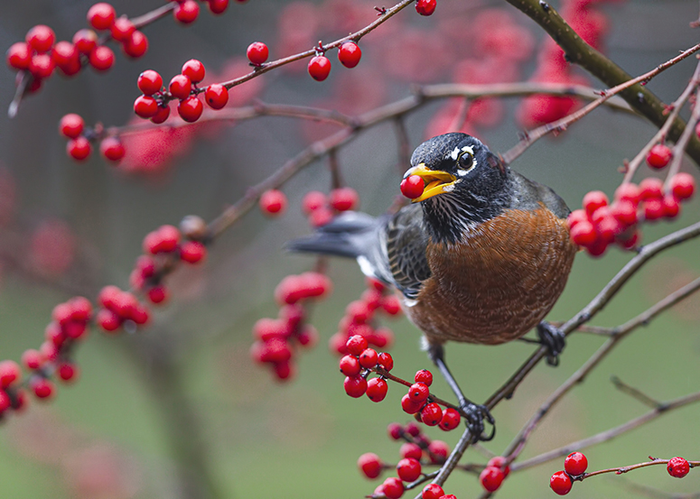
HOUSTON – (Jan. 13, 2022) – In one of the first studies of its kind, researchers have gauged how biodiversity loss of birds and mammals will impact plants’ chances of adapting to human-induced climate warming.

More than half of plant species rely on animals to disperse their seeds. In a study featured on the cover of this week’s issue of Science, U.S. and Danish researchers showed the ability of animal-dispersed plants to keep pace with climate change has been reduced by 60% due to the loss of mammals and birds that help such plants adapt to environmental change.
Researchers from Rice University, the University of Maryland, Iowa State University and Aarhus University used machine learning and data from thousands of field studies to map the contributions of seed-dispersing birds and mammals worldwide. To understand the severity of the declines, the researchers compared maps of seed dispersal today with maps showing what dispersal would look like without human-caused extinctions or species range restrictions.
“Some plants live hundreds of years, and their only chance to move is during the short period when they’re a seed moving across the landscape,” said Rice ecologist Evan Fricke, the study’s first author.
As climate changes, many plant species must move to a more suitable environment. Plants that rely on seed dispersers can face extinction if there are too few animals to move their seeds far enough to keep pace with changing conditions.
“If there are no animals available to eat their fruits or carry away their nuts, animal-dispersed plants aren’t moving very far,” he said.
And many plants people rely on, both economically and ecologically, are reliant on seed-dispersing birds and mammals, said Fricke, who conducted the research during a postdoctoral fellowship at the University of Maryland’s National Socio-Environmental Synthesis Center (SESYNC) in collaboration with co-authors Alejandro Ordonez and Jens-Christian Svenning of Aarhus and Haldre Rogers of Iowa State.
Fricke said the study is the first to quantify the scale of the seed-dispersal problem globally and to identify the regions most affected. The authors used data synthesized from field studies around the world to train a machine-learning model for seed dispersal, and then used the trained model to estimate the loss of climate-tracking dispersal caused by animal declines.
He said developing estimates of seed-dispersal losses required two significant technical advances.
“First, we needed a way to predict seed-dispersal interactions occurring between plants and animals at any location around the world,” Fricke said.
Modeling data on networks of species interactions from over 400 field studies, the researchers found they could use data on plant and animal traits to accurately predict interactions between plants and seed dispersers.
“Second, we needed to model how each plant-animal interaction actually affected seed dispersal,” he said. “For example, when an animal eats a fruit, it might destroy the seeds or it might disperse them a few meters away or several kilometers away.”
The researchers used data from thousands of studies that addressed how many seeds specific species of birds and mammals disperse, how far they disperse them and how well those seeds germinate.
“In addition to the wake-up call that declines in animal species have vastly limited the ability of plants to adapt to climate change, this study beautifully demonstrates the power of complex analyses applied to huge, publicly available data,” said Doug Levey, program director of the National Science Foundation’s (NSF) Directorate for Biological Sciences, which partially funded the work.
The study showed seed-dispersal losses were especially severe in temperate regions across North America, Europe, South America and Australia. If endangered species go extinct, tropical regions in South America, Africa and Southeast Asia would be most affected.
“We found regions where climate-tracking seed dispersal declined by 95%, even though they’d lost only a few percent of their mammal and bird species,” Fricke said.
Fricke said seed-disperser declines highlight an important intersection of the climate and biodiversity crises.
“Biodiversity of seed-dispersing animals is key for the climate resilience of plants, which includes their ability to continue storing carbon and feeding people,” he said.
Ecosystem restoration to improve the connectivity of natural habitats can counteract some declines in seed dispersal, Fricke said.
“Large mammals and birds are particularly important as long-distance seed dispersers and have been widely lost from natural ecosystems,” said Svenning, the study’s senior author, a professor and director at Aarhus University’s Center for Biodiversity Dynamics in a Changing World. “The research highlights the need to restore faunas to ensure effective dispersal in the face of rapid climate change.”
Fricke said, “When we lose mammals and birds from ecosystems, we don’t just lose species. Extinction and habitat loss damage complex ecological networks. This study shows animal declines can disrupt ecological networks in ways that threaten the climate resilience of entire ecosystems that people rely upon.”
NSF’s Levey said, “Through SESYNC and other NSF investments, we are enabling ecologists to forecast what will happen to plants when their disperser ‘teammates’ drop out of the picture in the same way we predict outcomes of sports games.”
IMAGE CREDIT: Paul D. Vitucci

Leave a Reply