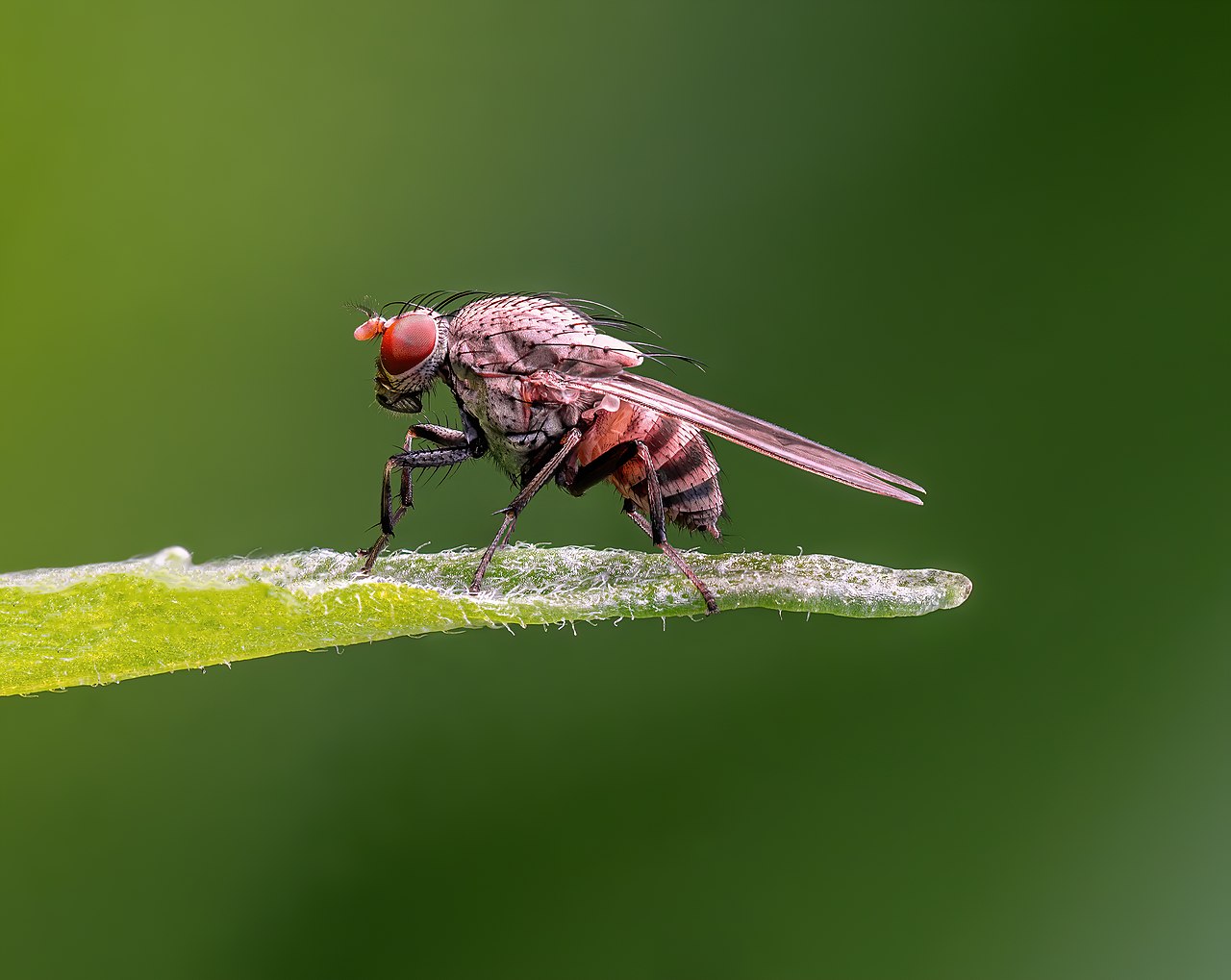
The fruit fly, long the organism of choice for scientists studying genetics and basic biological processes, still harbors some secrets of its own.

One of these is the fly’s so-called “head-heart.” This tiny pumping station supplies hemolymph—the insect equivalent of blood—to the fly’s antennae. While biologists have long known about the existence of the fly head-heart, no one had explored how it worked in much detail.
In a new study, biologists at the University of Iowa give a full accounting how the fly’s head-heart functions. The researchers discovered the fly’s head-heart beats much like a human’s: Its rhythmic pulses are automatically generated by a tiny muscle that runs through the middle of the brain, from front to back of the fly’s head, and it’s this muscle’s contraction and relaxation that drives the supply of hemolymph into the antennae.
“What we showed is that the rhythmic contraction of the head-heart is not controlled by the fly’s brain but the muscle itself,” says Alan Kay, professor in the Department of Biology at Iowa. “It’s like its own pacemaker.”
The human heart also is controlled by specialized muscle cells located within the heart. That main muscle in our chests is a wondrously synchronized metronome, taking in blood when it relaxes and forcefully pushing out blood when it contracts. That blood is then conveyed throughout our bodies by a vast, intricate network of tubes, from main branches like arteries to tiny channels called capillaries.
Insects operate differently. There is a main heart in the abdomen that supplies hemolymph, but that pump’s action doesn’t reach the extremities. To compensate, insects instead have secondary hearts, which make sure hemolymph reaches vital outer areas, such as the antennae, where smell and hearing take place.
One of these auxiliary hearts is in the fruit fly’s head. A critical part of that head-heart, the Iowa biologists found, is an elastic-walled chamber called an ampulla. When the muscle in the head contracts, it stretches this ampullar membrane, opening valves in the wall and allowing the ambient hemolymph—which had been sent to the head by the fly’s main heart—to flow into the 50-micrometer-wide ampullary chamber. When the head-heart muscle relaxes, the valves close, and the hemolymph is pushed through tubes that connect to the antennae by the tension in the elastic membrane.
“When human hearts contract, blood is pumped from the heart into the body,” says Kay, the study’s corresponding author. “With the fruit fly, the ‘blood’ flows in when the muscle contracts and is pumped out when the muscle relaxes.”
“It works like our hearts but in an opposite way,” adds Daniel Eberl, professor in the Department of Biology at Iowa and a co-author on the study.
The rhythmic contraction of the fly’s head-heart muscle, at two to three times per second, not only stimulates hemolymph flow but also jiggles the fly with each contraction, the Iowa biologists found. The biologists theorize this jiggling is important for the fly brain’s health.
“There is no active circulation within the fly brain,” Kay says. “So, we think the continuous agitation of the brain by the head-heart could help move metabolites in the extracellular space of the fly brain, as well as waste products to keep the fly’s brain clean. Human brains also receive rhythmic jogs from our hearts, and other scientists have suggested that these are essential for our brains’ vitality.”
Much of the insights about the fly’s head-heart came from a technique pioneered by Kay and Eberl, with help from researchers in Iowa’s College of Dentistry and College of Engineering. Called goggatomy, the technique involves rapidly encasing the insect with a light-cured resin, allowing researchers to open the exoskeleton and study the insect’s organs and cells while it remains alive.
For this study, the researchers used goggatomy to produce videos in a living fly of the head-heart in action, including:
- the head-heart muscle in action in a living fly brain, viewed from above;
- the real-time flow of hemolymph into the ampulla when the head-heart muscle contracts in a living fly;
- the jet of hemolymph flooding into the fly’s antennae when the head-heart muscle relaxes in a living fly; and
- the head-heart muscle contracting and extending, in isolation.
The study, “Myogenic contractions of a somatic muscle powers rhythmic flow of hemolymph through Drosophila antennae and generates brain pulsations,” was published online Sept. 29 in the Journal of Experimental Biology.
Co-authors include Jing Wang, who earned his doctorate in biology from Iowa and is now at the University of California San Diego.
The U.S. National Science Foundation and the National Institutes of Health funded the research.



Leave a Reply