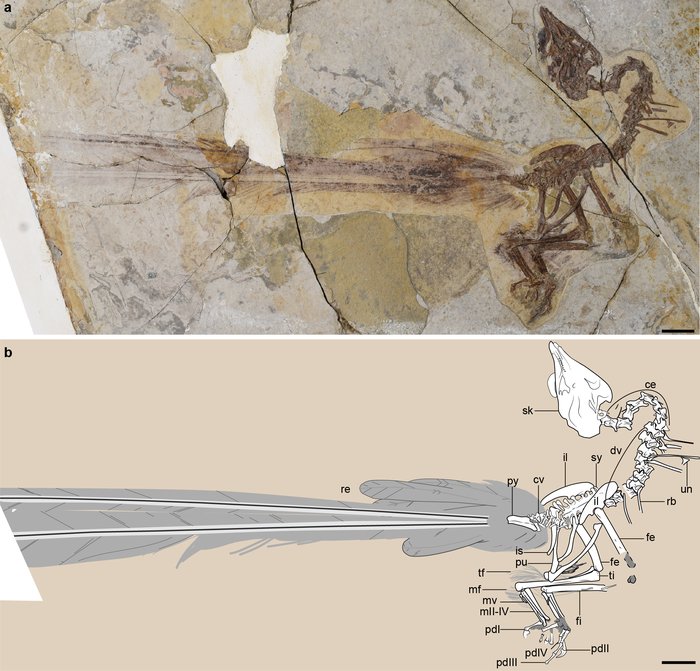
If you had to describe a male peacock’s tail feathers, you might pick words like “dazzling” or “beautiful.” You probably wouldn’t go with “stealthy,” “aerodynamic,” or “subtle.” Peacock tails are just one example of how evolution walks a line between favoring traits that make it easier to survive, and traits that make it easier to find a mate– sometimes, it’s less about “survival of the fittest” and more about “survival of the sexiest.” In a new paper in Current Biology, scientists have found evidence of this age-old conundrum in the form of a fossil bird from the Early Cretaceous with a pair of elaborate tail feathers longer than its body.
“We’ve never seen this combination of different kinds of tail feathers before in a fossil bird,” says Jingmai O’Connor, a paleontologist at Chicago’s Field Museum and one of the study’s authors.
“This new discovery vividly demonstrates how the interplay between natural and sexual selections shaped birds’ tails from their earliest history,” says Wang Min, a researcher at the Chinese Academy of Sciences and the paper’s first author, along with scientists from Nanjing University and Shandong Tianyu Museum of Nature.
The fossil was discovered in the 120-million-year-old deposits of the Jehol Biota in northeastern China. The researchers named it Yuanchuavis after Yuanchu, a bird from Chinese mythology. It was a small bird, about the size of a bluejay, but its tail was more than 150% the length of its body. And the tail’s length isn’t the only unusual thing about it.
“It had a fan of short feathers at the base and then two extremely long plumes,” says O’Connor. “The long feathers were dominated by the central spine, called the rachis, and then plumed at the end. The combination of a short tail fan with two long feathers is called a pintail, we see it in some modern birds like sunbirds and quetzals.”
“Yuanchuavis is the first documented occurrence of a pintail in Enantiornithes, the most successful group of Mesozoic birds,” says Wang. “Notably, the morphology preserved in Yuanchuavis essentially represents a combination of the two tail morphologies previously recognized in other enantiornithines which are most closely related to Yuanchuavis: the tail fan is aerodynamically functional, whereas the elongated central paired plumes are used for display, which together reflect the interplay between natural selection and sexual selection.” In other words, Yuanchuavis would have been able to fly well, but its long tail feathers that might have helped it find mates didn’t make flying any easier– its fancy tail was literally a drag.
This balance between natural and sexual selection has interested scientists since the time of Darwin: if evolution produces organisms that are better able to meet the pressures of the world around them, then why would an animal develop traits that make it worse at flying or more noticeable to its predators?
“Scientists call a trait like a big fancy tail an ‘honest signal,’ because it is detrimental, so if an animal with it is able to survive with that handicap, that’s a sign that it’s really fit,” says O’Connor. “A female bird would look at a male with goofily burdensome tail feathers and think, ‘Dang, if he’s able to survive even with such a ridiculous tail, he must have really good genes.’”
From just a few tail feathers, scientists have been able to piece together hypotheses about what Yuanchuavis was like in life. Long, elaborate tail feathers can help attract a mate, but they’re not especially useful– they’re less aerodynamic than a short fan of feathers, so birds that have them tend not to live in places that require superb flight. “Birds that live in harsher environments that need to be able to fly really well, like seabirds in their open environment, tend to have short tails,” says O’Connor. “Birds with elaborate tails that are less specialized for flight tend to light in dense, resource-rich environments like forests.”
And when birds have features that make them less efficient flyers or more noticeable to predators, that tends to give some information about their home lives. “When you see something on a bird that’s really extravagant, that bird is usually male and not very involved with caring for its young,” says O’Connor. Big flashy feathers require more resources to maintain, making the male unable to invest resources in childrearing, and there’s a risk that his plumage might draw attention to the location of its nest. So, its plainer partner will do most of the work caring for the young.
In addition to better picturing what this specific bird was like in life, the discovery of Yuanchuavis could help scientists answer bigger-picture questions about the birds that survived the big extinction event 66 million years ago. Yuanchuavis is an enantiornithine, a member of a group that was very successful in the time of the dinosaurs, but went extinct along with the dinos. “Understanding why living birds are the most successful group of vertebrates on land today is an extremely important evolutionary question, because whatever it was that allowed them to be so successful probably also allowed them to survive a giant meteor hitting the planet when all other birds and dinosaurs went extinct,” says O’Connor.
Understanding how sexual selection may have shaped ancient birds like Yuanchuavis could help us better understand bird diversity today. “It is well known that sexual selection plays a central role in speciation and recognition in modern birds, attesting to the enormous extravagant feathers, ornaments, vocals, and dances,” says Wang. “However, it is notoriously difficult to tell if a given fossilized structure is shaped by sexual selection, considering the imperfect nature of the fossil record. Therefore, the well-preserved tail feathers in this new fossil bird provide great new information about how sexual selection has shaped the avian tail from their earliest stage.”
“The complexity we see in Yuanchuavis’s feathers is related to one of the reasons we hypothesize why living birds are so incredibly diverse, because they can separate themselves into different species just by differences in plumage and differences in song,” says O’Connor. “It’s amazing that Yuanchuavis lets us hypothesize that that kind of plumage complexity may already have been present in the Early Cretaceous.”
IMAGE CREDIT: Wang Min et al.



Leave a Reply