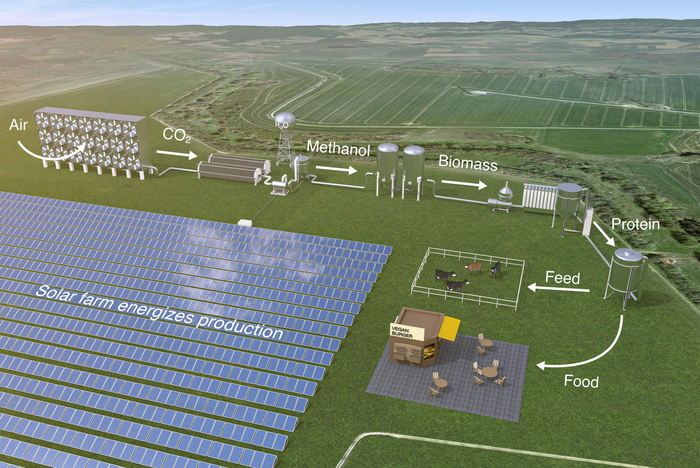
Microbes have played a key role in our food and drinks – from cheese to beer – for millennia but their impact on our nutrition may soon become even more important. The world is facing growing food challenges as the human population continues to increase alongside its demand for resource intensive animal products. If these needs are to be met solely by conventional agriculture, the environmental cost will be huge. An international research team led by a Göttingen University alumnus has now shown that using solar-panels to produce microbial protein – which is rich not just in proteins but also in other nutrients – is more sustainable, efficient and environmentally friendly than growing conventional crops. This method uses solar energy, land, nutrients, and carbon dioxide from the air. Their research was published in PNAS.
Using computer simulations drawing directly from laboratory results, the researchers modelled large-scale microbial food production facilities, which use solar energy, air, water, and nutrients to grow microbes. The protein-rich biomass is harvested and processed, and the resulting powder can be used as feed for animals, or as food for people. The study carried out an analysis of the energy requirements for each step, from the very start to the end product, taking into account: electricity generation (from solar panels), electrochemical production of energy-rich substrate for the microbes, microbe cultivation, harvesting, and processing the protein-rich biomass. Several types of microbes and growth strategies were compared in order to identify the most efficient.
The study found that for each kilo of protein produced, solar-powered microbes require only 10% of the land area compared to even the most efficient plant crop – soybean. The study calculated that even in northern climates with less sunshine, the yields of solar-powered microbial foods could far outproduce staple crops, while minimizing water and fertilizer use. Importantly, this production could also be located in regions not suitable for agriculture, such as deserts.
In previous research, the protein from these types of microbes has shown beneficial effects when fed to livestock and is already produced at large scale in the EU. “We expect that microbial protein will also be beneficial as a supplement to our diets, since it provides a high-quality protein source composed of all essential amino acids, as well as vitamins and minerals,” explains first author Dorian Leger, who carried out the work in the MPI of Molecular Plant Physiology while studying at the University of Göttingen, along with colleagues from Italy and Israel. “This technology has the potential to support food production while preventing damage to the environment. Current farming methods contribute to polluted ecosystems and depleted water reserves worldwide.”
At the moment, 30-40% of the Earth’s land is used for farming, yet one in ten people are undernourished. Leger says, “Integrating the cultivation of nutrient-rich microbes with renewable energy systems, such as solar panels, has the potential to produce more food with less resources. This could free up vast amounts of agricultural land, and, in addition, prevent the further destruction of natural ecosystems thereby making a valuable contribution to conservation and sustainability whilst promoting food availability globally.”
IMAGE CREDIT: Paul Van Leer, Dorian Leger, Silvio Matassa, Elad Noor, Alon Shepon, Ron Milo, Arren Bar-Even



Leave a Reply